Blog

Articles on survey design, data collection, KAP studies and analytics from the KAPsurvey team, with tips you can apply today.

Managing Complex Family Hierarchies in Field Research

Managing Complex Family Hierarchies in Field Research

Field research rarely follows a flat, simple structure. A single household evaluation might involve tracking a family head, multiple spouses, several children, and distinct agricultural plots.

Capturing these nested, multi-level relationships using standard form builders quickly becomes unmanageable. Enumerators end up scrolling through hundreds of redundant fields, leading to input errors, app freezes, and fragmented analysis.

The Limits of Static Survey Tools

Traditional survey engines treat every interview as a linear sequence. Capturing dynamic list items, such as recording each child’s age, education, and immunization history, presents significant technical barriers in basic systems:

  • Manual Duplication: Survey authors create fixed, duplicate question blocks for separate individuals. If a household has ten children, unused question blocks clutter the screen and consume device memory.
  • Logic Breakdowns: Branching rules fail when attempting to filter items conditionally across nested lists, such as isolating only school-aged children for specialized education modules.
  • Excessive Cognitive Load: Field enumerators spend valuable interview time matching responses across separate sections instead of focusing on the respondent.

Engineered Solutions for Dynamic Rosters

Handling complex organizational hierarchies requires specialized software architecture capable of generating dynamic sub-surveys on the fly.

Built explicitly for sophisticated social research, KAPsurvey incorporates an advanced dynamic roster engine. The platform automatically creates nested sub-forms based on real-time respondent inputs, keeping data clean and structured.

Key operational capabilities include:

  • Automated Sub-Form Generation: Inputting a household count instantly generates dedicated, linked profiles within the main survey—eliminating manual template duplication.
  • Cross-Roster Filtering: Filter follow-up questions dynamically using previous answers across different levels of the family hierarchy.
  • Relational Database Output: Survey exports arrive pre-linked with primary and secondary keys, removing the need for manual data restructuring during analysis.

Precision at Every Level

Capturing human reality demands flexible technology that adapts to complex living arrangements rather than forcing families into rigid, flat templates.

Streamline your complex household evaluations today. Visit KAPsurvey to experience flexible, high-precision research infrastructure built for modern field teams.

Read more→
Why Multi-Language Surveys Break Generic Tools

Why Multi-Language Surveys Break Generic Tools

If you have ever managed a multi-region field deployment across non-English speaking communities, you know that translation is never as simple as swapping words.

A single survey in a multilingual country might need to be administered in four different national and local dialects - such as Swahili, Amharic, French, and local regional languages. When field managers try to execute multi-language data collection using generic form builders, the process rapidly devolves into administrative chaos.

Here is why standard software breaks down during localized research, and how dedicated platforms ensure complete linguistic precision in the field.

The Hidden Pitfalls of Generic Multi-Language Surveying

Most popular survey tools treat translation as an afterthought or a basic visual layer. When complex research requirements meet real-world linguistic diversity, three major failure points emerge:

  • Distorted Skip Logic: In basic form builders, adding multiple language layers often breaks skip logic and conditional display rules. A question meant to branch differently for rural vs. urban respondents suddenly fails because the underlying logic variable was tied to English text strings rather than standardized language keys.
  • Font and Script Rendering Failures: Non-Latin scripts, right-to-left languages (like Arabic or Hebrew), and special characters often render incorrectly on field devices. When an enumerator sees missing text or broken characters on their tablet, they are forced to improvise translations on the fly—destroying standardized methodology.
  • Version Control Disasters: If a project director updates a single question mid-survey, standard tools force you to manually re-translate and re-map that question across every separate language file. One missed translation key leads to missing data columns during analysis.

Building True Multilingual Architecture

To collect clean, comparable data across diverse populations, your technology must treat localization as a core structural element, not an add-on feature.

This is why leading research teams build their multilingual operations on KAPsurvey. The platform is engineered specifically for global research, allowing teams to manage multi-language surveys seamlessly from a single unified interface.

Here is how modern technology streamlines localized data collection:

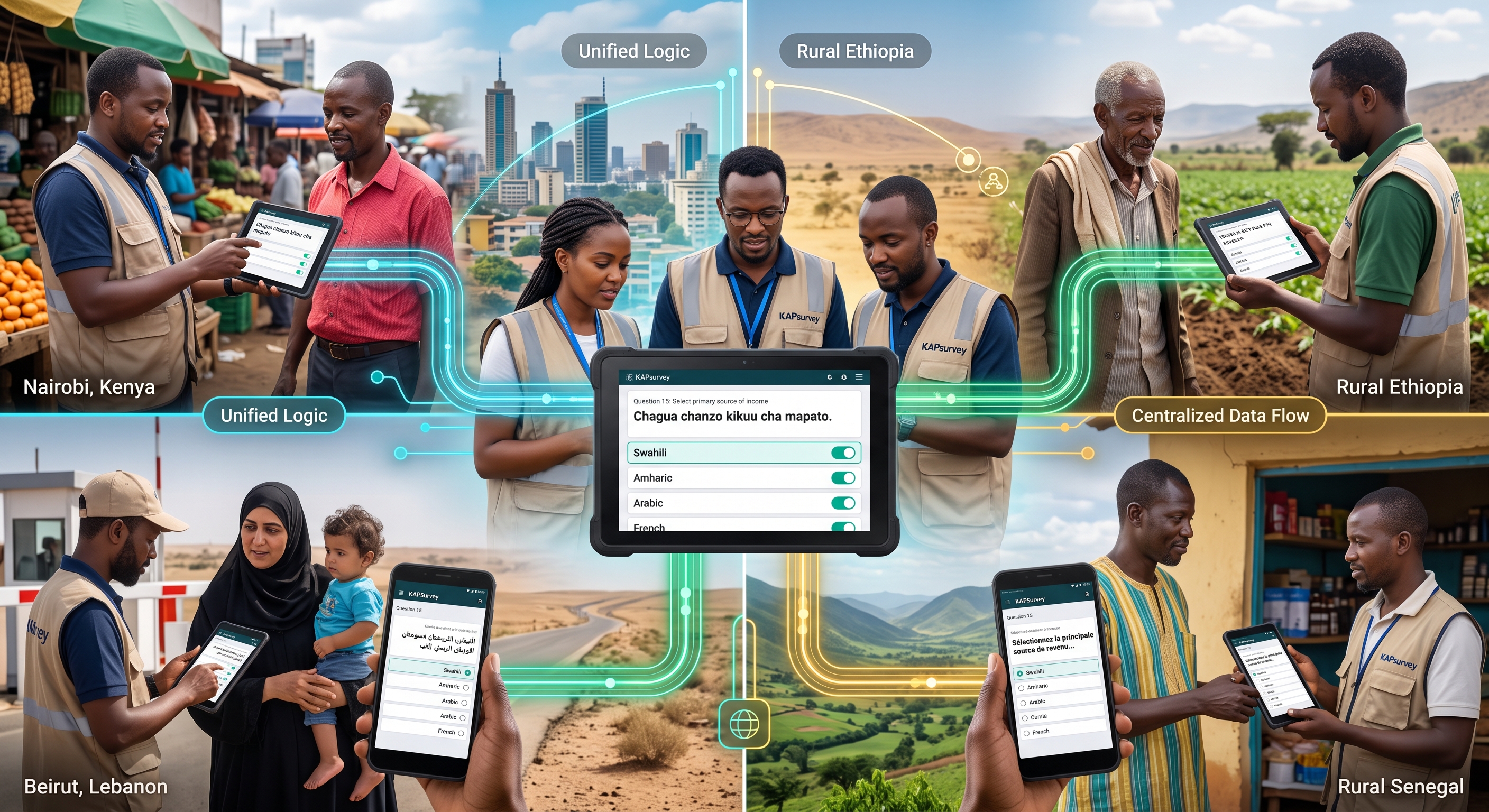
  • Unified Question Logic, Multiple Languages: On KAPsurvey, you build your survey logic once. Translations exist as clean linguistic layers over a single set of standardized variable codes. You can update skip logic or add validation rules at any point, and the changes instantly apply across all language versions.
  • Dynamic On-Screen Language Toggling: During an interview, an enumerator can toggle between languages with a single tap on their screen—without losing their place or resetting the form. If a respondent prefers starting in Swahili but needs a technical term clarified in English, the field worker can switch instantly and continue smoothly.
  • Native Script & Right-to-Left Support: The KAPsurvey mobile app supports complex character sets, custom fonts, and right-to-left layout rendering automatically across all mobile devices and tablets, ensuring readable text in any dialect.

Speak the Local Language, Keep Global Precision

Language should build bridges with local communities, not create barriers in your data pipeline.

By eliminating translation errors and software glitches, you give your field enumerators the tools they need to conduct natural, respectful, and methodologically sound interviews in any language.

Ready to scale your multi-country research without translation headaches? Visit KAPsurvey today to see how easy multi-language field operations can be.

Read more→
Why Your Field App Fails When the Signal Drops

Why Your Field App Fails When the Signal Drops

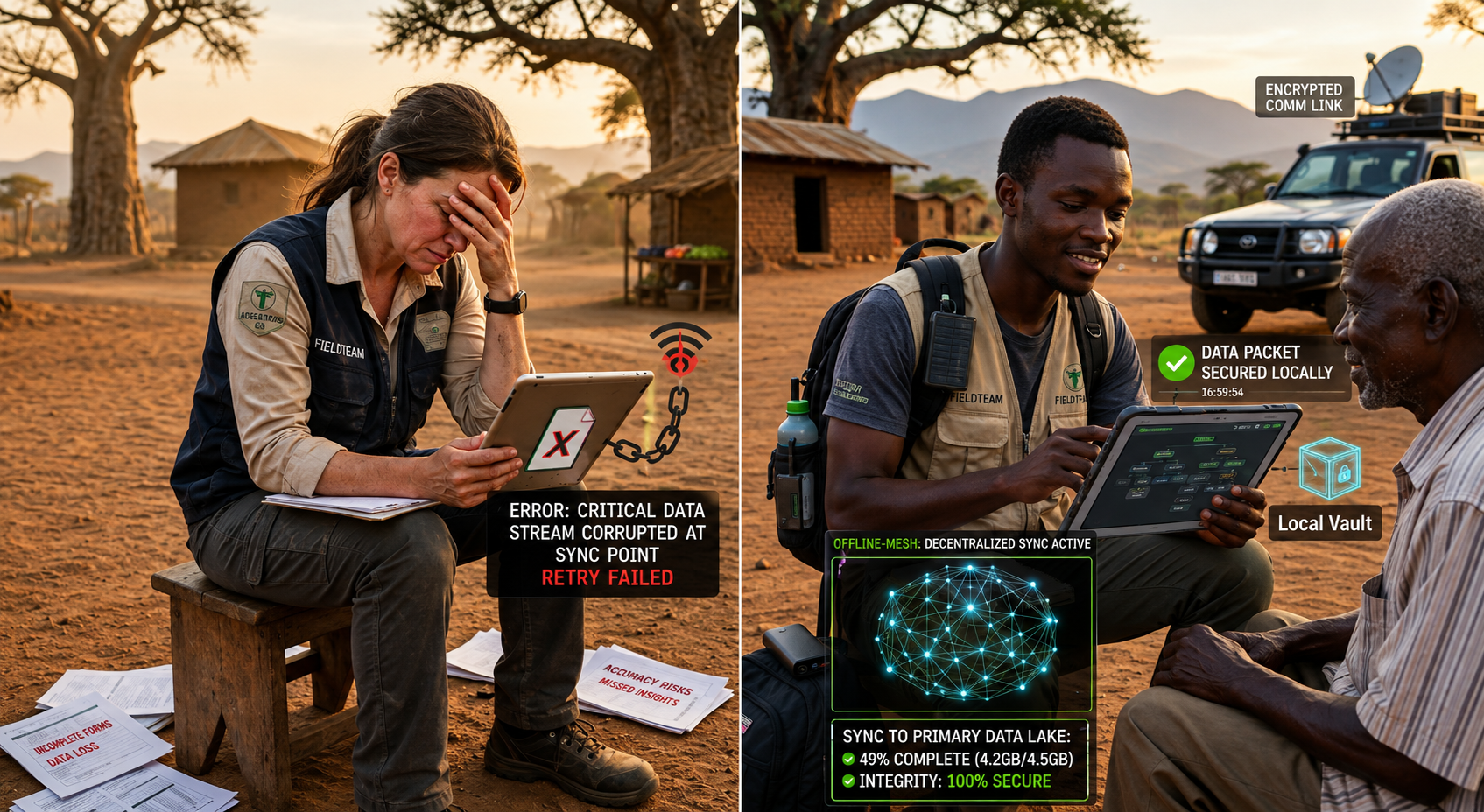
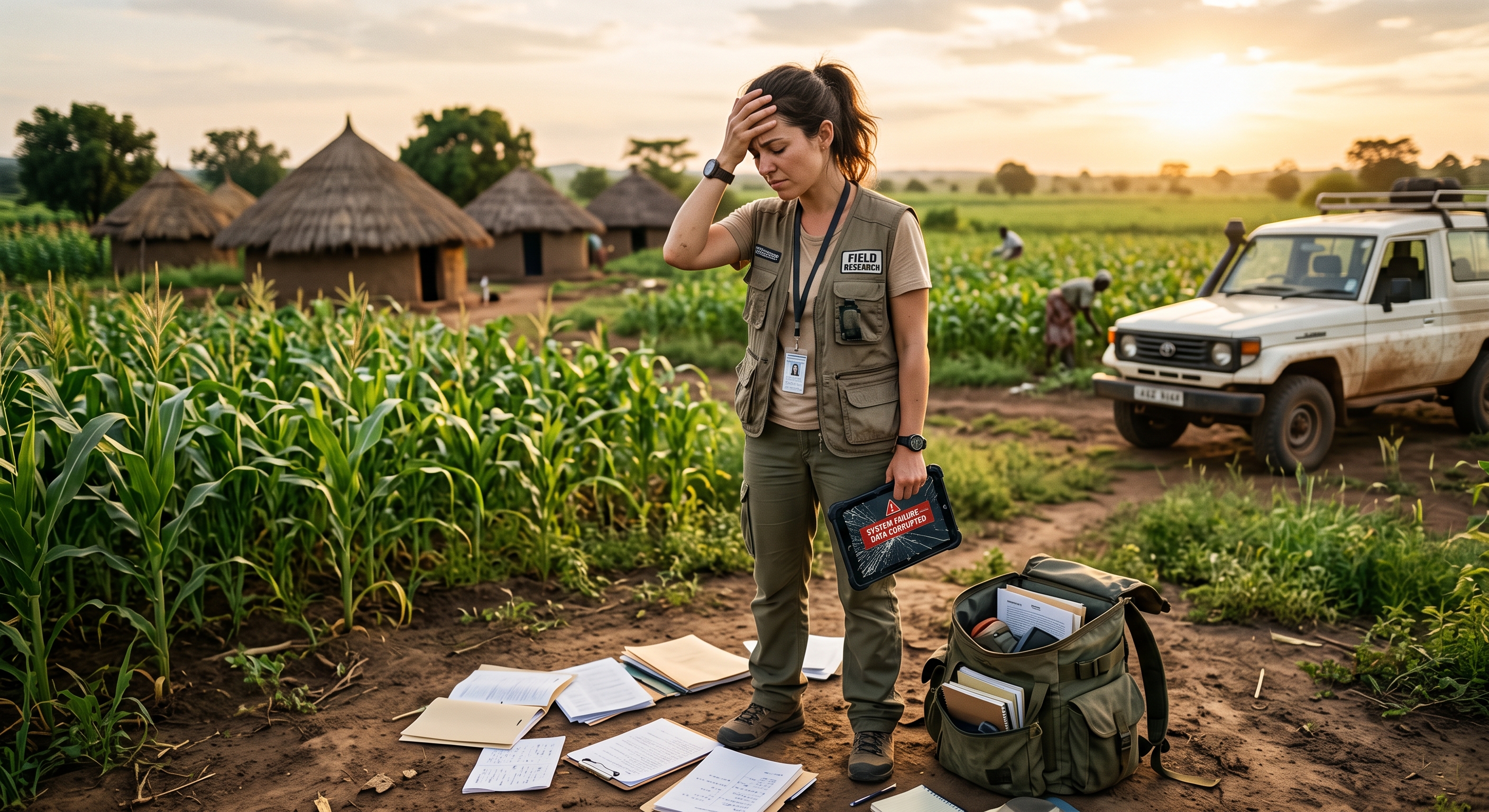
You are a hundred miles from the nearest cell tower. Your enumerator has just spent 45 minutes conducting a crucial household interview. They press Save, but instead of a confirmation screen, the app displays a spinning wheel of death. The screen goes black, and the data vanishes.

If your organization operates in remote, low-connectivity regions, this nightmare scenario is probably painfully familiar. The culprit? You are likely using a cloud-first tool masquerading as an offline solution.

Here is why standard survey tools fail in the field, and how true offline-first architecture is saving data collection in 2026.

The Danger of Cached Offline Modes

Many popular form builders claim to work offline, but they actually rely on browser caching. They are built expecting a continuous server connection to process complex operations. When that connection inevitably drops, the cracks begin to show:

  • Broken Skip Logic: If your survey relies on dynamic branching or complex calculations, fake offline tools often freeze because they cannot ping the server to determine the next question.
  • Media Bottlenecks: Collecting GPS coordinates, audio, or photo evidence often crashes standard apps when offline, corrupting the entire survey record.
  • Sync Disasters: When field teams finally reach a Wi-Fi zone, cloud-first apps often panic, resulting in duplicated records, overridden data, or total sync failure.

When technology fails in the field, it doesn't just cost you data—it erodes the trust of the communities you are interviewing and severely burns out your enumerators.

The True Offline-First Difference

To operate reliably in the world's most remote regions, your team needs software built specifically for zero-connectivity environments from the ground up.

This is where KAPsurvey stands apart. The KAPsurvey mobile application is built with a genuine offline-first architecture. This means the entire survey engine—including all complex skip logic, validation rules, and media capture—runs natively on the device itself.

  • Uninterrupted Logic: Enumerators can navigate the most complex surveys with instant loading times and zero lag, with no server connection required.
  • Encrypted Local Storage: Data is secured in a locally encrypted vault on the tablet until a stable connection is found.
  • Intelligent Syncing: Once online, the app trickles the data securely to the cloud, automatically resolving any conflicts without manual intervention.

Your field teams work too hard to lose data to a dropped signal. Visit KAPsurvey to equip your enumerators with technology that works exactly where they need it most.

Read more→
 How Real-Time Data is Winning the Next Wave of Global Grants

How Real-Time Data is Winning the Next Wave of Global Grants

If you sit on the leadership team of an NGO, a global health initiative, or a research consultancy in 2026, you already know the uncomfortable truth: the landscape for international funding has fundamentally changed.

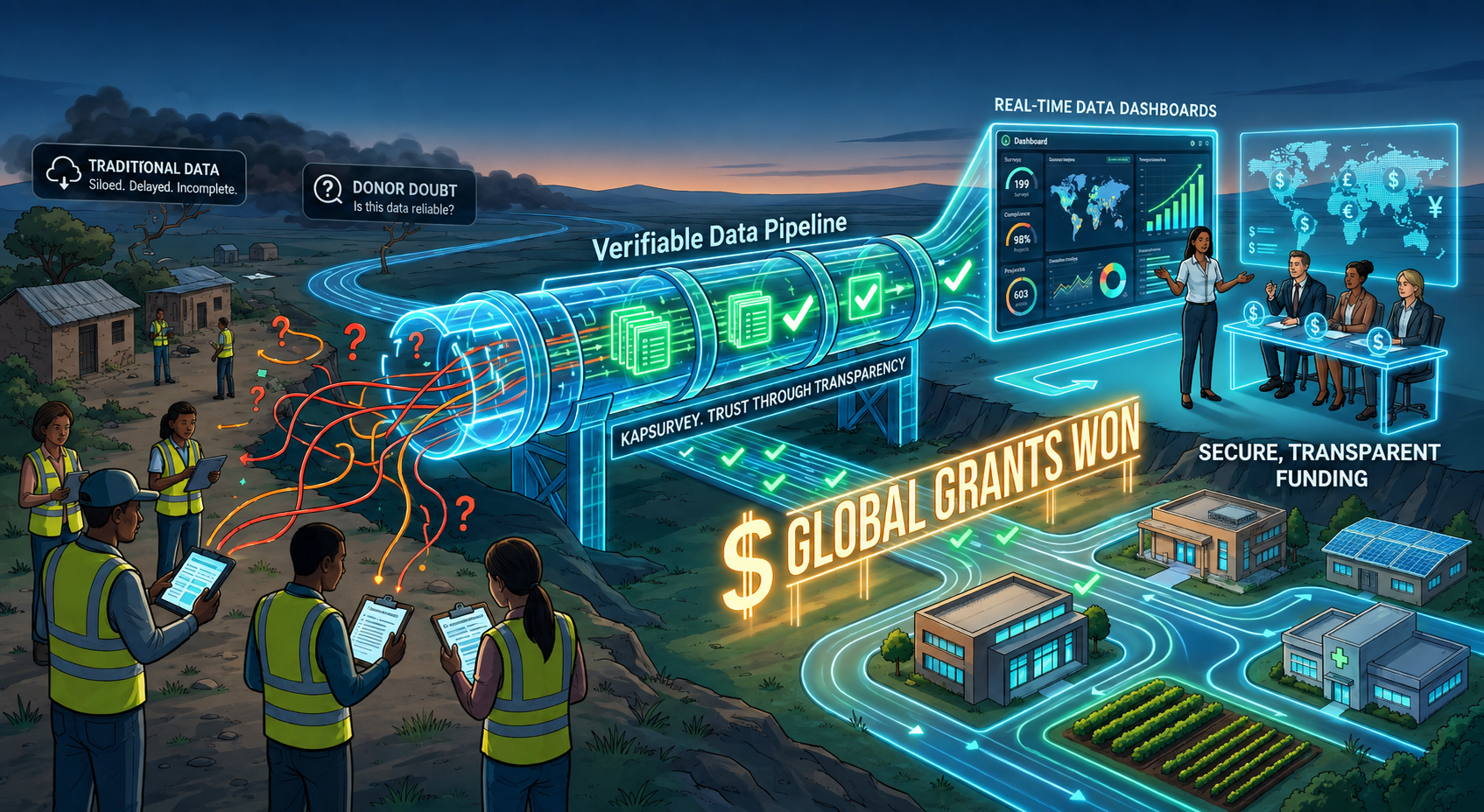
A decade ago, organizations could often secure grant renewals based on strong proposals, historical reputation, and a well-written end-of-year PDF report. Today, institutional donors, philanthropic foundations, and government ministries operate with intense scrutiny. They are demanding radical transparency, immediate visibility into field operations, and irrefutable proof of impact.

The era of trust us, the intervention is working is officially over.

If your organization is still relying on fragmented survey tools and delayed spreadsheets to report to your donors, you are not just risking your data quality—you are actively risking your future funding. Here is why the organizations winning the biggest grants today are upgrading their M&E tech stacks, and how platforms like KAPsurvey are giving them the competitive edge.

The Donor's Dilemma: Stale Data and the "Black Box"

When donors evaluate whether to renew a multi-million-dollar grant, their biggest fear is the "black box" of field execution.

They provide the funding, the NGO deploys to the field, and then... silence. Months go by. Eventually, the donor receives an executive summary claiming success, but they have zero visibility into how that data was collected, whether the sample sizes were actually met, or if the data was heavily manipulated during a weeks-long "cleaning" phase in Excel.

When you rely on generic form builders and manual reporting, you create three massive red flags for modern donors:

  1. Stale Insights: If your data takes three months to clean and analyze, you are asking donors to fund the future based on a reality that is already a quarter out of date.
  2. Unverifiable Chains of Custody: When data is exported from a tablet, downloaded to a local laptop, cleaned in a spreadsheet, and copy-pasted into a slide deck, the chain of custody is broken. Donors cannot verify the integrity of the original responses.
  3. Reactive, Not Proactive: Donors want to fund agile organizations. If your tools only allow you to see results after the project is over, you cannot prove that you are actively steering the program away from failure in real-time.

Earning Trust Through Transparent Technology

To win competitive funding today, your grant proposals need to explicitly state how you will guarantee data integrity and transparency. Organizations that write enterprise-grade technology into their proposals are winning more bids.

This is why leading program directors are standardizing their operations on the KAPsurvey Platform. It transforms M&E from a back-office chore into a frontline fundraising asset.

Here is how deploying a purpose-built ecosystem secures donor confidence:

1. The Live Dashboard Pitch

Imagine walking into a grant renewal meeting. Instead of handing the donor a printed report from last year, you pull up a secure, read-only link generated by KAPsurvey. You show them live data streaming in from enumerators currently deployed in the field. You can filter by region, instantly showing them the behavioral shifts their money is funding today. This level of transparency instantly separates you from organizations relying on static PDFs.

2. Auditable, End-to-End Security

Compliance is no longer optional. When you write KAPsurvey into your grant proposal, you can assure donors that sensitive beneficiary data never sits unencrypted on a generic offline app. Data moves securely from the offline-first KAPsurvey Mobile app directly into an encrypted, role-based cloud vault. There are no missing CSV files, no broken chains of custody, and full compliance with international privacy laws.

3. Demonstrating ROI Faster

Donors want to see Return on Investment (ROI). Because KAPsurvey’s built-in analytics engine automatically calculates complex indicator scores the moment data syncs, you completely bypass the traditional "data cleaning delay." You can prove the efficacy of a pilot program in weeks, not months, allowing you to ask for scale-up funding while the momentum is still hot.

Make Your Data Your Best Fundraiser

Your field teams are doing incredible, life-changing work. But if you cannot translate that work into undeniable, transparent, and timely data, you will struggle to fund your next mission.

In 2026, technology is a core pillar of your organizational credibility. Stop asking donors to trust a messy spreadsheet. Visit kapsurvey.com today to learn how you can build an airtight, transparent data pipeline that proves your impact and secures your next round of funding.

Read more→
How Poor Field Software Increases Enumerator Burden and Compromises Data Quality

How Poor Field Software Increases Enumerator Burden and Compromises Data Quality

When research directors talk about poor data quality, the conversation usually revolves around sample sizes, bias, respondent fatigue, or questionnaire design. But there's another structural issue that often gets overlooked: the cognitive load placed on field enumerators.

In 2026, field workers are expected to capture increasingly complex behavioral and program data. Yet many organizations still rely on disjointed software, generic form builders, and survey apps that become difficult to use when connectivity is limited.

The problem isn't simply that clunky software frustrates enumerators. Every unnecessary decision they have to make, every irrelevant question they have to navigate, and every technical problem they have to troubleshoot takes attention away from the actual interview.

And when the technology makes the enumerator's job harder, the quality of the data can suffer with it.

The Cognitive Cost of Clunky Tools

An enumerator's primary job is to establish rapport, build trust, ask questions accurately, and record responses correctly. That's already a demanding interpersonal task.

When the technology adds unnecessary friction, their attention gets divided between the respondent and the device in their hands.

Here are three ways generic tools can create unnecessary pressure in the field.

1. The Broken Logic Trap

Rigorous field research often requires complex skip logic and dynamic routing. If a respondent answers "No" to a screening question, the next five questions may no longer be relevant.

When a survey tool doesn't handle this logic smoothly, the enumerator may have to manually navigate past irrelevant questions or determine the correct route themselves.

That creates unnecessary cognitive load.

Instead of concentrating on the respondent's answers and maintaining a natural conversation, the enumerator is thinking about which question comes next. The result can be a slower interview, disrupted rapport, or avoidable data-entry errors.

Good survey software should make the correct path obvious rather than asking the enumerator to figure it out.

2. The Blind Follow-Up

Longitudinal research creates another challenge.

Enumerators may return to the same household, school, clinic, business, or community several times to measure changes over time. If the survey application doesn't provide access to relevant historical records, the enumerator may have to repeat questions about information the research team already collected.

For the respondent, that can feel repetitive. For the enumerator, it means spending valuable interview time collecting information that may not have changed.

A better approach is to give field teams the relevant context before they begin the follow-up visit.

For example, instead of asking a clinic to provide the same facility information from scratch, the enumerator can review the existing record and focus the conversation on what has changed since the previous visit.

That makes the interaction more efficient while giving the research team a clearer picture of change over time.

3. The Offline Anxiety

Few things create more pressure for an enumerator than uncertainty about whether their work has been saved.

Field research rarely happens entirely within reliable network coverage. Enumerators may work in rural areas, inside buildings, or in locations where connectivity fluctuates throughout the day.

If an application depends heavily on a live connection, a weak signal can turn a routine submission into a technical problem.

An enumerator who has just spent 45 minutes conducting an important interview shouldn't have to worry about whether the application will successfully save the record.

Reliable offline functionality changes that experience. Instead of constantly checking the network, the enumerator can concentrate on the respondent and the interview.

Empowering the Field with KAPsurvey

The goal of field technology shouldn't simply be to replace paper forms with digital ones.

It should reduce the amount of unnecessary work an enumerator has to do.

That's the thinking behind KAPsurvey. The platform is designed to support field teams in environments where connectivity, complex questionnaires, repeated visits, and strict data-quality requirements can all create challenges.

Offline-First Data Collection

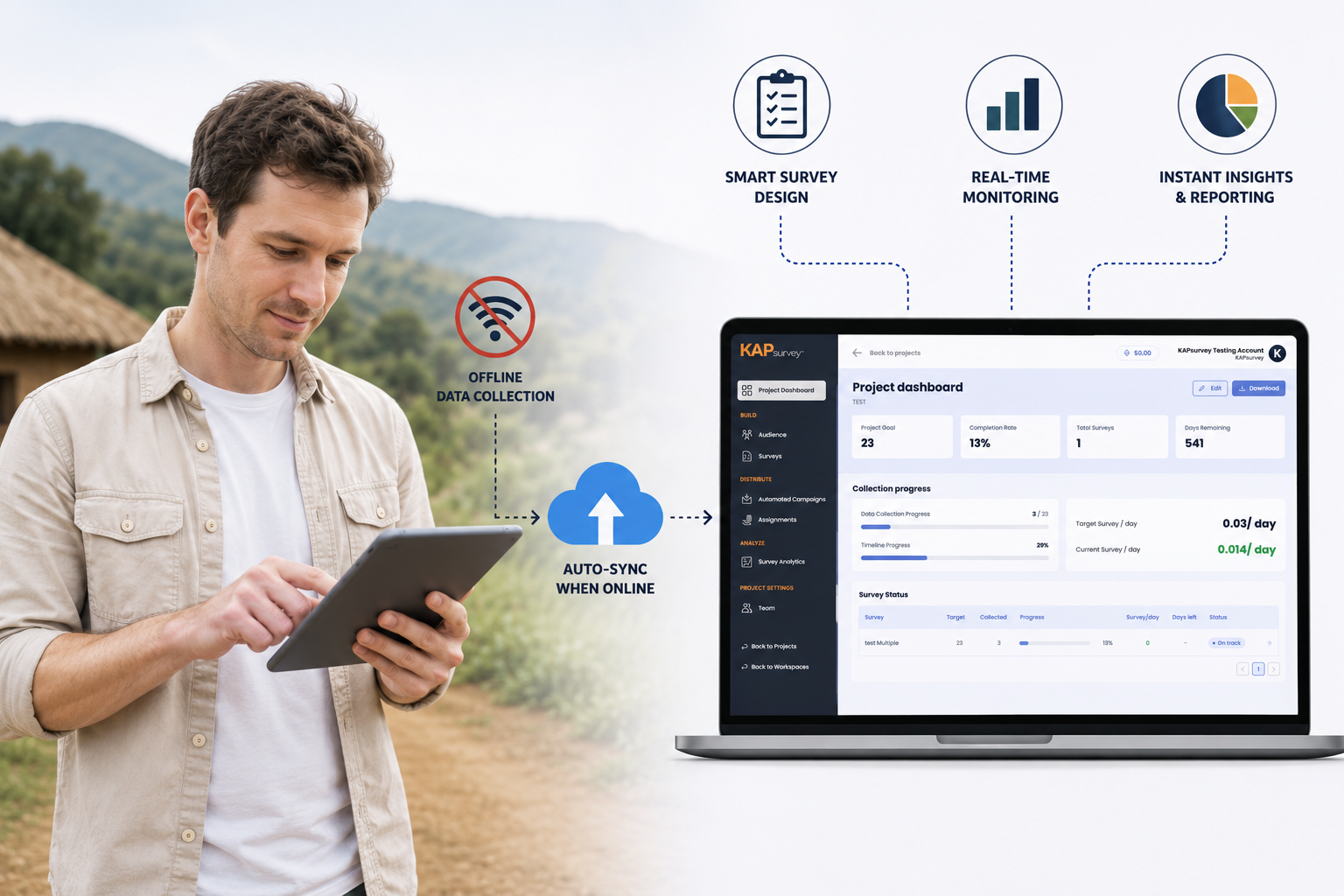
KAPsurvey's dedicated mobile app allows enumerators to continue collecting data when connectivity is unavailable.

Records can be securely stored locally and synchronized when a connection becomes available. This means field teams don't have to depend on continuous internet access to complete their work.

For the enumerator, that means less time worrying about connectivity and more time focusing on the interview.

Unified Case Management

KAPsurvey can connect records across visits, allowing project teams to provide enumerators with relevant historical information before deployment.

When an enumerator returns to a previously visited clinic, household, or other case, they can work from the existing record rather than treating every visit as a completely new interaction.

The result is a more focused follow-up process: verify what has changed, capture what is new, and avoid unnecessary repetition.

Intelligent Logic and Validation

Complex questionnaires shouldn't require enumerators to remember every routing instruction.

KAPsurvey supports skip logic, randomization, and validation rules that guide the enumerator through the appropriate questions based on the respondent's answers.

Validation rules can also help prevent invalid entries. For example, if a questionnaire requires an age within a defined range, the system can flag or prevent an entry that falls outside that range.

This reduces the number of decisions the enumerator has to make manually and adds another layer of protection against avoidable data-entry errors.

Better Tools, Better Data

Enumerators are where research methodology meets the real world.

They are the people asking the questions, interacting with respondents, recording observations, and collecting the information that ultimately becomes your dataset.

If the technology supporting them is confusing, unreliable, or unnecessarily demanding, the consequences can extend beyond user frustration. It can affect interview quality, collection timelines, respondent experience, and data integrity.

The solution isn't simply to give field teams more training. Sometimes, the better answer is to give them better tools.

A purpose-built platform can reduce unnecessary cognitive load, simplify complex workflows, support offline collection, and help field teams capture more consistent data.

When your enumerators can focus on the conversation instead of fighting the software, everyone benefits: the field team, the respondent, the research manager, and ultimately the quality of the insights produced.

Your field teams shouldn't have to work around your technology. Your technology should work for them.

Learn more about KAPsurvey and see how an offline-first, purpose-built data collection platform can support your next field deployment.

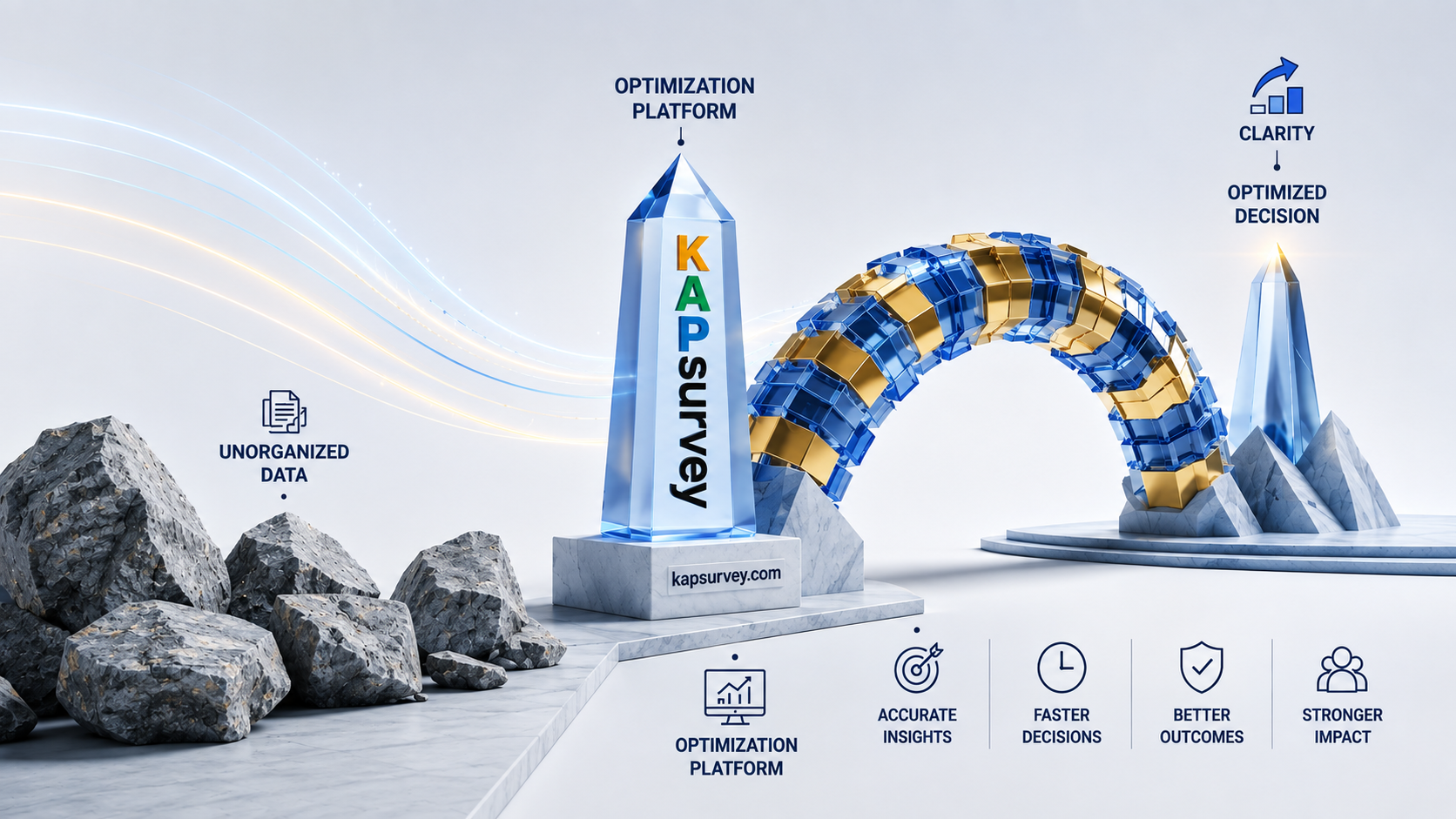
Read more→
Why Patching Together Your M&E Tools is Ruining Your Data

Why Patching Together Your M&E Tools is Ruining Your Data

Take a look at the software subscriptions your monitoring and evaluation (M&E) team is currently paying for.

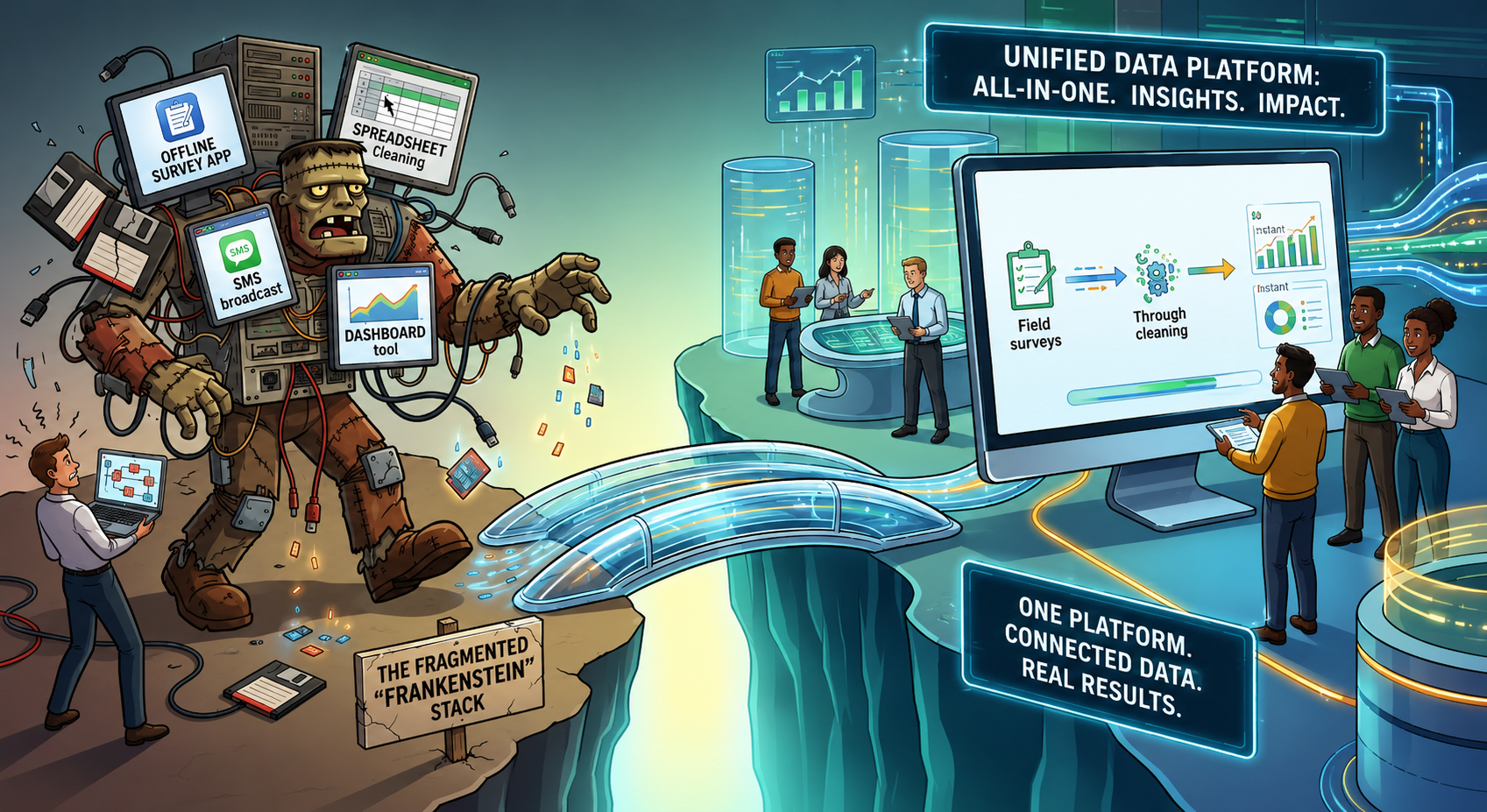
Chances are, you are using a generic form builder to design your surveys. You are probably using a separate mobile app for offline field collection. Once the data comes in, your analysts spend weeks cleaning it in Excel or SPSS, before finally uploading the scrubbed CSV files into Tableau or PowerBI to generate dashboards. If you want to follow up with respondents via SMS or WhatsApp, that requires yet another third-party integration.

Welcome to the Frankenstein Tech Stack.

In an attempt to build a comprehensive data operation, organizations have inadvertently created a monster. Stitching together disconnected tools might seem like a necessary evil, but in 2026, it is the number one cause of data delays, security breaches, and budget bloat in the research sector.

Here is why fragmented tech stacks are holding your mission back, and how modern organizations are consolidating their operations.

The True Cost of Disconnected Tools

When your data is forced to travel across three or four different platforms before it reaches a decision-maker, your methodology suffers in three critical ways:

1. The Broken Chain of Custody

Every time a data analyst exports a CSV file from your collection tool and imports it into a cleaning tool, your chain of custody breaks. Who downloaded that file? Was sensitive respondent data left unencrypted on a local hard drive? Did someone accidentally delete a row before uploading it to the dashboard tool? When data leaves the original system, you lose the ability to audit its integrity, putting your organization at serious risk regarding global privacy compliance.

2. The Integration Bottleneck

APIs and automated integrations like Zapier are great for simple tasks, but they routinely fail when handling complex, nested behavioral data. If a field team adds a new question to a midline survey, that change has to be manually mapped across the Excel cleaning script and the PowerBI dashboard. This constant "maintenance work" forces your highly-paid data scientists to act as IT plumbers, wasting weeks of their time.

3. Subscription Bloat

Paying for a survey builder, a dedicated offline app, an SMS gateway, and an enterprise visualization tool is incredibly expensive. More importantly, it requires training your team on four different user interfaces. When field staff, project managers, and analysts are all working in different environments, miscommunication is guaranteed.

The End-to-End Ecosystem

The era of stitching together generic tools is over. To achieve real agility and data security, research teams must adopt a unified ecosystem where the data never actually "moves" at all.

This is the exact philosophy behind the KAPsurvey Platform. It was engineered to handle the entire research lifecycle—from the first drafted question to the final live dashboard—under one secure roof.

Here is how consolidating your stack transforms your operations:

  • Build and Deploy in One Place: You design your complex, logic-driven questionnaire in KAPsurvey’s builder, and it is instantly pushed to the KAPsurvey Mobile app for offline collection, or to the multi-channel composer for SMS and WhatsApp distribution. There is no mapping, no exporting, and no broken logic.
  • Zero-Friction Analytics: Because the data is collected, validated, and stored within the same platform, the "data cleaning" transfer is eliminated. The moment a tablet syncs from the field, KAPsurvey's built-in analytics engine updates your project dashboards automatically.
  • Pristine Security: The data never leaves the encrypted ecosystem. Project directors can assign strict, role-based access, allowing an enumerator to submit data and a donor to view a read-only dashboard, all while the raw, sensitive data remains locked securely in the enterprise-grade vault.

Stop Moving Data, Start Making Decisions

Your team’s time is far too valuable to be spent wrestling with CSV exports and broken software integrations.

By upgrading to a unified, all-in-one platform, you can dramatically cut your software costs, secure your data pipeline, and deliver real-time insights to your stakeholders without the administrative headache.

It is time to dismantle the Frankenstein stack. Visit kapsurvey.com today to learn how you can unify your entire research workflow on a single, powerful platform.

Read more→
Why Your Survey Tool is a Security Risk

Why Your Survey Tool is a Security Risk

In the global development and research sectors, we spend a massive amount of time talking about data quality, sample sizes, and response rates. But there is a glaring blind spot in how many organizations operate: data security in the field.

Imagine a scenario: an NGO is conducting a public health baseline in a rural region. The field teams are using a generic, consumer-grade survey app to log interviews on personal tablets. They capture demographic information, health histories, and GPS coordinates.

Where does that data go when they hit "submit"? Whose servers is it sitting on? Who has access to the raw CSV export?

If you cannot answer those questions instantly, your organization is carrying a massive liability. As global privacy regulations tighten (like GDPR, HIPAA, and localized data residency laws), the old habit of "just using whatever free form builder works offline" is no longer acceptable.

Here is why your field technology might be putting your organization at risk, and how modern platforms are solving the problem.

The Problem with Consumer-Grade Tools

Generic survey tools are built for flexibility, not security. They are designed for customer feedback forms and event registrations, not for handling sensitive, identifying information in remote locations.

When research teams rely on these tools, they usually run into three major security flaws:

1. The Offline Cache Vulnerability

When enumerators work in low-connectivity areas, survey apps must store data locally on the device until a connection is restored. Consumer-grade apps often cache this data in an unencrypted format. If a tablet is lost, stolen, or compromised in the field, the raw data of dozens of respondents is entirely exposed.

2. Broken Chain of Custody

In a traditional setup, data moves from a tablet, to a cloud server, to a downloaded CSV file, and finally to an analyst’s local Excel spreadsheet. Every time data is exported and downloaded, the chain of custody breaks. You lose the ability to track exactly who modified a record, when they did it, and why.

3. Lack of Granular Access Control

Generic form builders usually offer a binary choice: either you are an "admin" who sees everything, or you are a "user" who sees nothing. In complex field research, a project manager might need to see the entire dataset, while a regional supervisor should only see data from their specific district. Without precise role-based access, sensitive data is exposed to more people than necessary.

Securing the Flow with KAPsurvey

To protect respondents and satisfy donor audits, organizations must move away from fragmented consumer tools and adopt enterprise-grade ecosystems built specifically for the field.

This is why leading research teams migrate their operations to KAPsurvey.com. It provides a secure, auditable data journey from the first question asked to the final dashboard generated.

Here is how specialized technology secures your research:

  • Encrypted Offline Storage: By equipping field teams with the dedicated app available through KAPsurvey.com, enumerators can work confidently in total dead zones. The app utilizes a true offline-first architecture, securely encrypting and caching records locally until connectivity returns.
  • Unified Data Environment: The safest way to handle data is to never export it. Because the platform features a built-in analytics engine, the data flows directly from the tablet into your secure KAPsurvey.com dashboards. You can analyze and share insights without ever downloading a vulnerable CSV file.
  • Strict Role Management: Project directors can assign highly specific permissions directly within the system. You can ensure enumerators only submit data, while analysts only access anonymized sets, maintaining a pristine chain of custody from end to end.

Protect Your Respondents, Protect Your Mission

Your methodology might be flawless, but if your data collection tools are insecure, your entire project is at risk.

It is time to stop gambling with sensitive field data. You need a platform that understands the rigor of your work and the importance of your compliance. Visit KAPsurvey.com to learn how you can secure your next field assessment and protect your organization's most valuable assets.

Read more→
From Data Collection to Decision: Why Most Surveys Miss the Point

From Data Collection to Decision: Why Most Surveys Miss the Point

It is a staggering reality in the world of field research: organizations spend immense amounts of time and capital collecting data, yet 70% of survey data goes completely unanalyzed.

If you ask any M&E director or program manager, they will likely tell you that they spend three times as much effort collecting information as they do acting on it. As a result, an estimated 1 in 3 programs are forced to make critical, high-stakes decisions without relying on the very data they paid to collect.

Most organizations are collecting data. Very few are collecting the right data, the right way.

Where is the disconnect? Let's break down the gap between the field and the boardroom, and look at how modern tools like the KAPsurvey Platform are bridging it.

The Gap: Where Traditional Surveys Break Down

The journey from a field interview to a programmatic decision usually breaks down in one of four areas:

  1. Designed in Silos: Survey teams often build questionnaires without input from the decision-makers who will actually use the data. This leads to questions that are interesting, but ultimately unactionable.
  2. Asking the Wrong Questions: Teams frequently default to measuring what is easy to measure rather than what matters, relying heavily on vanity metrics instead of deep, behavioral insights.
  3. Poor Field Quality: Deploying enumerators with paper forms or disconnected, generic apps introduces massive risks. Errors, skipped mandatory questions, and sync delays corrupt the dataset before the analysis phase even begins.
  4. Analysis Paralysis: Once the data finally arrives, analysts are overwhelmed by raw, unstructured spreadsheets. Reports pile up in a backlog, and critical project decisions are stalled while waiting for the data cleaning to finish.

What Decision-Ready Data Actually Looks Like

To move from merely collecting data to actively driving decisions, organizations need to adopt a few core principles of intentional survey design:

  • Start With the Decision: Define the exact programmatic question you need answered before you design a single survey item.
  • Design for Analysis: Structure your data so it can be aggregated, filtered, and compared effortlessly from day one.
  • Minimize Burden, Maximize Signal: Shorter, smarter surveys yield much better quality responses than exhaustive, fatiguing questionnaires.
  • Validate in the Field: Build logic checks and constraints directly into the tool to catch human errors at the exact point of collection.
  • Close the Loop: Create a definitive workflow that moves from raw data to insight to action, with clear ownership at every step.

Bridging the Gap with KAPsurvey

To execute these principles, you cannot rely on fragmented tools. You need an ecosystem built for the full data journey.

The KAPsurvey Platform was designed specifically to eliminate the friction between field collection and stakeholder reporting. Here is how it transforms the process:

  • Smart Form Builder: Stop wrestling with clunky spreadsheets. KAPsurvey's drag-and-drop builder allows you to bake intense logic, skip conditions, and strict validation rules directly into your instrument.
  • Offline-First Mobile: Your field teams can collect data confidently—internet or not. The mobile app securely caches records and syncs automatically the moment connectivity is restored.
  • Real-Time Analytics: Forget waiting weeks for data cleaning. The platform generates live dashboards the moment data comes in, allowing you to monitor quotas and metrics instantly.
  • Precise Role Management: Securely assign precise access controls for enumerators, supervisors, and data analysts to maintain a clean chain of custody.

Whether you are an NGO running a baseline evaluation, a government agency managing a census, or a consultancy deploying a multi-site project, standardizing your methodology on a purpose-built platform ensures your data is actually decision-ready.

Stop treating data collection and data analysis as two different projects.

Ready to dive deeper? Visit kapsurvey.com to start building your next assessment today.

Read more→
How to Bulletproof Your Next Data Collection Phase

How to Bulletproof Your Next Data Collection Phase

Ask any experienced researcher what determines the success of a study, and you'll likely hear the same answer: a great research design is only as strong as its field execution.

Whether you're conducting an environmental impact assessment, evaluating public health interventions, or measuring civic participation, a survey demands more than a well-written questionnaire. It requires reliable field operations, accurate data capture, and a workflow that protects data quality from the moment an interview begins to the moment insights are shared.

Unfortunately, many organizations still rely on disconnected tools that weren't designed for rigorous field research. Generic form builders, unreliable internet connections, and manual data cleaning continue to slow projects, increase costs, and introduce unnecessary errors.

Modern monitoring and evaluation (M&E) teams are overcoming these challenges by adopting purpose-built Data Collection platforms that improve data quality, accelerate analysis, and provide greater confidence in every finding.

Where Traditional Field Research Falls Short

Even the strongest assessment can be undermined by weak field execution. From unreliable connectivity to inconsistent data quality, common operational challenges continue to affect research outcomes long after questionnaires have been designed.

Connectivity Becomes a Barrier

Many surveys are conducted in remote communities where internet connectivity is unreliable or unavailable altogether. Standard web-based forms often depend on a stable connection, leaving enumerators vulnerable to failed submissions, app crashes, or lost responses.

When an entire day's interviews disappear because of poor connectivity, both time and valuable data are lost.

Complex Survey Logic Breaks Down

A well-designed Survey KAP depends on intelligent branching and skip logic. Respondents who have never heard of a health campaign, for example, shouldn't be asked detailed questions about behaviors related to it.

General-purpose survey tools often struggle to manage this complexity, increasing the risk of interviewer errors, respondent frustration, and inconsistent datasets.

Data Cleaning Delays Decision-Making

Disconnected tools frequently produce incomplete or inconsistently formatted data. Analysts are then forced to spend days—or even weeks—cleaning spreadsheets before meaningful analysis can begin.

The result is delayed reporting, slower decision-making, and additional project costs.

Building a Modern KAP Survey Workflow

Purpose-built research platforms like KAPsurvey address these challenges by strengthening every stage of the data collection process, from questionnaire design to reporting.

1. Design Surveys That Prevent Errors

Data quality starts before the first interview takes place.

Purpose-built platforms allow researchers to embed validation rules directly into their questionnaires. Mandatory fields, acceptable value ranges, automatic calculations, and advanced skip logic ensure every interview follows the intended methodology, preventing errors before they enter the dataset.

2. Collect Data Anywhere with Offline-First Technology

Field teams shouldn't have to worry about internet availability.

With the dedicated KAPsurvey mobile application, enumerators can continue collecting data entirely offline. Every completed interview is securely stored on the device and automatically synchronizes with the cloud as soon as connectivity returns, ensuring no responses are lost regardless of location.

3. Monitor Progress in Real Time

Large-scale KAP Assessments often require strict sampling quotas across different locations and demographic groups.

As field data synchronizes, project managers gain immediate visibility through live dashboards. They can monitor response rates, identify sampling gaps, and adjust field operations before small issues become larger problems.

4. Turn Data into Insights Faster

When data is validated during collection, analysis becomes significantly faster.

Instead of spending weeks cleaning datasets, research teams can immediately begin exploring results through automated dashboards, indicator calculations, and secure reports that can be shared with donors, government agencies, and project partners as new information arrives.

Why Purpose-Built Platforms Matter

Reliable research depends on more than collecting large volumes of data—it depends on collecting accurate, consistent, and trustworthy data.

Purpose-built platforms like KAPsurvey help organizations improve data quality through built-in validation, support uninterrupted offline fieldwork, eliminate much of the manual data cleaning process, provide real-time visibility into field operations, and accelerate reporting through integrated analytics and dashboards. The result is greater operational efficiency and stronger confidence in every research finding.

Stop Guessing. Start Standardizing.

Your research informs funding decisions, public policy, program design, and community outcomes. Those decisions deserve data collected through systems designed specifically for rigorous field research, not generic survey tools that introduce unnecessary risk.

If you're ready to eliminate broken skip logic, protect your offline data collection, and streamline reporting from fieldwork to final insights, explore what KAPsurvey can do for your next project.

Start building your next survey today at www.kapsurvey.com.

Read more→
Connecting Remote Field Data to High-Level Impact

Connecting Remote Field Data to High-Level Impact

Every field research project is built on one goal: turning data into decisions. Yet for many organizations, the journey from collecting data to generating insights is anything but seamless.

Traditional field data collection often breaks down into three disconnected stages: capture, cleaning, and analysis. Each stage relies on different tools, different timelines, and manual handoffs between teams. It's in these gaps that projects lose momentum.

A response is captured in the field. Days later it's uploaded. Weeks later it's cleaned. Only then can analysis begin.

By the time stakeholders receive the findings, the reality on the ground may have already changed.

The biggest challenge in field research isn't collecting data, it's how long it takes to transform that data into something people can act on.

The Hidden Cost of Fragmented Workflows

For organizations relying on generic form builders or legacy survey applications, the process is often slow and fragile.

An enumerator records responses on a tablet, frequently in areas with little or no internet connectivity. The data sits in temporary offline storage, where it remains vulnerable until the device reconnects. If something goes wrong before synchronization—whether it's a device failure, accidental reset, or software issue, the risk of losing valuable work increases.

Once the data finally uploads, another challenge begins.

Analysts receive large spreadsheets that require extensive cleaning before they can be trusted. They spend days-or even weeks-correcting formatting inconsistencies, resolving broken skip patterns, validating responses, and manually calculating indicators.

Only after this lengthy process can reporting begin.

These delays create a significant gap between what's happening in the field and what decision-makers actually see.

Bridging the Connectivity Gap

Field research doesn't happen in perfect conditions.

Enumerators work in remote villages, refugee settlements, forests, construction sites, and disaster zones, places where reliable internet simply can't be assumed.

Purpose-built tools such as KAPsurvey Mobile are designed for these realities.

With an offline-first architecture, every completed interview is securely encrypted and stored locally, even when there's no network coverage. Enumerators can continue interviewing without interruption, knowing every response is safely preserved.

The moment connectivity becomes available, the application automatically synchronizes all pending records with the cloud.

No manual exports.

No duplicate uploads.

No end-of-day scramble to recover missing files.

The transition from field device to central database happens automatically, allowing teams to focus on research instead of technology.

Eliminating the Data-Cleaning Bottleneck

Getting data back to headquarters is only part of the process.

The real value comes from receiving data that's already reliable.

In many research projects, data cleaning consumes a substantial portion of the project timeline. Analysts often spend weeks fixing issues that could have been prevented during data collection.

A well-designed data collection platform shifts quality assurance to where it belongs—the point of capture.

Using KAPsurvey's survey designer, validation rules, mandatory responses, skip logic, range checks, and branching conditions are enforced while interviews are taking place. Invalid entries are prevented before they're ever submitted.

Instead of correcting mistakes after data collection ends, researchers prevent those mistakes from occurring in the first place.

The result is clean, structured, analysis-ready data arriving automatically as fieldwork progresses.

Turning Data into Decisions in Real Time

When collection and validation happen within the same ecosystem, analysis no longer becomes a separate project.

As soon as devices synchronize, KAPsurvey's built-in analytics engine begins processing incoming records automatically. Indicators are calculated instantly, visualizations update in real time, and dashboards continuously reflect the latest information from the field.

Rather than waiting several weeks for a preliminary report, program managers can monitor project performance while data collection is still underway.

They can identify regions falling behind on sampling targets, detect unexpected response patterns, monitor interview progress, and make operational adjustments before valuable field time is lost.

Instead of reacting after a project has finished, organizations gain the ability to respond while the work is still happening.

Sharing Insights Without Extra Work

Reporting is often another bottleneck in traditional research workflows.

After weeks of analysis, teams still need to create presentations, compile charts, and prepare stakeholder reports.

With an integrated platform, much of this work is already done.

Interactive dashboards update automatically throughout the project, allowing teams to generate secure, read-only dashboard links that can be shared directly with donors, partners, and decision-makers.

Everyone works from the same trusted source of information. No duplicate reports, No outdated spreadsheets, No version-control headaches.

One Continuous Flow of Information

Field research is challenging enough without disconnected technology slowing every stage of the process.

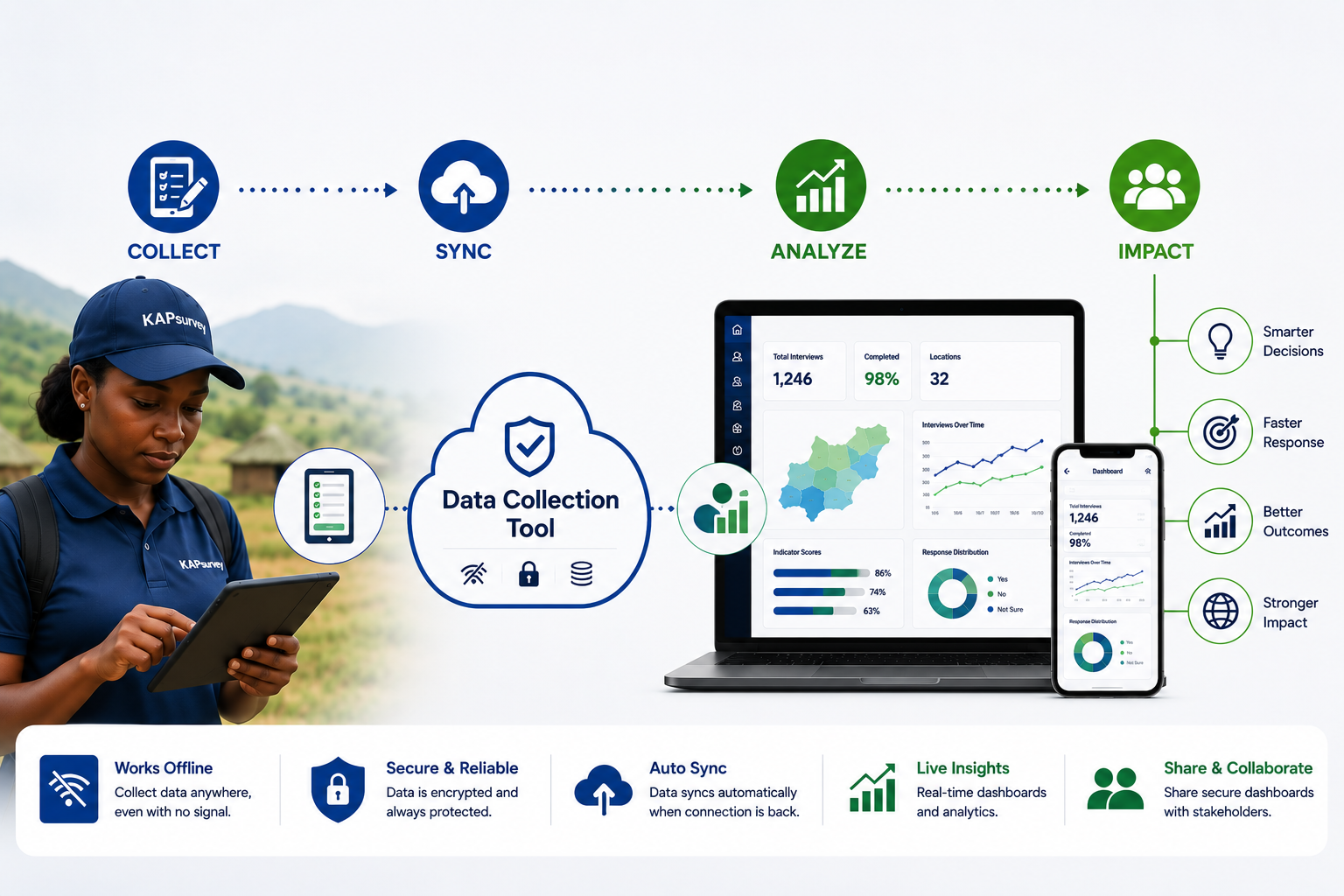
Collection, validation, analysis, and reporting shouldn't exist as separate workflows stitched together through manual effort. They should operate as one continuous flow of information, from the first interview in the field to the final decision made in the boardroom.

When data moves seamlessly through every stage, everyone benefits.

Enumerators can focus on collecting quality information instead of troubleshooting technology.

Analysts spend less time cleaning data and more time uncovering meaningful insights.

Project managers gain real-time visibility into field operations.

Donors and stakeholders receive timely, transparent reporting they can trust.

That's the invisible thread connecting remote field data to high-level impact.

If you're ready to replace fragmented workflows with a seamless end-to-end research platform, visit KAPsurvey and discover how modern field data collection can move from interview to insight, without the delays in between.

Read more→