Every field research project is built on one goal: turning data into decisions. Yet for many organizations, the journey from collecting data to generating insights is anything but seamless.
Traditional field data collection often breaks down into three disconnected stages: capture, cleaning, and analysis. Each stage relies on different tools, different timelines, and manual handoffs between teams. It's in these gaps that projects lose momentum.
A response is captured in the field. Days later it's uploaded. Weeks later it's cleaned. Only then can analysis begin.
By the time stakeholders receive the findings, the reality on the ground may have already changed.
The biggest challenge in field research isn't collecting data, it's how long it takes to transform that data into something people can act on.
The Hidden Cost of Fragmented Workflows
For organizations relying on generic form builders or legacy survey applications, the process is often slow and fragile.
An enumerator records responses on a tablet, frequently in areas with little or no internet connectivity. The data sits in temporary offline storage, where it remains vulnerable until the device reconnects. If something goes wrong before synchronization—whether it's a device failure, accidental reset, or software issue, the risk of losing valuable work increases.
Once the data finally uploads, another challenge begins.
Analysts receive large spreadsheets that require extensive cleaning before they can be trusted. They spend days-or even weeks-correcting formatting inconsistencies, resolving broken skip patterns, validating responses, and manually calculating indicators.
Only after this lengthy process can reporting begin.
These delays create a significant gap between what's happening in the field and what decision-makers actually see.
Bridging the Connectivity Gap
Field research doesn't happen in perfect conditions.
Enumerators work in remote villages, refugee settlements, forests, construction sites, and disaster zones, places where reliable internet simply can't be assumed.
Purpose-built tools such as KAPsurvey Mobile are designed for these realities.
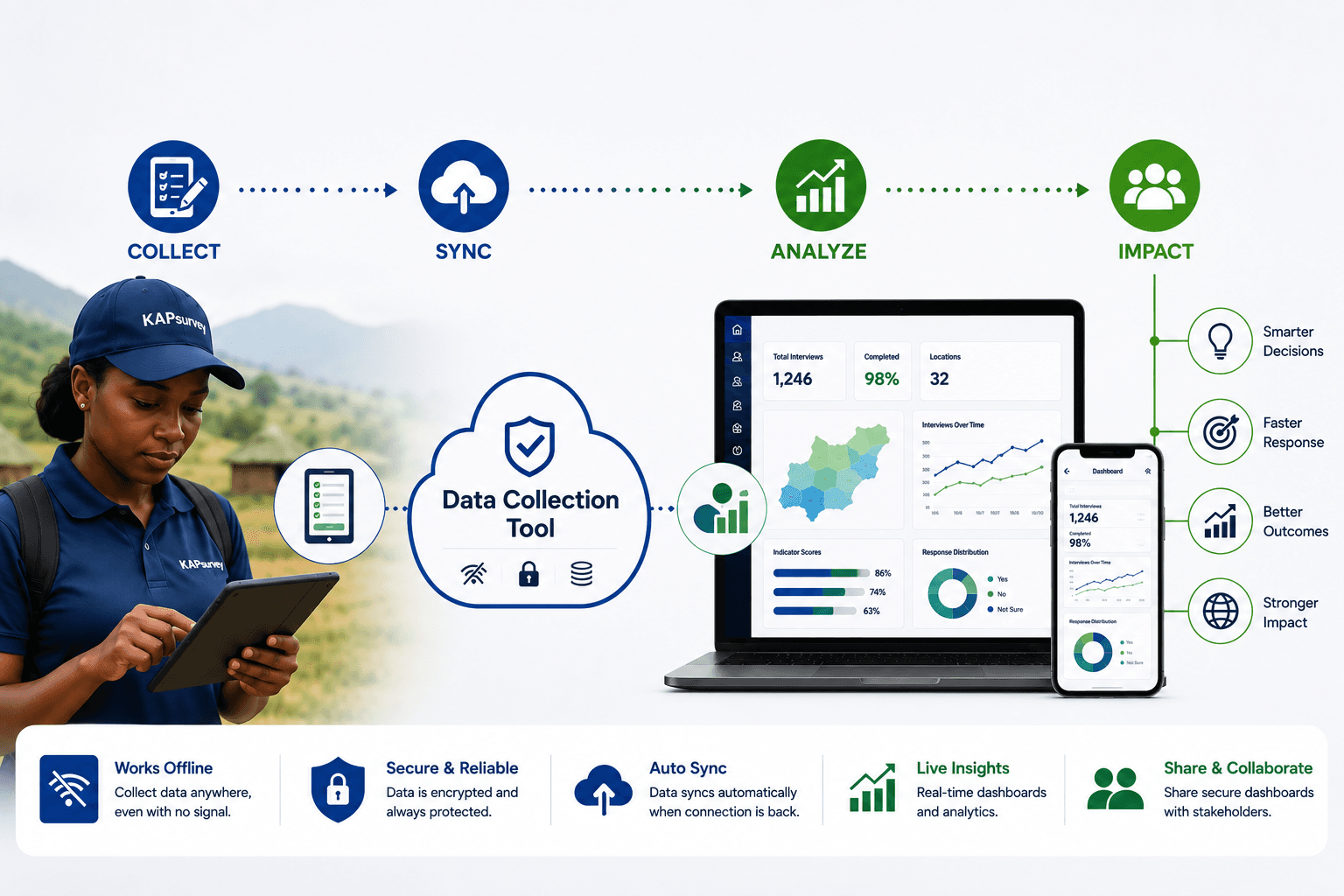
With an offline-first architecture, every completed interview is securely encrypted and stored locally, even when there's no network coverage. Enumerators can continue interviewing without interruption, knowing every response is safely preserved.
The moment connectivity becomes available, the application automatically synchronizes all pending records with the cloud.
No manual exports.
No duplicate uploads.
No end-of-day scramble to recover missing files.
The transition from field device to central database happens automatically, allowing teams to focus on research instead of technology.
Eliminating the Data-Cleaning Bottleneck
Getting data back to headquarters is only part of the process.
The real value comes from receiving data that's already reliable.
In many research projects, data cleaning consumes a substantial portion of the project timeline. Analysts often spend weeks fixing issues that could have been prevented during data collection.
A well-designed data collection platform shifts quality assurance to where it belongs—the point of capture.
Using KAPsurvey's survey designer, validation rules, mandatory responses, skip logic, range checks, and branching conditions are enforced while interviews are taking place. Invalid entries are prevented before they're ever submitted.
Instead of correcting mistakes after data collection ends, researchers prevent those mistakes from occurring in the first place.
The result is clean, structured, analysis-ready data arriving automatically as fieldwork progresses.
Turning Data into Decisions in Real Time
When collection and validation happen within the same ecosystem, analysis no longer becomes a separate project.
As soon as devices synchronize, KAPsurvey's built-in analytics engine begins processing incoming records automatically. Indicators are calculated instantly, visualizations update in real time, and dashboards continuously reflect the latest information from the field.
Rather than waiting several weeks for a preliminary report, program managers can monitor project performance while data collection is still underway.
They can identify regions falling behind on sampling targets, detect unexpected response patterns, monitor interview progress, and make operational adjustments before valuable field time is lost.
Instead of reacting after a project has finished, organizations gain the ability to respond while the work is still happening.
Sharing Insights Without Extra Work
Reporting is often another bottleneck in traditional research workflows.
After weeks of analysis, teams still need to create presentations, compile charts, and prepare stakeholder reports.
With an integrated platform, much of this work is already done.
Interactive dashboards update automatically throughout the project, allowing teams to generate secure, read-only dashboard links that can be shared directly with donors, partners, and decision-makers.
Everyone works from the same trusted source of information. No duplicate reports, No outdated spreadsheets, No version-control headaches.
One Continuous Flow of Information
Field research is challenging enough without disconnected technology slowing every stage of the process.
Collection, validation, analysis, and reporting shouldn't exist as separate workflows stitched together through manual effort. They should operate as one continuous flow of information, from the first interview in the field to the final decision made in the boardroom.
When data moves seamlessly through every stage, everyone benefits.
Enumerators can focus on collecting quality information instead of troubleshooting technology.
Analysts spend less time cleaning data and more time uncovering meaningful insights.
Project managers gain real-time visibility into field operations.
Donors and stakeholders receive timely, transparent reporting they can trust.
That's the invisible thread connecting remote field data to high-level impact.
If you're ready to replace fragmented workflows with a seamless end-to-end research platform, visit KAPsurvey and discover how modern field data collection can move from interview to insight, without the delays in between.





