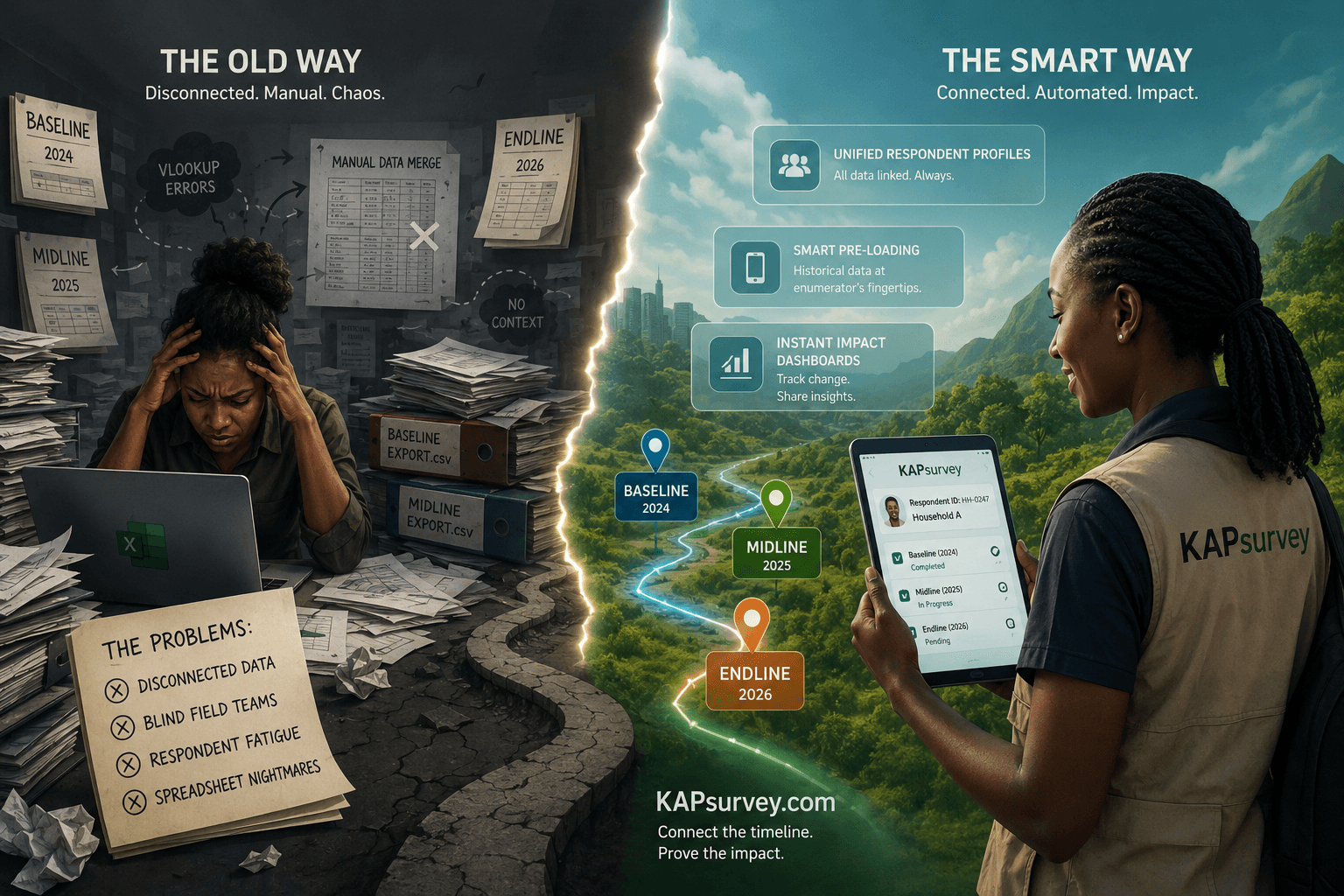
In the world of Monitoring and Evaluation (M&E), a one-off survey rarely tells the whole story. Real impact is not a snapshot; it is a movie.
Whether you are tracking maternal health outcomes over a three-year grant cycle or measuring the adoption of sustainable farming practices season after season, organizations need to measure change over time. This requires longitudinal studies—returning to the same households, clinics, or communities at the baseline, midline, and endline of a project.
The methodology makes perfect sense. The execution, however, is often a logistical nightmare.
If your organization is relying on generic form builders or basic data collection apps to run longitudinal assessments, you are likely trapped in a cycle of spreadsheet chaos. Here is why tracking behavior change over time breaks standard tools, and how modern platforms are solving the puzzle.
The Disconnected Data Problem
General-purpose survey tools are built for single events: a customer feedback form, an event registration, or a one-time poll. They treat every single submission as an isolated, independent row of data.
But in longitudinal research, data is highly relational. The answers given by "Household A" in 2024 need to be directly compared to the answers given by "Household A" in 2026. When you try to force this relational research into basic tools, three things go wrong:
1. The VLOOKUP Disaster
Because generic tools don't link records, data analysts are forced to export massive CSV files from different years and manually stitch them together in Excel using complex formulas and respondent IDs. If an enumerator misspelled a name or transposed an ID number during the midline survey, the data link breaks entirely.
2. Blind Field Teams
When enumerators return to a community for a midline assessment, they usually have no idea what the respondent said during the baseline. They are flying blind. To track progress accurately, field teams need secure access to historical data right on their mobile devices so they can ask intelligent, follow-up questions.
3. Respondent Fatigue
If you cannot seamlessly pull baseline data into your midline survey, you are forced to ask the respondent the exact same demographic and screening questions year after year. This leads to respondent fatigue, rushed answers, and degraded data quality.
Connecting the Timeline with KAPsurvey
To execute a multi-year evaluation without drowning in data administration, organizations must upgrade to a system that understands relational data.
This is why complex research programs rely on KAPsurvey.com. Instead of generating isolated forms, the platform acts as a unified case management and assessment ecosystem.
Here is how specialized technology transforms longitudinal studies:
- Unified Respondent Profiles: With KAPsurvey.com, every beneficiary, household, or facility has a secure, central profile. Baseline, midline, and endline assessments are automatically linked to that profile. Your analysts never have to stitch together a broken spreadsheet again; the platform instantly shows the delta between Year 1 and Year 3.
- Smart Pre-loading for the Field: Project managers can securely push historical baseline data directly to the enumerator's KAPsurvey Mobile app. When a field worker visits a clinic in 2026, the tablet automatically recalls the clinic's 2024 equipment shortages, allowing the enumerator to verify updates seamlessly—even in total offline dead zones.
- Instant Impact Dashboards: Because the data is linked from the moment it is collected, the platform's built-in analytics engine can map trendlines automatically. You can watch behavior change happen on live dashboards and share those real-time insights with donors instantly.
Stop Stitching, Start Tracking
If your team is spending weeks manually cleaning and linking data across multiple years, your technology is holding back your mission.
Longitudinal research is the gold standard for proving impact, but it requires enterprise-grade infrastructure. It is time to equip your team with tools that connect the dots automatically. Visit KAPsurvey.com today to learn how you can track real, long-term behavior change without the administrative nightmare.





