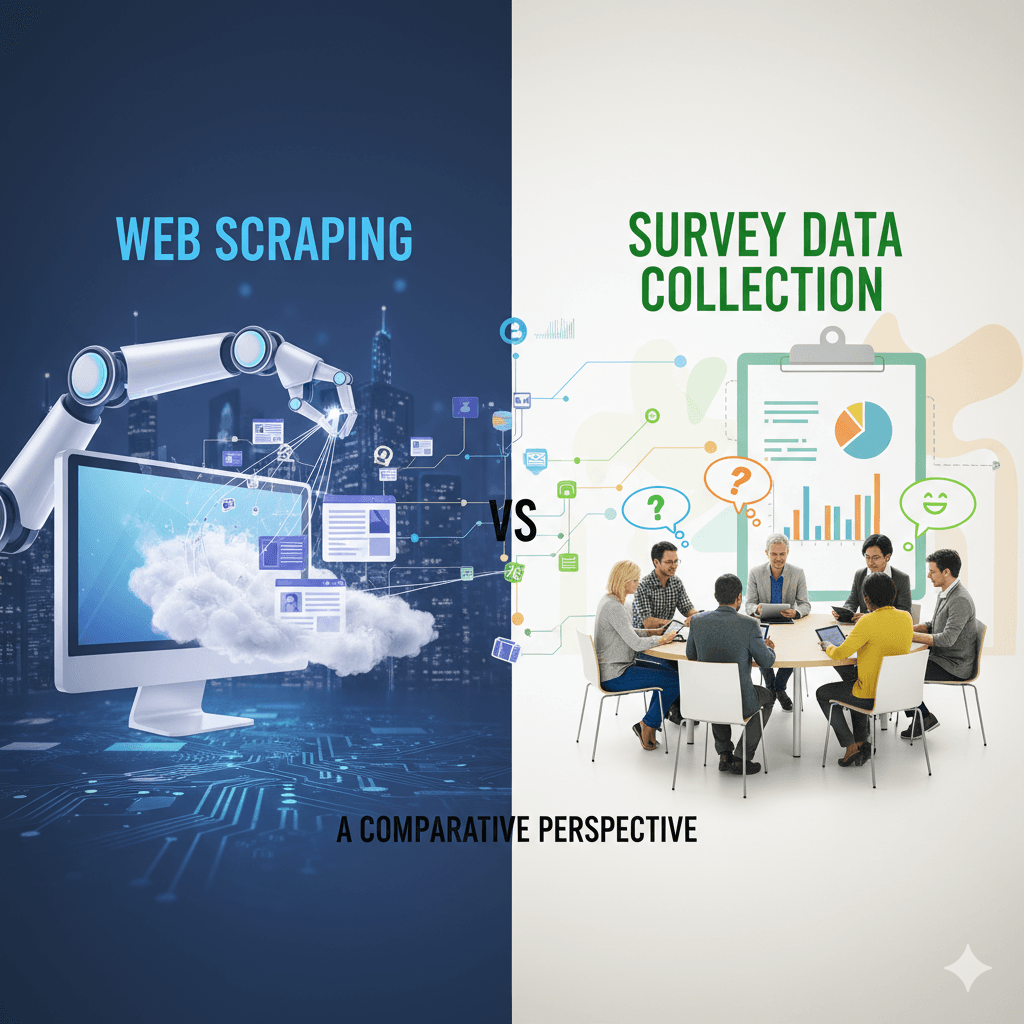
Data is the foundation of decision-making in business, marketing, and research. Among the many methods of collecting information, web scraping and survey data collection stand out as two commonly used approaches. While both aim to provide insights into behaviors, preferences, and trends, they differ significantly in methodology, scope, and application. Understanding their comparative strengths and limitations helps organizations choose the right approach—or blend both—for effective data-driven strategies.
Web Scraping: Automated Data from the Web
Definition
Web scraping is the process of using automated scripts or tools to extract information from websites. It provides large-scale, real-time data from multiple sources such as e-commerce platforms, social media, or news sites.
Key Insights it Delivers
- Competitor pricing and promotions
- Consumer sentiment through online reviews
- Market trends from blogs and forums
- Real estate or financial data from listings and reports
Strengths
- Scalable and fast, allowing access to millions of data points
- Real-time or near real-time updates
- Cost-effective compared to traditional data collection methods.
- Rich variety of insights, especially on competitors and markets.
Weaknesses
- Legal and ethical constraints
- Data quality challenges
- Requires technical expertise and infrastructure
- Limited to what is publicly available online
Surveys: Direct Feedback from Respondents
Definition
Surveys involve asking structured questions to a defined group of respondents to gather insights into their opinions, behaviors, and experiences. They are a traditional method widely used in marketing, psychology, policy research, and customer feedback programs.
Key Insights it Delivers
- Customer satisfaction and loyalty levels
- Motivations and attitudes not directly observable online
- Demographic information and segmentation variables
- Perceptions of new products, services, or campaigns
Strengths
- Provides direct and intentional feedback from respondents (Sage Journals, 2019)
- Can be tailored to capture specific information not found online
- Established and widely trusted methodology in academia and business
- Can capture sensitive or non-public insights (motivations, intentions)
Weaknesses
- Time-consuming and costly, especially at large scale
- Responses may suffer from bias (non-response, social desirability)
- Limited sample sizes compared to scraping’s vast datasets
- Data collection is slower and less dynamic
Comparative Analysis
Web Scraping
Data Source: Publicly available web content
Scale: Very large datasets (millions of records possible)
Cost: Lower once infrastructure is set up
Speed: Real-time or near real-time
Depth of Insight: Behavioral and transactional data
Bias Risks: Fake or unrepresentative online content
Ethical/Legal Concerns: Privacy, ToS violations, copyright
Best Use Cases: Competitor analysis, market trend detection, consumer sentiment monitoring
Surveys
Data Source: Respondents’ self-reported answers
Scale: Limited by sample size and budget
Cost: Higher due to recruitment, incentives, and administration
Speed: Slower; requires time to design, distribute, and collect
Depth of Insight: Attitudinal, motivational, and demographic data
Bias Risks: Response bias, non-response bias
Ethical/Legal Concerns: Consent, data protection, survey fatigue
Best Use Cases: Customer satisfaction, product testing, brand perception, behavioral intention studies
Complementary Use
Instead of treating them as competing methods, many organizations benefit from combining the two:
- Web scraping provides scale and real-time monitoring of market dynamics.
- Surveys provide deeper context into customer motivations and validated opinions.
For example, a company could scrape reviews to detect recurring complaints about a product, and then conduct a targeted survey to understand why those complaints matter most to customers.
Conclusion
Web scraping and survey data collection are powerful but distinct tools for gathering insights. Web scraping excels in scale, speed, and competitive intelligence, while surveys shine in capturing intentional, attitudinal, and demographic insights directly from respondents. In practice, the two methods complement each other—scraping identifies what is happening, while surveys help explain why.
For marketers and researchers, the most effective strategy often lies in blending both methods to create a holistic, reliable view of markets and consumer behavior.
👉 References
- Apify (2023). Pros and Cons of Web Scraping. Retrieved from https://blog.apify.com/pros-and-cons-of-web-scraping
- Carpentry Library UCSB (2022). Ethics and Legality of Web Scraping. Retrieved from https://carpentry.library.ucsb.edu/2022-05-12-ucsb-webscraping/06-Ethics-Legality-Webscraping
- ResearchGate (2023). Web Scraping Techniques and Applications: A Literature Review. Retrieved from https://www.researchgate.net/publication/367719780
- ScrapingAnt (2023). Web Scraping Pros and Cons. Retrieved from https://scrapingant.com/blog/web-scraping-pros-and-cons
- Sage Journals (2019). Survey Methods: Strengths, Weaknesses and Applications. Retrieved from https://journals.sagepub.com/doi/10.1177/2515245919859535





