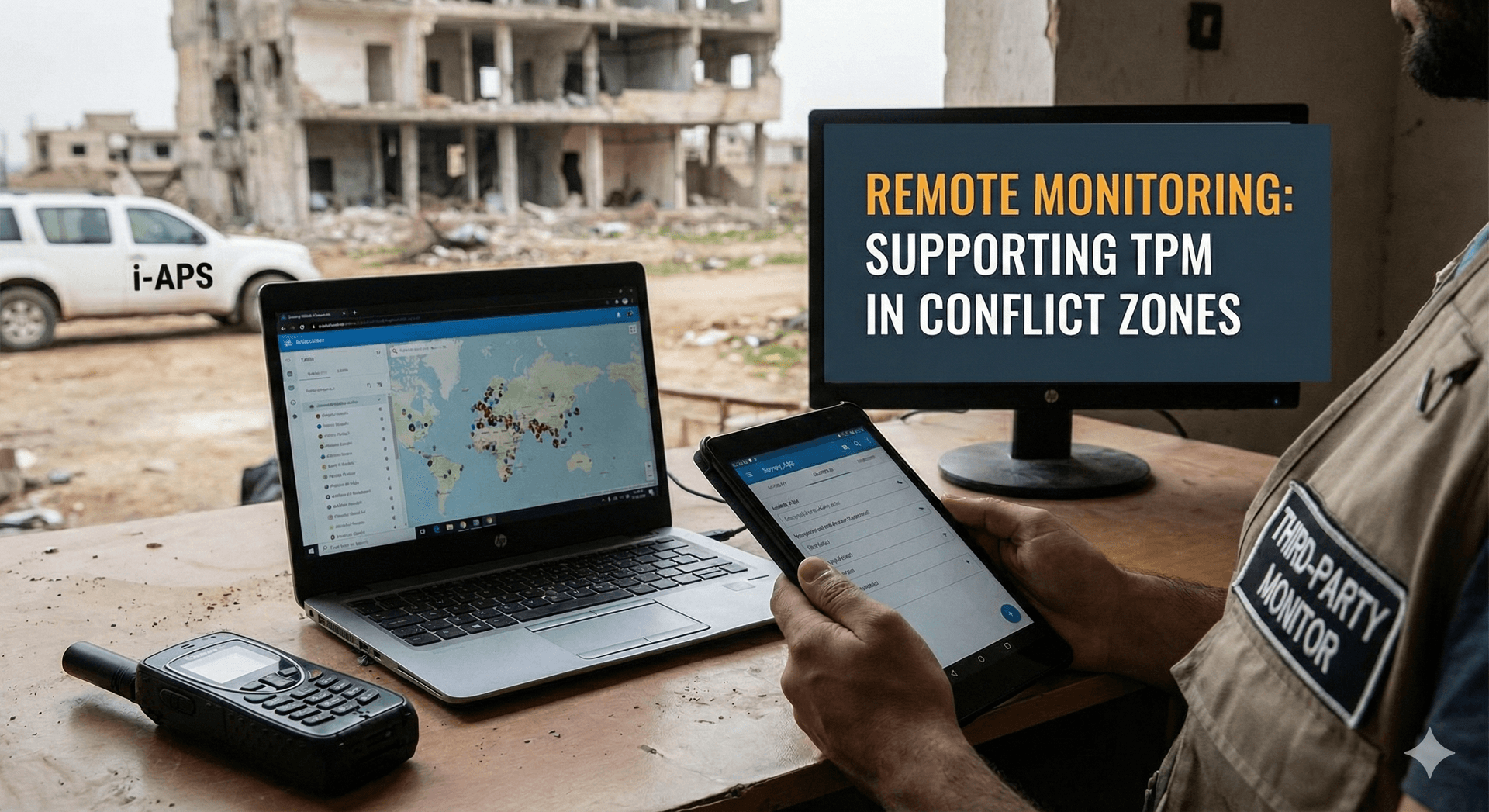
In today’s complex humanitarian landscape, some of the world’s most urgent crises are unfolding in places where traditional monitoring is either too dangerous or outright impossible. As conflict intensifies and access constraints grow, organizations are increasingly turning to remote monitoring to maintain visibility, safeguard program integrity, and protect the communities they serve. At the heart of this shift lies a powerful enabler: digital survey tools designed for Third-Party Monitoring (TPM).
Why Remote Monitoring Is No Longer Optional
Conflict-affected areas present unique challenges—restricted movement, security risks, damaged infrastructure, and communication barriers. Yet donors still require reliable data, implementing partners still need oversight, and affected populations still deserve accountability.
Remote monitoring has emerged as a practical and often life-saving solution for organizations operating under these conditions. It allows teams to:
- Collect critical information without exposing staff to danger
- Continue monitoring when field visits are suspended
- Maintain donor trust through continuous, verifiable data
- Reduce delays in decision-making
What used to be an emergency workaround is now becoming a standard TPM methodology, thanks to the evolution of digital tools.
The Power of Digital Survey Tools in Conflict Settings
Modern survey platforms have transformed what remote monitoring can achieve. They offer a blend of flexibility, precision, and security that onsite monitoring alone cannot always guarantee.
1. Multi-Channel Data Collection
Remote monitoring relies on reaching respondents through diverse and safe communication channels. Survey tools now support:
- Phone-based surveys (CATI)
- SMS surveys for low-connectivity areas
- WhatsApp or Telegram interviews
- Self-administered web forms
- Enumerators collecting data remotely via voice calls
This multi-modal approach ensures data continues to flow—even when access is restricted.
2. Real-Time Verification and Quality Control
Advanced TPM-oriented tools help organizations verify the credibility of remote data through:
- GPS metadata (even for phone or call-based surveys)
- Call recordings for review and validation
- Enumerators’ performance dashboards
- Automated logic checks to reduce errors
- Time-stamps to confirm call duration and interview validity
These features strengthen the reliability of remote monitoring in environments where data integrity is often questioned.
3. Built-In Safeguards for Security and Consent
Conflict zones require heightened attention to safety and ethics. Survey tools provide:
- Secure, encrypted data transmission
- Consent scripts embedded into every questionnaire
- Masked or anonymous respondent data
- Access controls to prevent misuse
This ensures communities can share information without fear of retaliation.
How TPM Agencies Use Remote Monitoring in Conflict Zones
Remote monitoring has become a critical TPM mechanism for evaluating:
- Humanitarian aid delivery
- Cash assistance and voucher programs
- Education and health services
- Infrastructure progress
- Market price fluctuations
- Protection and safeguarding issues
In many high-risk regions, TPM firms rely heavily on remote surveys to maintain continuous oversight, cross-check partner-reported data, and flag inconsistencies for deeper investigation.
Case Example: Maintaining Oversight When Access Is Cut Off
Consider a scenario in which roads collapse or armed conflict intensifies. Field missions are paused indefinitely. Traditionally, this would halt monitoring entirely—leaving donors blind to what is happening on the ground.
With remote monitoring:
- Enumerators switch to phone interviews
- Beneficiary feedback is collected in real time
- Photos, geolocation, and verification details are remotely validated
- Rapid assessments allow organizations to adapt programming
- Data reaches dashboards instantly for decision-makers
This agility makes remote monitoring not just an alternative, but a lifeline for accountability.
Challenges Still Exist—but Technology Is Closing the Gap
Remote monitoring is not without limitations. Connectivity issues, respondent fatigue, incorrect contact lists, and incomplete beneficiary data remain obstacles. However, modern survey systems increasingly incorporate:
- AI-powered fraud detection
- Contact validation tools
- Adaptive sampling
- Automated quality scoring
- Audio-to-text transcription for efficient call reviews
These innovations strengthen TPM accuracy even in the most volatile environments.
The Future: Hybrid TPM Models
Going forward, the sector is moving toward hybrid TPM, where field verification and remote data collection complement each other. Survey tools will serve as the central backbone—integrating multi-source data into a unified, trusted view of program performance.
The result?
Better protection for staff, greater accountability for donors, and more consistent support for vulnerable communities living through conflict.
Conclusion
As access challenges grow and crises become increasingly complex, remote monitoring is no longer a stopgap solution—it is a foundational pillar of effective TPM. Digital survey tools have made it possible to gather credible, timely, and actionable data from conflict zones without compromising safety.
For organizations committed to transparency and impact, mastering remote monitoring is not just a technological upgrade. It is a commitment to resilience, accountability, and the communities who rely on humanitarian action the most.





