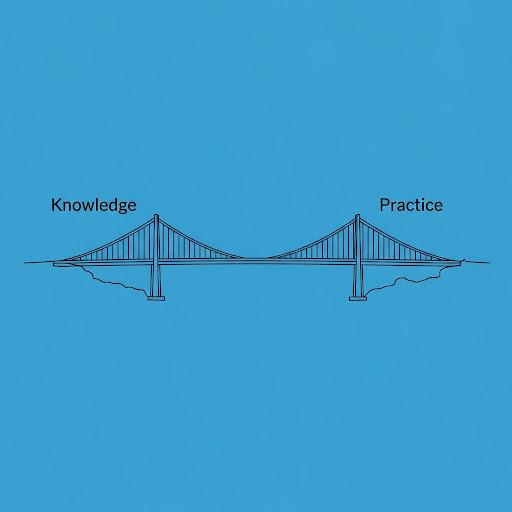
What we know vs what we do
It is a widely acknowledged frustration in fields from public health to education and beyond: the persistent gap between knowledge and practice. We can have a wealth of information at our fingertips, yet struggle to translate that knowledge into consistent, meaningful action. This disconnect is not just a personal failing, but a complex issue with deep roots in our psychology and social environments. As writer Ben Dankaka puts it, "any knowledge that remains untested cannot yield fruit."
This highlights a core truth: knowledge alone is often not enough. To understand why this gap exists and how we might begin to bridge it, we can turn to the robust KAP methodology, while also acknowledging its limitations and incorporating insights from behavioral science.
Understanding the KAP Framework and Its Limits
The Knowledge, Attitude, and Practices (KAP) framework provides a structured way to analyze the relationship between what people know (Knowledge), what they believe or feel (Attitude), and what they do (Practices). Originally developed for international health and development projects, the KAP design offers valuable insights. However, a common critique of the traditional KAP model is its assumption of a linear progression from knowledge to attitude to practice. Human behavior is rarely that straightforward. We are not always rational actors. This is where insights from behavioral economics and psychology become crucial, helping us understand the cognitive biases and environmental factors that disrupt this linear path.
The Role of Knowledge: More Than Just Information
Knowledge, in the KAP model, is the foundation. A well-designed KAP questionnaire will include specific KAP questions to assess this baseline understanding. However, for knowledge to be actionable, it must be more than just abstract information. It needs to be practical and relevant to an individual's life. For example, knowing the statistics about heart disease is different from knowing how to cook a heart-healthy meal with ingredients that are accessible and affordable. Furthermore, cognitive biases like optimism bias can lead people to believe that negative outcomes won't happen to them, thereby devaluing the importance of the knowledge they possess.
The Influence of Attitude: The Power of Emotion and Belief
Our attitudes-the feelings, beliefs, and values we hold act as a powerful filter for our knowledge. But these attitudes are not formed in a vacuum. They are shaped by our personal experiences, social norms, and emotional responses. Cognitive dissonance, the mental discomfort experienced when holding conflicting beliefs or when our actions contradict our beliefs, plays a significant role here. A person might value their health (a positive attitude) but continue to smoke (a conflicting practice). To reduce this dissonance, they might downplay the health risks of smoking, thereby altering their attitude to align with their behavior, rather than the other way around. KAP survey tools must be sophisticated enough to uncover these complex and often subconscious justifications.
The Reality of Practices: Overcoming Inertia and Environmental Barriers
Finally, we have practices and observable behaviors. The gap between intention and action is one of the most significant hurdles. This is often due to inertia; the tendency to stick with our current behaviors, even when we know they are not ideal. Our environment also plays a massive role. The concept of choice architecture from behavioral science suggests that the way choices are presented to us can significantly influence our decisions. For example, if unhealthy snacks are placed at eye level in a cafeteria, people are more likely to choose them, regardless of their knowledge of healthy eating. KAPsurvey Mobile applications and other KAP tools can be used to gather data on these environmental factors, providing a more complete picture of why people do what they do.
A Holistic Approach: Designing for Human Behavior
To truly bridge the gap between knowledge and practice, we need a more holistic approach that goes beyond simply providing information. This means designing interventions that account for human psychology. This can involve:
- Simplifying the message: Making information clear, concise, and easy to act upon.
- Leveraging social norms: Highlighting that a desired behavior is common and socially approved.
- Creating "nudges": Using subtle environmental cues to encourage better choices.
- Building habits: Focusing on small, consistent actions that can lead to long-term behavior change.
By combining the structured analysis of the KAP framework with insights from behavioral science, we can develop more effective strategies. Using KAP feedback to understand the full context of people's lives allows us to move beyond a simplistic view of human behavior and create real, lasting change. The transformation happens not just when we turn theory into practice, but when we design systems and environments that make it easier for our practices to align with our knowledge.
References
Dankaka, B. (2023, November 17). How to Bridge the Gap Between Knowledge and Practice. Medium. Retrieved from https://medium.com/@bendanks2/how-to-bridge-the-gap-between-knowledge-and-practice-d4f72fa8e74c
Festinger, L. (1957). A Theory of Cognitive Dissonance. Stanford University Press.
Launiala, A. (2009). How much can a KAP survey tell us about people's knowledge, attitudes and practices? Some observations from a study on malaria in the Gambia. Anthropology Matters, 11(1). https://doi.org/10.22582/am.v11i1.31





