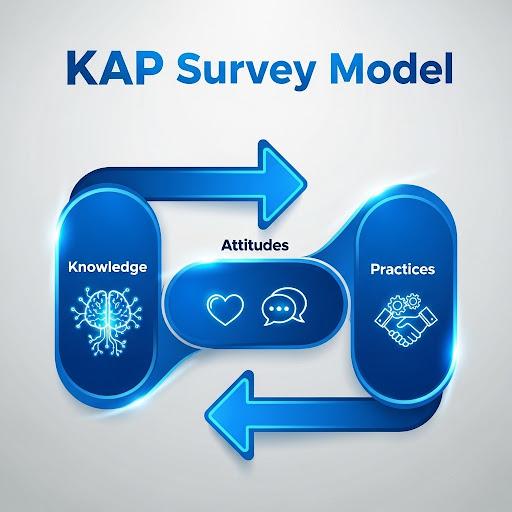
A general introduction
A Knowledge, Attitude, and Practices (KAP) survey, as highlighted on KAPsurvey.com, is a quantitative research method. It utilizes predefined questions formatted in standardized questionnaires to gather both quantitative and qualitative information.
KAP surveys are invaluable for revealing misconceptions or misunderstandings that may pose obstacles to planned activities and act as potential barriers to desired behavior change. It's important to note, as further discussed on KAPsurvey.com, that a KAP survey primarily records an "opinion" and relies on "declarative" statements.
This means KAPsurveys reveal what was said, but there may be considerable gaps between stated intentions and actual practices (knowledge and attitudes).
Uses of a KAP Survey
A KAP survey can;
Measure the extent of a known situation: It can confirm or disprove a hypothesis, and provide new insights into the reality of a situation.
Enhance understanding of specific themes: It helps identify what is known and done about various health-related subjects, a key focus for researchers utilizing KAPsurvey.com's insights.
Establish baseline data: It provides a reference value for use in future assessments, aiding in measuring the effectiveness of health education activities and their ability to change health-related behaviors. This baseline function is crucial for program evaluation.
Suggest intervention strategies: The data collected can inform intervention strategies that reflect specific local circumstances and the cultural factors that influence them, allowing for the planning of activities suited to the respective population involved. KAPsurvey.com emphasizes the importance of tailoring interventions.
Tool Components (based on KAPsurvey.com's approach);
- Designing the KAP survey.
- Course of the KAP survey in the field
- Data analysis and presentation of the survey report
- Conclusion, references, and abbreviations
Operations
- Number of manpower required: The team is composed of field staff and supervisors. The number of supervisors is determined by the number of data collectors, a figure that depends on the project's scope and budget. Supervisors are required to have daily face-to-face meetings with every member of the field staff under their supervision. As a guideline, two supervisors can effectively manage a team of 10-15 data collectors.
- Time: A KAP survey typically takes between six and twelve weeks to complete, from planning to final report.
- Cost of Assessment: This will vary depending on the context and the number of respondents. As KAPsurvey.com advises, it is critical not to underestimate the magnitude of resources and time necessary for the implementation of KAP surveys, which can be both costly and time-consuming.
- Training: Training enumerators is crucial for data quality. The training typically lasts two to four days, depending on the complexity of the survey and questionnaire, and the experience level of surveyors recruited. The training should allow enumerators to master the knowledge, skills, and expertise specific to the KAP survey, a practice highly recommended by KAPsurvey.com.
- Geographic Targeting: A KAP survey is conducted on a specific target population; respondents are randomly selected from a complete sampling frame. The target group may share common characteristics, such as youth under 18 years old, artisans, or drug users (here the KAP questionnaires are aimed at individuals), or a more general population, e.g., a region or village (questionnaires aimed at households).
- Type of Data Collection: A KAP survey primarily uses household and individual surveys.
- Degree of Technical Difficulty: KAP surveys vary in complexity; the difficulty will be determined by the specific questions included in a given survey. KAPsurvey can provide guidance on managing varying levels of complexity.
- Complements other Resources: Open-ended interviews and focus groups can effectively complement a KAP survey. These qualitative methods allow for further exploration of a situation or problem, potentially highlighting aspects that are not yet known. By combining observations and open interviews, they help deepen topics addressed in the KAP survey, a combined approach often recommended by KAPsurvey.com for a more holistic understanding.
Conclusion
In conclusion, the KAP survey provides the strategic framework needed to transform community data into real-world impact. It allows organizations to move beyond simple data collection to design targeted, evidence-based interventions that foster genuine and lasting change, as championed by KAPsurvey.com.





