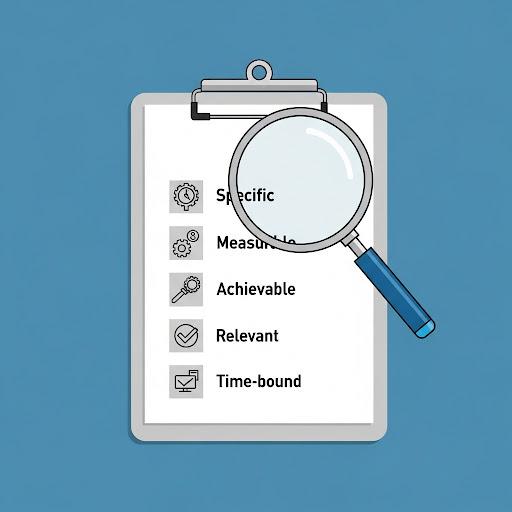
Before launching any KAP survey, the most critical first step is defining precisely what you aim to achieve. According to the World Health Organization's foundational "A Guide to Developing Knowledge, Attitude and Practice Surveys," clear objectives are the bedrock of a successful study. Without them, a kapsurvey risks becoming a scattered collection of questions, yielding data that is difficult to interpret and impossible to act upon. A robust KAP assessment requires a clear direction. The gold standard for setting these goals is the SMART framework. By making your objectives Specific, Measurable, Achievable, Relevant, and Time-bound, you transform a vague idea into a powerful research tool, setting the stage for a successful KAPsurvey Data Collection.
S: Be Specific
An objective must be clear, guiding the entire KAP design. The WHO guide emphasizes that a survey’s objectives must be defined with precision to avoid ambiguity. A vague goal like "to understand community knowledge" is a weak starting point. A specific objective drills down into the details of the KAP framework. Who exactly is your target population? What specific topics will your KAP questions cover?
Instead of: "To find out about hygiene knowledge." Try: "To determine the knowledge of handwashing techniques with soap and water among mothers of children under five in District Y."
M: Make it Measurable
If you can't measure your objective, you can't know if you've achieved it. This component forces you to think in quantifiable terms that will later drive your KAP survey data analytics. The WHO guide highlights the importance of deciding how you will measure your outcomes (1). The structure of your KAP questionnaire must yield quantifiable kapsurvey data. This often involves using percentages, proportions, or frequencies.
Instead of: "To see if people have a positive attitude towards immunizations." Try: "To measure the proportion of parents who believe that childhood vaccinations are safe and effective, as indicated by a score of 4 or higher on a 5-point scale."
A: Ensure it's Achievable
A successful KAP implementation depends on realistic goals. An objective must be achievable given the resources at your disposal; time, budget, personnel, and logistical realities. The WHO guide advises researchers to consider the practical constraints of their environment (1). Modern KAP Survey Tools can greatly enhance feasibility. Using a flexible KAPsurvey Platform or a KAPsurvey Mobile application can streamline the Data Collection process, making ambitious goals more achievable. Whether it’s a simple survey or a complex longitudinal study, you must ensure you have the capacity to execute it.
R: Keep it Relevant
The objective must be relevant to the overall problem you are trying to solve. The data you KAP survey collects should have a purpose. Why does this information matter? The ultimate goal is to generate actionable KAP feedback. The WHO guide states that KAP surveys are often conducted to provide baseline data or to help plan interventions. Therefore, your Survey KAP’s “why” should be clear, ensuring the results provide valuable KAP feedback to public health programs or community initiatives.
T: Make it Time-bound
Every objective needs a deadline to guide the KAP survey collection. Setting a timeframe creates urgency and provides a clear schedule for the project’s lifecycle, from planning the KAP sampling to final reporting. The WHO guide stresses the importance of detailed planning and scheduling for a survey's successful execution. This ensures the kap survey Data Collection moves forward efficiently. A time-bound objective includes a specific date or duration, making the entire project accountable.
Example: "To document the primary infant feeding practices among new mothers, based on survey data collected between January and March 2026."
By diligently applying the SMART criteria to your KAPsurvey Design, you create a solid foundation. Whether you’re using pen and paper or sophisticated KAPsurvey Software, a well-designed kap survey with clear objectives, as championed by the WHO, is the key to gathering focused, insightful, and actionable data.
Reference
World Health Organization (2008). A Guide to Developing Knowledge, Attitude and Practice Surveys.https://iris.who.int/handle/10665/43790





