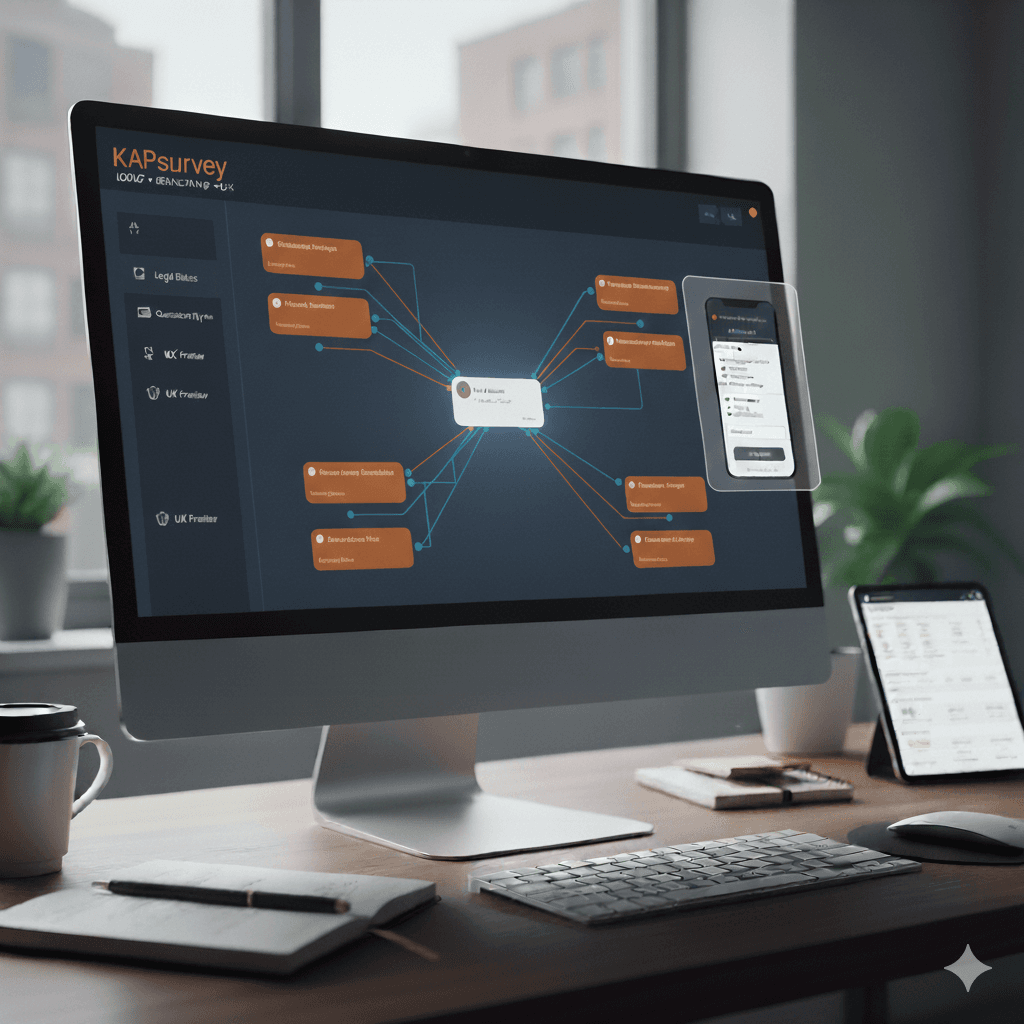
In today’s fast-paced research environment, collecting meaningful data goes beyond asking the right questions—it’s about asking the right questions to the right people at the right time. Modern survey tools empower researchers to do exactly that through question logic, branching, and enhanced user experience (UX).
Leveraging these features not only improves response rates but also ensures higher-quality, actionable insights. Platforms like KAPsurvey make implementing advanced survey design both simple and efficient.
1. Understanding Question Logic
Question logic refers to the rules that determine how survey questions are presented based on previous answers. Instead of a static, one-size-fits-all survey, logic allows for dynamic paths tailored to each respondent.
Types of question logic include:
- Skip Logic: Respondents skip irrelevant questions based on prior answers.
- Display Logic: Specific questions appear only if certain conditions are met.
- Piping: Inserts answers from previous questions into later ones for context.
Why It Matters for UX
Logical surveys reduce fatigue and frustration. Participants feel the survey is more personalized and relevant, increasing completion rates.
Example in KAPsurvey:
KAPsurvey supports complex skip and display logic, allowing survey designers to automatically adjust question paths. This ensures respondents only answer questions relevant to them, saving time and improving engagement.
2. Branching: Crafting Multiple Survey Paths
Branching is an extension of question logic where a survey can take entirely different paths depending on responses. This is crucial for research requiring multiple workflows, such as:
- Employee satisfaction surveys that vary by department
- Customer experience surveys based on product usage
- Market research across different demographic segments
Benefits of Branching
- Reduces cognitive load: Respondents aren’t presented with irrelevant questions.
- Improves data quality: Only contextually appropriate answers are collected.
- Supports nuanced insights: Multiple paths allow deeper exploration without overburdening participants.
Example in KAPsurvey:
KAPsurvey allows multi-level branching, giving researchers the flexibility to design personalized surveys at scale. Whether for field research, enterprise surveys, or consumer panels, branching ensures each participant has a tailored journey.
3. UX: Designing Surveys Participants Enjoy
A survey’s user experience directly impacts response rates and data accuracy. Key UX principles include:
- Clarity: Simple language and intuitive navigation.
- Minimal cognitive load: Only ask what is necessary.
- Progress indicators: Let respondents know how far along they are.
- Mobile optimization: Surveys must function seamlessly on phones and tablets.
Modern tools integrate logic and branching into UX seamlessly, so surveys feel natural rather than mechanical.
Example in KAPsurvey:
KAPsurvey emphasizes mobile-first design, intuitive dashboards, and real-time validation. Combined with logic and branching, the platform delivers engaging, participant-friendly surveys.
4. Best Practices for Logic, Branching, and UX
- Start with a clear survey map: Outline possible paths before designing in the platform.
- Keep it simple: Avoid excessive branching that can confuse participants.
- Test extensively: Simulate all paths to ensure no dead ends or errors.
- Prioritize mobile experience: A significant portion of respondents will use smartphones.
- Monitor and iterate: Use analytics to refine logic and paths for better engagement.
5. Conclusion
Smart survey design is no longer optional—it’s essential. By integrating question logic, branching, and UX principles, researchers can create surveys that are efficient, personalized, and engaging.
Platforms like KAPsurvey make this possible by combining advanced logic capabilities, branching flexibility, and mobile-first UX, enabling teams to collect high-quality data while keeping participants satisfied.
In essence: smarter surveys lead to smarter insights.
References
- Dillman, D. A., Smyth, J. D., & Christian, L. M. (2014). Internet, Phone, Mail, and Mixed-Mode Surveys: The Tailored Design Method. Wiley.
- Couper, M. P. (2008). Designing Effective Web Surveys. Cambridge University Press.
- KAPsurvey Official Website. (n.d.). Features & Capabilities. Retrieved from https://www.kapsurvey.com
- Tourangeau, R., Conrad, F. G., & Couper, M. P. (2013). The Science of Web Surveys. Oxford University Press.





