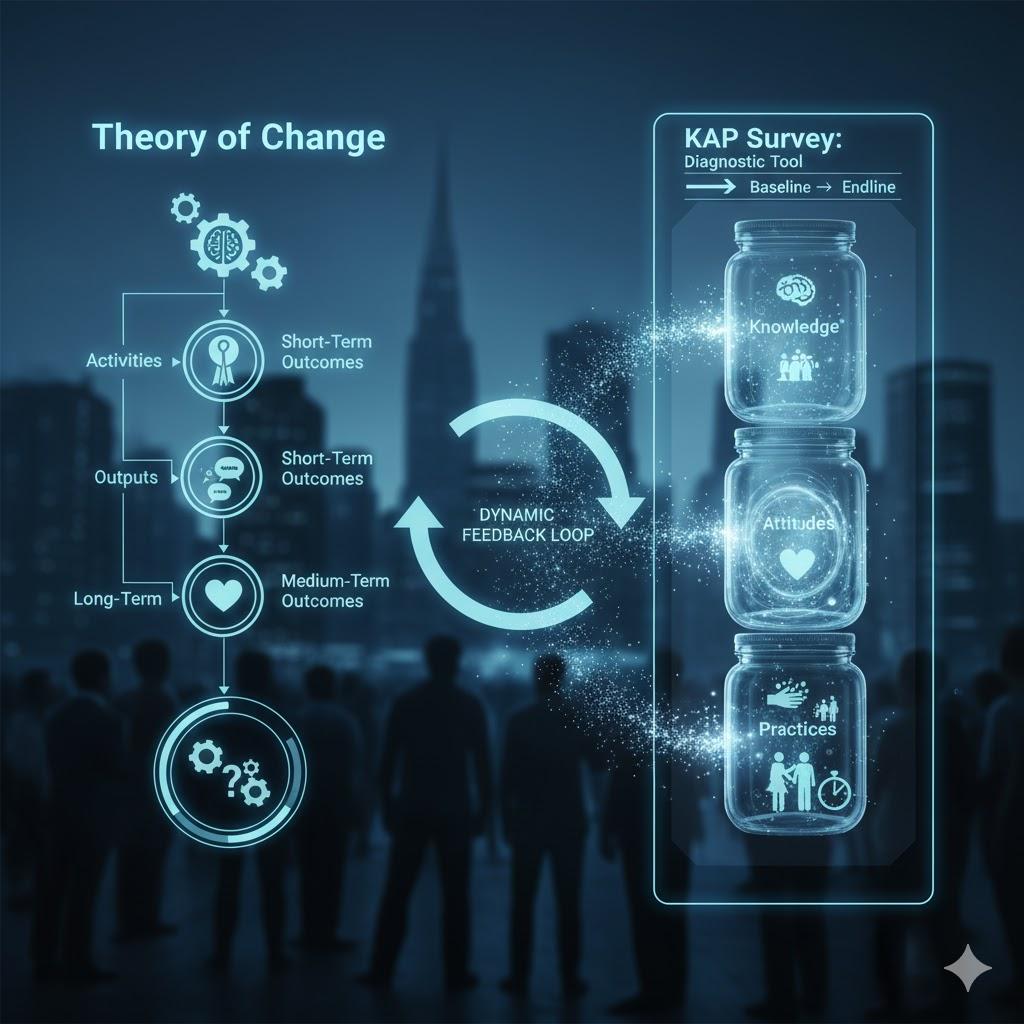
A Theory of Change is essentially your program's strategic map. It moves beyond a simple list of activities and goals to articulate the causal pathway of how you believe change will happen. It visualizes the entire "if-then" logic: if we conduct these activities, then we will produce these outputs, which will then lead to these short-term outcomes, which will then contribute to these medium-term outcomes, ultimately resulting in our long-term impact. This map is built not just on logic but on a set of critical assumptions but the conditions you believe must be true for your chain of causality to hold. For instance, a program might assume, "If people know that handwashing prevents disease, they will wash their hands."
The KAP Survey: Your Diagnostic Tool
A KAP survey, on the other hand, is your primary diagnostic tool. It is designed to precisely measure the three elements that are the bedrock of human behavior change. It captures Knowledge (what people know), Attitudes (what they believe, feel, or value), and Practices (what they actually do). When you deploy a baseline KAP survey, you are taking a snapshot of the starting line. When you deploy an endline survey, you are measuring the distance traveled. It provides the empirical evidence of what has—or has not—shifted within your target community.
Connecting the Dots: Where KAP Fits the Causal Pathway
The link between these two tools is not just convenient; it is essential. The components of a KAP survey map perfectly onto the most critical, yet often hardest to measure, part of a Theory of Change: the outcomes. Your ToC's short-term outcomes are almost always changes in Knowledge and Attitudes. For example, your program's activities (like workshops or media campaigns) are designed to first increase participants' knowledge about a topic and then shift their attitudes to be more favorable toward a new idea. In contrast, your medium-term outcomes are the holy grail of behavior change: the adoption of new Practices. This direct alignment means your KAP survey is no longer just a separate M&E activity; it is the primary instrument for validating your ToC's causal pathway.
From Assumption to Evidence: Using KAP to Test Your Logic
This integration is most powerful when it's used to test your ToC's assumptions. Let's return to the assumption: "If people know handwashing is good, they will do it." A KAP survey gives you the data to scientifically test this. What if your survey reveals that Knowledge is high (90% of people know handwashing is important) but Practice is low (only 30% do it regularly)? This is a game-changing insight. It proves your initial assumption was wrong. Your ToC's logic is broken. But this isn't a failure; it's a vital discovery. It tells you to stop investing in awareness (Knowledge) and start investigating the real barriers to Practice; perhaps a lack of access to soap and water, a conflicting social norm, or a simple lack of convenience.
Creating a Dynamic Feedback Loop for Real-Time Adaptation
Ultimately, linking your KAP survey to your ToC transforms your entire approach to program management. It creates a dynamic feedback loop for learning and adaptation. Your baseline KAP data should inform the initial design of your ToC, ensuring it's grounded in reality. Your mid-term and endline KAP data are then used to monitor and validate that ToC as you go. This turns your ToC from a static, framed document on the wall into a living, breathing strategic tool that can be course-corrected in real-time. It allows you to move beyond "bean counting" (e.g., "we held 50 workshops") and truly measure what matters: "Our workshops successfully shifted attitudes, which led to a measurable change in community practice."
References
World Health Organization (WHO). (2008). Advocacy, communication and social mobilization (ACSM) for TB control: A guide to developing KAP surveys.
Rogers, P. (2014). Theory of Change. Methodological Briefs: Impact Evaluation 2. UNICEF Office of Research.
USAID Learning Lab. (2018). Developing a Theory of Change: A Technical Guide. U.S. Agency for International Development.