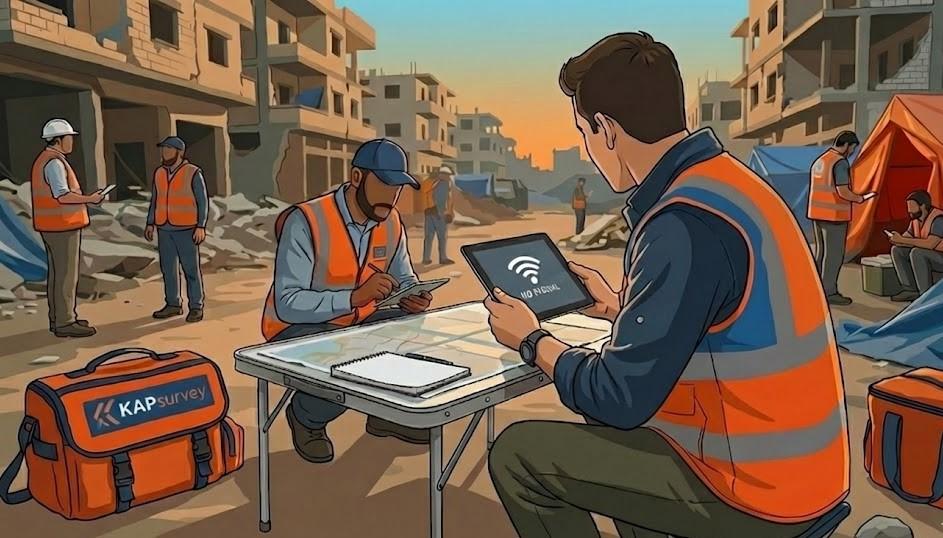
How Offline Data Integration is the Backbone of Modern Humanitarian Aid
In an era where digital tools drive everything from logistics to needs assessments, humanitarian aid has become increasingly dependent on connectivity. Yet, as recent history demonstrates, the very networks responders rely on are often the first casualties of conflict. This vulnerability has turned offline data integration, the ability to collect, store, and structure data without an internet connection for later synchronization from a technical convenience into an operational necessity.
The "online–offline bridge" is no longer optional; it is the difference between paralysis and action.
The Cost of Visibility Breakdowns
The humanitarian sector operates in some of the world’s most unstable environments, where infrastructure is fragile and targeted. The Gaza crisis in 2025 serves as a stark, vivid example of the dangers posed by relying solely on cloud-based systems. When the United Nations reported a “complete collapse of internet and data services” in June 2025, the consequences were immediate and severe.
Without an offline contingency, the flow of information stopped. As noted by OCHA (2025), the blackout effectively paralyzed aid operations because responders could not receive field assessments or track displacement. The information vacuum meant that:
- Needs remained unverified: Vital supplies could not be matched to specific locations because data could not travel from the field to the hub.
- Communities were cut off: As the ICRC (2025) observed, the loss of connectivity deprived civilians of life-saving information, such as evacuation routes and service availability.
- Response time lagged: By the time connectivity returned, the data gap had already deepened the crisis.
These events illustrate that when data cannot move, aid cannot move effectively.
The Buffer Against Chaos
Offline data integration acts as a critical buffer between the chaotic reality of the field and the coordination needs of headquarters. Flexible data-collection platforms and survey tools such as KAPsurvey, are designed to bridge this gap. They allow field teams to continue gathering structured information beneficiary feedback, health assessments, and monitoring data regardless of network status.
The importance of this capability lies in continuity. With tools like KAPsurvey, the "digital layer" of the operation does not collapse when the physical network fails. Field workers can capture data on a tablet or phone, storing it securely on the device. Once the team reaches a zone with connectivity, that data automatically syncs to shared platforms.
Why Integration Matters
The value of this integration extends beyond just "saving data." It fundamentally reshapes the quality of the response:
- Preserving Accuracy and Accountability: In the absence of offline tools, responders often revert to paper notes or memory, which are prone to loss and error. Digital offline tools ensure that data remains structured and verifiable, maintaining accountability even in blackouts.
- Reducing Latency: Instead of waiting for the internet to return before starting assessments, teams can work continuously. The moment the network is restored, the data is ready for analysis, drastically reducing the lag between assessment and action.
- Ensuring Equity: The most vulnerable populations often live in the least connected areas. If aid relies strictly on online tools, these communities become invisible to the system. Offline capabilities ensure that data from "dark zones" is captured and integrated into the broader response.
Conclusion
The experience of Gaza in 2025 proved that information vacuums can be just as deadly as physical supply shortages. In a landscape defined by unpredictable operating environments, the ability for data to survive temporary outages is essential. By adopting robust offline data integration strategies and utilizing flexible tools like KAPsurvey, humanitarian organizations can ensure that even when the lights go out, their visibility and their ability to act remains intact.
References
OCHA (2025). Gaza Humanitarian Response Update | 8–21 June 2025. United Nations Office for the Coordination of Humanitarian Affairs – occupied Palestinian territory. Jerusalem.





