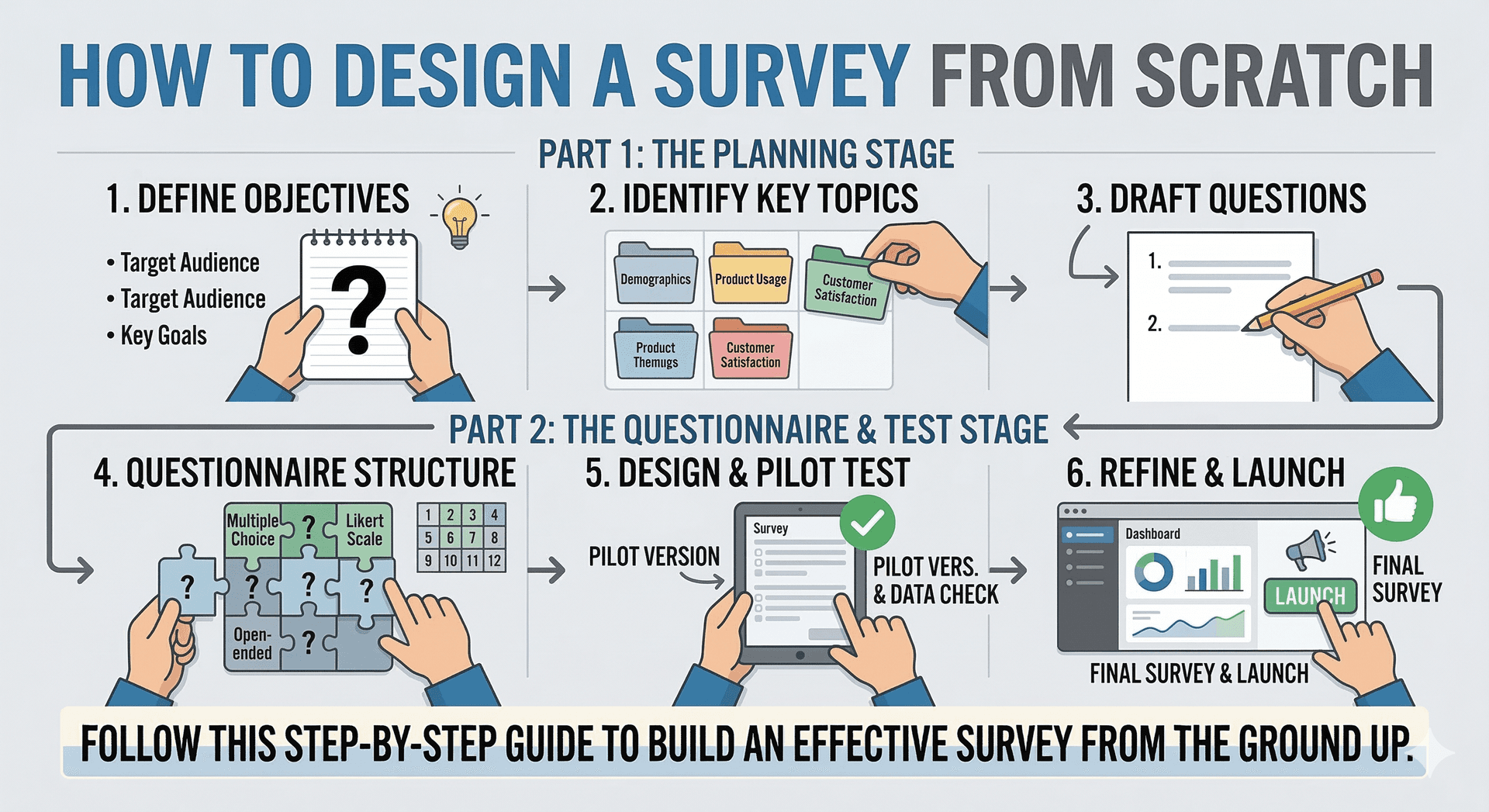
Whether you're measuring community health outcomes, evaluating a programme's impact, or understanding beneficiary needs, a well-designed survey is one of the most powerful tools in your research toolkit. Yet many surveys fail before the first response is collected — not because the questions are wrong, but because the design process was rushed.
This guide walks you through every stage of survey design, from clarifying your goals to delivering a questionnaire your respondents will actually complete. Follow these steps and you'll collect data that's clean, credible, and genuinely useful.
Step 1: Define Your Research Objectives
Before writing a single question, get crystal clear on why you're conducting this survey. Vague objectives produce vague data — and vague data leads to poor decisions.
Ask yourself:
• What specific decision or action will this data inform?
• Who are the stakeholders, and what do they need to know?
• What is the minimum information required to answer the research question?
Good objective example: "Measure the percentage of households in the target community with access to clean water within 500 metres of their home, disaggregated by gender of household head."
Weak objective example: "Understand water access in the community."
A precise objective acts as a filter throughout the design process. Every question you add should map directly to an objective. If it doesn't, cut it.
Step 2: Identify Your Target Population and Sampling Strategy
Who are you surveying, and how will you reach them? These two questions determine the validity and reliability of your findings.
Define Your Population
Be specific about who qualifies as a respondent. For example, 'all adults' is too broad — 'adults aged 18–60 who have received services from the programme in the past 12 months' is workable.
Choose a Sampling Method
• Random (probability) sampling: Every eligible person has an equal chance of selection. Best for generating statistically generalizable findings.
• Purposive sampling: Deliberately select participants who meet specific criteria. Common in qualitative or exploratory NGO research.
• Convenience sampling: Use available respondents. Fast and low-cost, but introduces selection bias — use with caution and acknowledge the limitation.
💡 Practical tip: For most field surveys, aim for a minimum sample size of 100–200 respondents per subgroup you plan to analyse separately. Use a sample size calculator (many are free online) to determine the right number based on your population size, confidence level, and acceptable margin of error.
Step 3: Choose Your Survey Mode
The way you deliver your survey affects how questions should be written, how long it can be, and who you'll actually reach.
• Paper / face-to-face: Essential in low-literacy settings or areas with limited connectivity. Allows enumerators to clarify questions but introduces interviewer bias.
• Online (e.g. KAPsurvey, KoBoToolbox, ODK, Google Forms): Fast, scalable, and free or low-cost. Requires respondents to have device access.
• Phone / SMS: Useful for reaching dispersed populations. Keep surveys short — ideally under 10 minutes.
• Mixed-mode: A combination of methods. Increases reach but can introduce inconsistency; use identical question wording across modes.
Step 4: Draft Your Questions
This is where most survey design mistakes happen. Good questions are clear, neutral, and answerable by your target population without confusion.
Question Types to Know
• Closed-ended (multiple choice, yes/no, Likert scale): Easier to analyse; best for quantitative data.
• Open-ended: Captures nuance and unexpected insights; requires more coding effort during analysis.
• Ranking questions: Useful for understanding priorities, but cognitively demanding — use sparingly.
• Matrix / grid questions: Efficient for multiple items on the same scale, but can cause respondent fatigue.
Core Rules for Writing Good Questions
• One idea per question: Avoid double-barrelled questions like 'Was the training useful and well-organised?' Split into two.
• Use plain language: Write at the reading level of your respondents. Avoid jargon, acronyms, and technical terms unless your audience is specialist.
• Avoid leading questions: 'How much did you benefit from the programme?' assumes benefit. Better: 'To what extent, if any, did the programme benefit you?'
• Offer exhaustive and mutually exclusive response options: Response categories shouldn't overlap, and there should always be an option that applies to every respondent (including 'Not applicable' or 'Prefer not to say' where relevant).
• Be specific about time frames: 'In the past 30 days, how many times did you...?' is far more reliable than 'How often do you usually...?'
⚠️ Watch out for: Social desirability bias — respondents answering how they think they should, rather than the truth. This is especially common in NGO evaluations where beneficiaries feel pressure to give positive feedback. Anonymity, neutral wording, and enumerator training all help reduce this.
Step 5: Structure Your Questionnaire
A survey is not just a list of questions — it's an experience for your respondent. Structure it to maintain engagement and reduce error.
• Start with easy, non-sensitive questions: Build rapport before asking about income, health, or opinions.
• Group questions by topic: Use logical sections (e.g., Demographics → Programme Experience → Outcomes) so respondents aren't jumping between unrelated topics.
• Place sensitive or demographic questions last: Asking age, income, or gender at the end reduces early drop-out.
• Use skip logic carefully: If respondents who answered 'No' to question 4 should skip to question 8, make this explicit — both in digital tools and paper versions.
• Keep it as short as possible: Every additional minute of survey length increases drop-out and reduces data quality. Ruthlessly cut questions that aren't linked to your objectives.
A good rule of thumb: a well-structured survey for NGO field use should take no more than 20–25 minutes to complete. For online surveys with voluntary respondents, aim for under 10 minutes.
Step 6: Pilot Test Your Survey
Never skip the pilot. A survey that makes perfect sense to you may be confusing, offensive, or unanswerable to your respondents.
Run a small pilot test (5–15 respondents from your target population) and look for:
• Questions that are misunderstood or interpreted differently by different people
• Response options that don't cover all situations
• Questions that feel intrusive or cause discomfort
• The actual time taken to complete the survey
• Technical issues in digital surveys (logic errors, display problems on mobile)
After the pilot, revise your questionnaire before full deployment. Document every change you make and why — this is part of good research practice.
Step 7: Plan for Data Quality and Ethics
Data quality doesn't happen by accident. Build in safeguards from the start.
Data Quality Checks
• Train enumerators thoroughly if using field surveyors — inconsistent administration is a major source of error.
• Build in validation rules in digital tools (e.g., age must be between 0–120; required fields cannot be blank).
• Conduct back-checks on a random subset of completed interviews to verify data integrity.
Ethical Considerations
• Obtain informed consent: Explain the purpose of the survey, how data will be used, and that participation is voluntary.
• Protect respondent privacy: Anonymise data where possible. Never collect identifying information you don't need.
• Consider harm: Some questions — particularly around trauma, conflict, or sensitive health topics — can cause distress. Have a referral pathway in place.
• Follow your organisation's data protection policy and relevant national regulations (e.g., GDPR if collecting data from EU residents).
📋 Quick checklist before you launch: Objectives are specific and measurable ✓ | Questions map to objectives ✓ | Language is appropriate for the audience ✓ | No double-barrelled or leading questions ✓ | Response options are exhaustive and mutually exclusive ✓ | Pilot test completed and revisions made ✓ | Consent process in place ✓ | Data storage and security plan confirmed ✓
Bringing It All Together
Designing a good survey is equal parts science and craft. The science lies in sampling, measurement, and statistical rigour. The craft lies in writing questions that real people can understand and answer honestly.
For NGOs and researchers working in the field, the stakes are high. The data you collect will shape programmes, influence funders, and ultimately affect the communities you serve. Investing time in thoughtful survey design — rather than rushing to the field with an untested questionnaire — is one of the highest-return activities in any research project.
Start with clear objectives, design with your respondent in mind, test before you deploy, and protect the people who give you their time and trust. Do those things, and your data will be worth acting on.