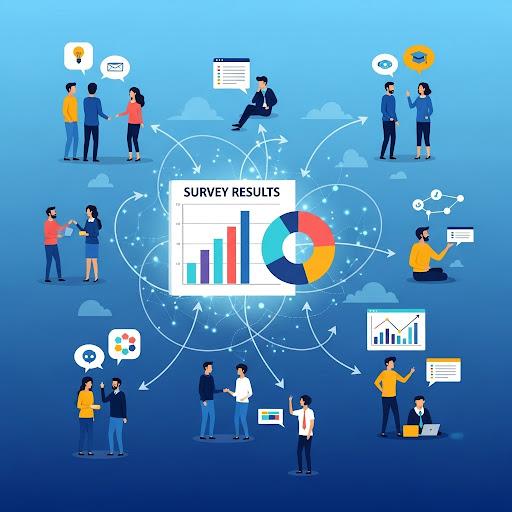
Social Learning
In our data-driven world, surveys are ubiquitous. From quick customer satisfaction polls to in-depth national censuses, we are constantly asked to quantify our opinions, experiences, and behaviors. While often viewed simply as tools for data collection; a snapshot of public opinion at a single moment; their true power lies in their ability to act as catalysts for social learning. When the results of a survey are shared, they don't just inform; they reflect our collective selves back to us, creating a dynamic process of reflection, conversation, and adaptation. Social learning, at its core, is learning from others by observing, imitating, and modeling their behaviors and attitudes. Survey results provide a unique, large-scale mechanism for this fundamental human process to unfold.
Establishing Social Norms and Benchmarks
One of the most powerful ways survey results drive social learning is by illuminating social norms. Humans are inherently social creatures, and we often look to others for cues on how to act, especially in situations of uncertainty. This principle, known as social proof, suggests that we tend to view a behavior as more correct if we see others performing it. Surveys are a formal mechanism for revealing this collective behavior.
For example, a municipal survey might reveal that 85% of residents in a particular neighborhood regularly sort their waste for recycling. For an individual who has been skeptical or complacent about recycling, this statistic does more than convey information; it establishes a powerful community norm. The knowledge that the vast majority of their peers are engaged in this behavior can motivate them to adopt it, not necessarily through force, but through a desire to align with the community standard.
In an organizational context, employee engagement surveys serve a similar function. When an employee sees that their positive experience of the company culture is shared by 90% of their colleagues, it validates their feelings and reinforces their commitment. Conversely, if they discover their dissatisfaction is an outlier, it may prompt them to reconsider their perspective. These results provide a benchmark against which individuals measure their own experiences, learning where they stand in relation to the group.
Challenging Assumptions and Fostering Dialogue
Survey results are not always predictable; they often reveal surprising truths that challenge our deeply held assumptions. This element of surprise is a critical trigger for social learning, as it forces us to question our understanding of the world and engage in dialogue to make sense of the new information. A company might believe its key demographic is young adults, only for a market survey to show that its most loyal customers are senior citizens. This single piece of data can shatter the organization's self-concept, sparking critical conversations about its marketing, product design, and brand identity.
This process is equally relevant in the public sphere. A survey on local community priorities might reveal that while leaders assumed traffic congestion was the top concern, the majority of residents are actually more worried about the lack of green spaces. Such a finding brings a hidden consensus to light, challenging the official narrative and forcing a public dialogue. This conversation; in town halls, on social media, and in local newspapers is a form of collective learning, where a community re-evaluates its priorities and moves toward a more accurate, shared understanding of its own needs and desires. Without the survey data, these individual, unspoken preferences might have remained fragmented and invisible.
Creating a Shared Frame of Reference
A key challenge in any group, from a small team to an entire nation, is discussing complex issues without a common foundation. Individual experiences are subjective and anecdotal. Surveys overcome this by aggregating thousands of subjective inputs into a single, quantified dataset. This creates a shared frame of reference which is a common set of facts that can anchor a conversation.
Consider national surveys on topics like economic confidence or trust in institutions. When results are published showing that "economic optimism has fallen by 15 points," that statistic becomes a focal point in the national discourse. It is cited by journalists, debated by policymakers, and discussed by the public. It provides a common language to talk about a complex and diffuse social mood. This allows the conversation to move from a collection of personal anecdotes ("I feel worried about the economy") to a discussion of a collective reality ("We, as a society, are demonstrably more pessimistic"). This shift is crucial for productive problem-solving and allows a society to learn about its own evolving values and concerns.
Driving Behavioral and Policy Adaptation
Ultimately, social learning is meaningful when it leads to a change in behavior. Survey results often provide the impetus for this change, both at the individual and institutional levels. By clearly highlighting a problem or a gap between perception and reality, the data creates pressure for action.
A university that conducts a student well-being survey and discovers alarming rates of anxiety is compelled to act. The data legitimizes the problem and provides a mandate for introducing new mental health services or academic support systems. This is a form of organizational learning, where the institution adapts its practices in response to the measured needs of its community. This process often creates a feedback loop: new policies are implemented, and their effectiveness is measured in subsequent surveys, leading to a continuous cycle of learning, adaptation, and improvement.
In essence, surveys transform isolated opinions into a powerful collective voice. By revealing what we think, do, and want as a group, they establish norms, challenge our assumptions, and provide the common ground necessary for dialogue and change. They are not merely static reports but dynamic instruments that enable us to learn about, and from each other, paving the way for a more responsive and informed society.
References
Bandura, A. (1977). Social Learning Theory. Prentice Hall.
Cialdini, R. B. (2007). Influence: The Psychology of Persuasion. Collins.
Fowler, F. J. (2013). Survey Research Methods. Sage Publications.





