Built for organizations that need both control and flexibility — KAPsurvey's Workspaces, role-based permissions, templates, and collaboration tools make the hybrid governance model a practical reality.
Every organization running surveys at scale eventually confronts the same tension: the need for centralized control and the demand for departmental freedom. As explored in our previous analysis of centralized versus decentralized governance models, neither extreme is ideal on its own. The real question for business leaders is not which model to choose — it is which platform can support the hybrid approach that modern enterprises actually need.
KAPsurvey is a cloud-based survey platform designed with this organizational reality in mind. Rather than forcing teams into a rigid top-down structure or leaving them to operate in silos, KAPsurvey provides an architecture that enables a coordinated, enterprise-grade survey program one where a central team can set standards while individual departments retain the autonomy to execute on their own terms.
This article explores how four core KAPsurvey features Workspaces, User Roles and Permissions, Survey Templates, and Collaboration Tools directly address the governance challenges that enterprises face.
Workspaces: Departmental Independence Without the Chaos
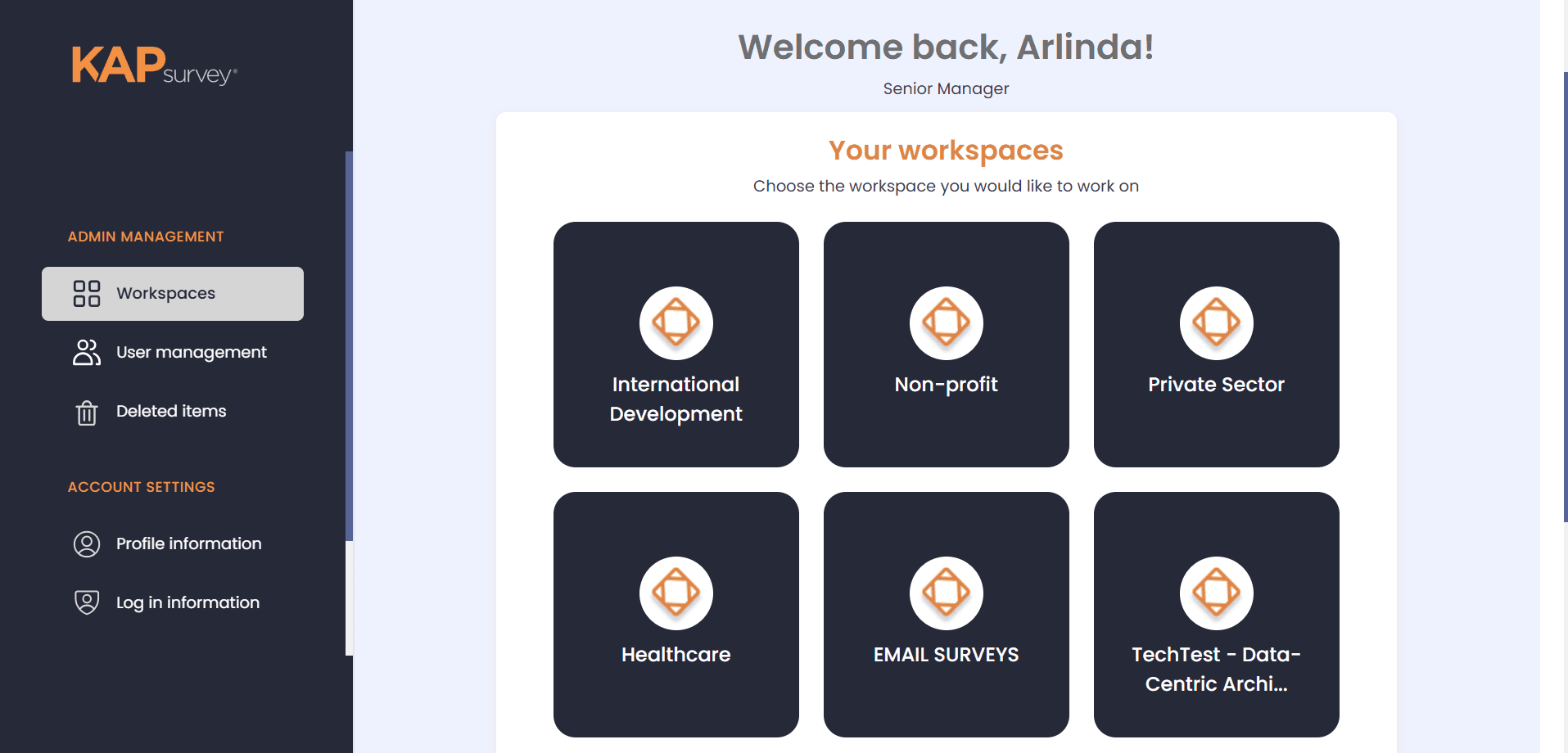
The Workspace is KAPsurvey's foundational unit of organization — and its most powerful governance feature. Each Workspace functions as a self-contained environment for a team, department, or business unit. HR, Customer Experience, Product, Marketing, and Finance can each operate in their own Workspace, with their own surveys, contacts, data, and reports — completely separate from one another.
This directly mirrors the decentralized model discussed in our governance analysis: departments gain genuine autonomy over their survey programs. A customer success manager in the CX Workspace does not need to submit a request to a central queue, wait for approval, or adapt their methodology to suit another team's standards. They can design, deploy, and analyze their surveys on their own timeline.
Real-World Example
Consider a mid-size financial services firm with four active survey programs: an annual employee engagement census (HR), a quarterly NPS tracker (CX), a post-implementation IT satisfaction survey (IT), and a regional client feedback initiative (Sales). In KAPsurvey, each of these teams operates in its own dedicated Workspace. Their data never mingles, their schedules never clash, and their methodologies are tailored to their specific context — while the central People Analytics team retains visibility across all four via an administrator-level view.
Crucially, Workspaces do not mean total fragmentation. KAPsurvey's organizational hierarchy allows a central administrator to see across all Workspaces, set platform-wide standards, and intervene where necessary — without disrupting day-to-day departmental operations. This is the hybrid model made operational: structured independence, not ungoverned autonomy.
The practical benefits of Workspace separation extend to data privacy as well. Because each Workspace operates as a distinct data environment, respondent data collected by HR is not accessible to Sales, and vice versa. This built-in data segregation simplifies GDPR and CCPA compliance significantly, reducing the risk of inadvertent cross-functional data exposure that plagues loosely governed decentralized programs.
User Roles and Permissions: The Governance Layer That Travels with Every User
One of the most persistent failure modes in enterprise survey programs whether centralized or decentralized is unclear accountability. When anyone can edit a live survey, publish without review, or access raw respondent data, quality and compliance suffer. KAPsurvey's role-based permission system is designed to eliminate this ambiguity.
Within each Workspace, administrators can assign granular roles that define exactly what each user can see, create, edit, approve, and publish. A typical enterprise deployment might include:
• Workspace Admins — full control over the Workspace: create and delete surveys, manage members, access all data, configure integrations.
• Survey Editors — can build and modify surveys within the Workspace but cannot publish without approval from an admin.
• Viewers / Analysts — read-only access to results and dashboards; cannot alter survey content or see raw respondent-level data.
• Collaborators — can comment on surveys and contribute to question design in draft mode, without touching live instruments.
This layered permission structure solves a problem that many organizations discover too late: in a purely decentralized model, the freedom given to departments often extends further than intended, with junior team members inadvertently publishing poorly designed surveys or accessing sensitive data they were never meant to see.
At the platform level, a Global Administrator typically a member of the central governance function can manage Workspace creation, enforce platform-wide settings, and audit activity across all departments. This means the central team retains meaningful oversight without needing to be operationally involved in every survey that goes out the door. It is governance by guardrail, not by bottleneck.
Governance Insight
Role-based permissions allow organizations to operationalize the principle of 'minimum necessary access' — a core tenet of both good data governance and regulatory compliance. Teams get exactly the access they need to do their jobs well, and no more.
Survey Templates: Standardization That Empowers Rather Than Constrains
One of the strongest arguments against decentralization is methodological inconsistency different teams writing questions in different ways, using different scales, and producing data that cannot be meaningfully compared. KAPsurvey's Template Library directly addresses this risk without sacrificing departmental ownership.
Central teams or KAPsurvey's own library of professionally designed instruments can publish approved survey templates to the platform. These templates serve as validated starting points: pre-tested question wording, proven scale choices, and logical survey flows that reflect measurement best practices. Departments can use these templates as-is or adapt them within defined parameters, rather than building from scratch every time.
For organizations with multiple departments measuring similar constructs employee experience, vendor satisfaction, post-training effectiveness shared templates create the methodological consistency needed for cross-functional benchmarking. If every department uses the same five-question onboarding experience survey, the central People Analytics team can, for the first time, compare onboarding quality across business units with confidence.
📋 Centrally Managed Template Library
HR publishes a validated employee wellbeing pulse survey template. Each business unit deploys it in their own Workspace on their own schedule same questions, same scale, local ownership. At quarter-end, the central team aggregates results across all units for an enterprise-wide view.
🎨 Customizable by Design
Templates in KAPsurvey are not rigid scripts. Departments can add contextual questions relevant to their team, localize language for regional audiences, and adjust branding all within the structural framework the central team has established. Freedom within form.
Templates also dramatically reduce the time and expertise required to launch a quality survey. A regional Sales manager who is not a research professional can deploy a methodologically sound customer satisfaction survey in minutes, rather than spending hours trying to design one from scratch or, worse, sending out a poorly constructed instrument that yields unusable data.
Collaboration Tools: Closing the Loop Between Departments and the Centre
Perhaps the most underappreciated feature set in any enterprise survey platform is the ability to collaborate across roles and teams during the survey design and review process. KAPsurvey builds collaboration directly into the survey workflow, making it easy for central governance teams and departmental owners to work together — not just alongside each other.
Draft surveys can be shared for review before publication, with collaborators able to leave inline comments on specific questions, flag concerns about wording or sensitivity, and suggest alternatives — all without modifying the live instrument. This creates a lightweight peer-review process that catches problems before they reach respondents.
For organizations that want to maintain a central review step without creating a bottleneck, KAPsurvey's collaboration model is particularly effective. The CX team drafts their quarterly client survey in their Workspace, shares a review link with the central Insights team, who adds comments and approves — all within the platform, without email chains or version-control confusion. The departmental team retains ownership; the central team exercises oversight. This is the hybrid governance model in practice.
Why This Matters for Governance
Collaboration tools transform the central survey governance team from a gatekeeper a point of friction into a centre of excellence. Instead of blocking surveys in a queue, they add value through review, guidance, and cross-functional synthesis. Departments move faster; the organization maintains quality. Everyone wins.
Shared dashboards and report-sharing features extend collaboration beyond the design phase into the insight phase. When survey results are published, relevant stakeholders senior leaders, cross-functional partners, or the central analytics team can be given view access to results in real time, eliminating the weeks-long reporting lag that often afflicts centralized programs.
The Bottom Line: A Platform Built for How Organizations Actually Work
The governance debate between centralization and decentralization is ultimately about control versus agility and KAPsurvey is built around the insight that modern organizations need both. Its Workspace architecture gives departments genuine independence. Its role-based permissions give central teams meaningful oversight. Its template library creates methodological consistency without stifling local adaptation. And its collaboration tools turn potential friction between central and departmental teams into a productive, value-adding exchange.
For organizations still running survey programs through a patchwork of departmental SurveyMonkey accounts, shared email inboxes, and spreadsheet trackers, KAPsurvey represents a structural upgrade not just in tooling, but in governance maturity. It provides the infrastructure for a hybrid model that most organizations aspire to but struggle to operationalize.
Whether your organization is just beginning to formalize its survey program or looking to scale an existing one across a complex enterprise, KAPsurvey's architecture ensures that the choice between control and freedom does not have to be a trade-off. With the right platform, it can be both.





