What drives change?
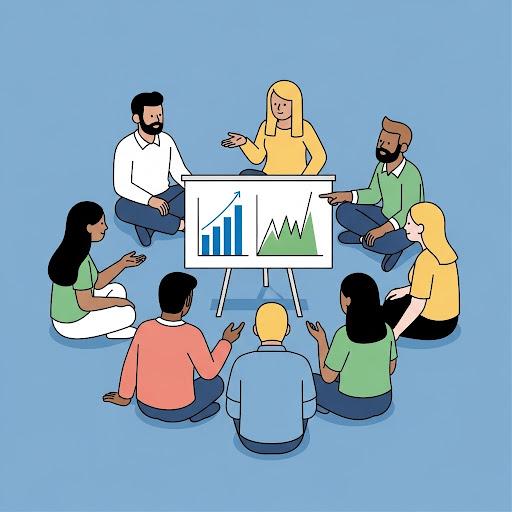
The silence in the community hall is heavy. A well-meaning project officer has just finished a detailed presentation on a new public health initiative. Everyone nods politely, but a familiar question hangs in the air: Will anything actually change? This gap between information and implementation is the persistent puzzle of community development. For decades, the go-to tool for understanding this gap has been the KAP survey. This form of assessment is designed to map what people Know, how they feel (Attitudes), and what they do (Practices). But its true power isn't just in the initial data collection; it's in using the results to spark powerful, community-wide social learning.
From Static Data to a Dynamic Dialogue
Traditionally, the KAP methodology is seen as a linear process. An organization conducts a KAP assessment to gather baseline data, analyze it, and then design a program. The entire process, from the initial KAP design and sampling to the final report, is treated as a diagnostic tool. However, this approach often reveals the "KAP gap"; the frustrating reality where communities possess the right knowledge but fail to adopt the desired practice. As researchers have pointed out, the simple KAP framework may not tell the whole story, often overlooking complex social factors.
The solution lies in understanding a fundamental truth about human nature, best explained by Social Learning Theory. We are inherently social creatures. We learn our most important behaviors not from pamphlets, but by observing and modeling the people around us. The critical insight is this: the results of a community survey, when shared as KAP feedback, can actively reshape the social environment. The KAPsurvey data itself becomes a tool for triggering the very social learning processes needed to close the gap.
Revealing Collective Truths: The Power of Social Norms
One of the most powerful forces governing our behavior is social norms; the unwritten rules of what is acceptable. We often act based on perceived norms (what we think everyone else believes), which can be wildly inaccurate. A phenomenon known as "pluralistic ignorance" can take hold, where most people in a group privately reject a norm but go along with it because they think everyone else accepts it.
This is where a KAP survey becomes a powerful agent for change. The carefully crafted KAP questions within the KAP questionnaire are designed to uncover these private beliefs. Imagine a program finds that many people privately support mental health initiatives but hesitate to speak up, assuming it's a cultural taboo. When the KAP survey data collection is complete and the results are shared in a public forum, the data might reveal that 70% of the community actually believes seeking mental health support is a sign of strength.
This revelation is transformative. It shatters the collective illusion, providing powerful social proof that validates what people already believed privately. It reduces the fear of judgment and establishes a new, accurate social norm. The KAP survey didn't teach anyone a new fact; it simply made the invisible, visible.
Identifying and Elevating Local Champions
Within any community, there are always "positive deviants"; people who, despite facing the same barriers, are already succeeding. The KAP implementation is unparalleled in its ability to systematically identify these local champions. Modern KAP Survey Tools, including KAPsurvey Mobile platforms, make this KAPsurvey collection process more efficient, helping to pinpoint these crucial individuals quickly.
These local champions are the most effective role models. Unlike an external expert, they are relatable, and their success feels achievable. When a survey identifies a local farmer named Maria who has tripled her yield using simple water conservation methods, her story becomes a practical lesson.
Sharing her story; identified through the KAPsurvey data analytics which is a direct application of social learning. It provides a real-world blueprint for action and, crucially, builds self-efficacy. When her neighbors see her success, their thinking shifts from "That's a nice idea" to "If Maria can do it, so can I." This belief in one's own ability is often the final ingredient needed to turn a positive attitude into practice.
Providing Undeniable Proof of Success
Finally, social learning is supercharged by vicarious reinforcement-the motivation from observing others receive rewards for their behavior. The KAPsurvey collect phase shouldn't just ask what people do, but also capture the positive outcomes they experience.
The power is in the KAP feedback. The results, when analyzed, provide undeniable proof that the desired practice works. The report doesn't just say, "Maria uses water conservation." It says, "Our KAP survey data analytics show that the few families using these methods reported 50% lower water bills and had consistently healthier crops during the dry season." This tangible, quantified success is a far more compelling argument than any lecture. It makes the benefits clear and desirable, motivating the community to follow the lead of its most successful members.
By moving from simple Data Collection to active community conversation, we unlock the true potential of the KAP methodology. The survey should be the start of a dialogue, not the end of a report.
Reference:
Launiala, A. (2009). How much can a KAP survey tell us about people's knowledge, attitudes and practices? Some observations from a study on malaria in the Lao People's Democratic Republic. Malaria Journal, 8(1), 36.