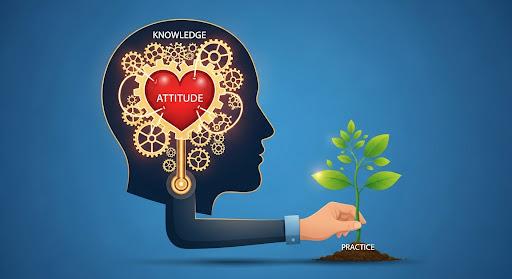
The Unseen Engine
The assumption is simple: if people know better, they will do better. Yet, time and again, we see a frustrating disconnect between what people know and what they actually do. A smoker knows the risks of lung cancer but continues to light up. A community understands the importance of clean water but doesn't consistently practice proper sanitation. This gap between knowledge and practice highlights a crucial, often underestimated, element in the equation of human behavior: attitude.
The Knowledge, Attitude, and Practice (KAP) model provides a valuable framework for understanding this dynamic. This model, widely used in public health and development, proposes a sequential relationship between these three elements. First, an individual or community gains knowledge about a particular issue. This knowledge then shapes their attitude, their beliefs, feelings, and predispositions towards that issue. Finally, this attitude influences their practice, or the actions they take. While this model has been critiqued for its linear simplicity, it effectively shines a spotlight on the pivotal role of attitude as the bridge; or barrier between knowing and doing.
The Power of Perspective: Attitude as a Behavioral Catalyst
Attitude is more than just a fleeting opinion; it's a complex and often deeply ingrained psychological construct. It's the lens through which we interpret information and the emotional engine that drives our decisions. A positive attitude towards a particular behavior, such as regular exercise, can be a powerful motivator. If someone genuinely believes that exercise is not only beneficial for their health but also enjoyable and a valuable use of their time, they are far more likely to incorporate it into their routine. Conversely, a negative attitude, perhaps viewing exercise as a chore, a waste of time, or something they are not capable of doing can create a significant barrier to action, regardless of their knowledge of its benefits.
This is where the KAP model becomes particularly insightful. It helps us understand why simply disseminating information is often not enough. A public health campaign that bombards a community with facts about the dangers of a high-sugar diet may increase knowledge, but it won't necessarily change eating habits. If the community's attitude towards sugary foods is one of comfort, cultural tradition, or convenience, this emotional connection will likely override the rational knowledge. To effect real change, interventions must also address these underlying attitudes. This might involve reframing healthy eating as a positive and enjoyable experience, highlighting its immediate benefits, or finding ways to integrate healthier options into existing cultural practices.
From Theory to Practice: Applying the KAP Model
The practical applications of the KAP model are vast. In healthcare, understanding a patient's attitude towards their treatment plan is crucial for adherence. A patient who is skeptical of a prescribed medication or feels it's an inconvenience is less likely to take it consistently. By assessing the patient's attitudes, healthcare providers can address their concerns, build trust, and foster a more positive outlook, ultimately improving health outcomes.
Similarly, in environmental conservation, understanding community attitudes towards issues like recycling or deforestation is essential for designing effective interventions. A community might know that deforestation is harmful, but if their attitude is one of economic necessity or a lack of personal responsibility, they are unlikely to change their practices. Conservation efforts must therefore go beyond simply providing information and work to foster a sense of stewardship and a belief that sustainable practices are both possible and beneficial.
Beyond the Linear Model: A More Nuanced View
While the KAP model is a powerful tool, it's important to recognize its limitations. Human behavior is rarely a simple, linear progression. Attitudes can be influenced by a multitude of factors beyond knowledge, including social norms, personal experiences, and economic circumstances. A person might have a positive attitude towards using public transportation but be unable to do so due to a lack of accessible routes. In this case, the barrier to practice is not attitudinal but structural.
Therefore, a more holistic approach is often needed, one that considers the broader context in which knowledge, attitudes, and practices are formed. This might involve combining the KAP model with other behavioral change theories and conducting qualitative research to gain a deeper understanding of the complex interplay of factors that influence human action.
Ultimately, the KAP model serves as a vital reminder that to change the world, we must do more than simply educate. We must also seek to understand and influence the intricate web of beliefs, feelings, and perspectives that shape our attitudes. It is in this unseen realm of the human mind that the true seeds of change are sown, and it is by nurturing these seeds that we can hope to close the gap between what we know and what we do, creating a healthier, more sustainable, and more equitable world for all.
References
World Health Organization. (2008). Advocacy, communication and social mobilization for TB control: a guide to developing knowledge, attitude and practice surveys. World Health Organization. https://iris.who.int/handle/10665/43790
Launiala, A. (2009). How much can a KAP survey tell us about people's knowledge, attitudes and practices? Some observations from medical anthropology research on malaria in pregnancy in Malawi. Anthropology Matters, 11(1).
Giri, P. A., Bangal, V. B., & Phalke, D. B. (2013). Knowledge and attitude of medical undergraduate, interns and postgraduate students in India towards emergency contraception. North American journal of medical sciences, 5(1), 37.