A Comprehensive Guide to Meaningful Insights
In the fields ranging from public health, international development, social change, etc., understanding a community is the first step toward empowering it. A KAP (Knowledge, Attitudes, and Practices) survey is one of the most powerful tools for gaining this understanding.
It provides a structured method to measure what people know, how they feel, and what they actually do regarding a specific issue.
However, the value of a KAP survey depends entirely on its design. A well-crafted survey can illuminate the path forward, while a poorly designed one can lead to confusing data, wasted resources, and misguided interventions.
Drawing from established best practices, like those outlined by the Food and Agriculture Organization (FAO), this guide will walk you through the essential steps to design a robust KAP survey that delivers clear, reliable, and actionable insights.
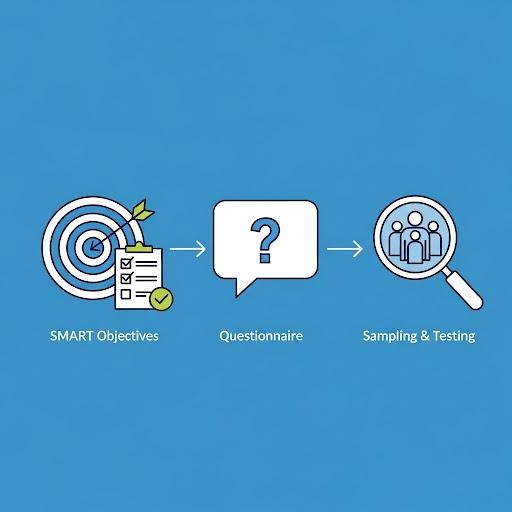
Start with SMART Objectives
The Foundation of Your Survey
Before writing a single question, you must define your objectives. This is the most critical phase, as your objectives will guide every decision you make. Vague goals lead to vague data. To ensure focus, your objectives should be SMART:
- Specific: Clearly state what you want to measure.
- Measurable: Define how you will quantify the knowledge, attitudes, or practices.
- Achievable: Ensure you have the resources (time, staff, budget) to meet the objective.
- Relevant: The objective must directly relate to your project's overall goals.
- Time-bound: Set a deadline for when the objective will be met.
For example, a weak objective might be "to learn about local hygiene." A SMART objective would be:
"To determine the percentage of households in District Y that can identify at least two critical times for handwashing, and to identify the top three perceived barriers to consistent handwashing by the end of the second quarter." This level of clarity ensures that every question you write has a distinct purpose.
Crafting Your Questionnaire
The Art and Science of Asking
With clear objectives, you can develop your questionnaire. This involves carefully structuring questions to measure knowledge, attitudes, and practices without introducing bias.
- Measuring Knowledge: These questions assess awareness and understanding. They can range from simple recall ("What are the main symptoms of malaria?") to recognition ("Which of the following are effective ways to prevent malaria?"). Be specific and avoid testing formal education unless it's relevant to your objective.
- Assessing Attitudes: This is often the most challenging part. Attitudes, beliefs, and opinions are subjective. To measure them effectively, use Likert scales (e.g., Strongly Agree, Agree, Neutral, Disagree, Strongly Disagree). It is vital to phrase these questions neutrally to avoid "social desirability bias," where respondents give answers they think you want to hear. For instance, instead of asking, "Do you agree that a balanced diet is good?" (which prompts a "yes"), ask, "For you, how important is it to have a balanced diet every day?"
- Investigating Practices: These questions are about behavior. Since self-reporting can be unreliable, it's crucial to be specific. Instead of asking, "Do you use a mosquito net?" ask, "Did you sleep under a mosquito net last night?" This focuses on a recent, specific action, reducing recall bias. For sensitive topics, ensure anonymity and build trust before asking direct questions.
- Questionnaire Structure: The flow of your survey matters. Start with simple, non-sensitive questions to build rapport. Group related questions into logical sections (e.g., all knowledge questions together). Place demographic questions (age, gender, education) at the end, as some people can find them intrusive at the beginning.
Reaching the Right People
Sampling and Field Testing
A survey's findings are only credible if they represent the target community accurately. Your sampling strategy is key. While complex methods exist, the goal is always to select a sample that is a miniature version of your total population. A random sample, where everyone has an equal chance of being selected, is often the gold standard for avoiding bias.
Once you have a draft questionnaire, it is absolutely essential to pre-test it. Administer the survey to a small group (10-20 people) from your target audience. This is not about collecting data; it's about testing the instrument itself. During the pre-test, look for:
- Are the questions clear and unambiguous?
- Are there any culturally sensitive or awkward phrases?
- How long does the survey take to complete? Is it too long?
- Do the answers you receive make sense and align with your objectives?
The feedback from a pre-test is invaluable. It is your best opportunity to fix confusing questions, adjust the flow, and ensure your data collectors (enumerators) are well-prepared.
Conclusion
A Strategic Tool for Evidence-Based Change
A well-designed KAP survey is more than a data collection exercise; it's a strategic process for engaging with a community and gathering the evidence needed to design effective programs. By investing time in developing clear objectives, crafting thoughtful questions, and rigorously testing your approach, you transform a simple questionnaire into a powerful tool for listening, learning, and ultimately, driving meaningful and sustainable change.
Reference
This article is based on the principles outlined in the Food and Agriculture Organization (FAO) of the United Nations publication, KAP Survey Model - Knowledge, Attitude and Practice. It can be accessed at: https://www.fao.org/4/i3545e/i3545e04.pdf