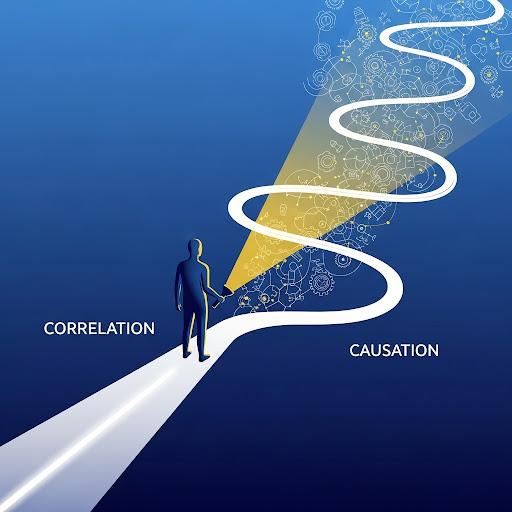
Seeing the Pattern
Correlation is simply a relationship or connection between two things. In data, it means that as one variable changes, another variable tends to change in a predictable way.
Imagine a KAP survey reveals that people with higher knowledge scores about the benefits of exercise also report practicing more physical activity. This is a positive correlation as knowledge goes up, exercise tends to go up. Conversely, you might find a negative correlation where higher knowledge about the dangers of smoking is linked to lower rates of tobacco use.
Finding a correlation is a great starting point. It signals that two factors are associated and are worth investigating further. The critical error is to stop there and assume that the knowledge caused the behavior. It’s like noticing that ice cream sales and drowning incidents both increase in the summer. The two are correlated, but one doesn't cause the other; a third factor, hot weather, causes both.
Causation: Finding the Driver
Causation means that one event is the direct result of another. To prove causation, you must demonstrate that a change in one variable produces a change in another, independent of other influences. This is a much higher standard of proof than correlation.
The main reason correlation doesn't imply causation is the presence of confounding variables. A confounder is a hidden third factor that influences both of the variables you are observing, creating a misleading association.
For example, a survey might show a strong correlation between attending financial literacy workshops and having higher personal savings.
- Correlation: Attending workshops is linked to more savings.
- Possible Confounder: The underlying cause might be personal motivation. Highly motivated individuals are more likely to seek out workshops and are also more disciplined about saving money. In this case, motivation is the true driver, not the workshop itself. The workshop is simply something that motivated people do.
Why the Distinction is Critical
Confusing correlation with causation isn't just an academic mistake; it leads to ineffective strategies and wasted resources.
Suppose an organization sees a correlation between positive attitudes toward recycling and high rates of household recycling.
- If they assume causation: They might launch a costly public awareness campaign to improve attitudes, believing this will automatically lead to more recycling.
- The reality: The true cause might be access to infrastructure. Neighborhoods with convenient, city-provided recycling bins have higher recycling rates, and the residents in those areas have subsequently developed positive attitudes because the practice is easy for them.
The awareness campaign would likely fail because it addresses a correlate (attitude) instead of the true causal factor (access). A more effective strategy would be to provide more recycling bins to other neighborhoods.
Conclusion
KAP surveys are incredibly valuable for generating hypotheses and understanding a community or feedback. They show us the connections, the correlations. However, they don't automatically explain the "why." To get to the root cause, we must think like scientists: question assumptions, look for confounding variables, and use more rigorous research methods when the stakes are high.
Remember, correlation shows us where to shine the spotlight, but causation is what we find when we investigate what's actually happening in the light.
References
Pearl, J., & Mackenzie, D. (2018). The Book of Why: The New Science of Cause and Effect. Basic Books.
Gordis, L. (2014). Epidemiology (5th ed.). Elsevier Saunders.
World Health Organization (2008). A Guide to Developing Knowledge, Attitude and Practice Surveys. WHO.





