🌍 Introduction
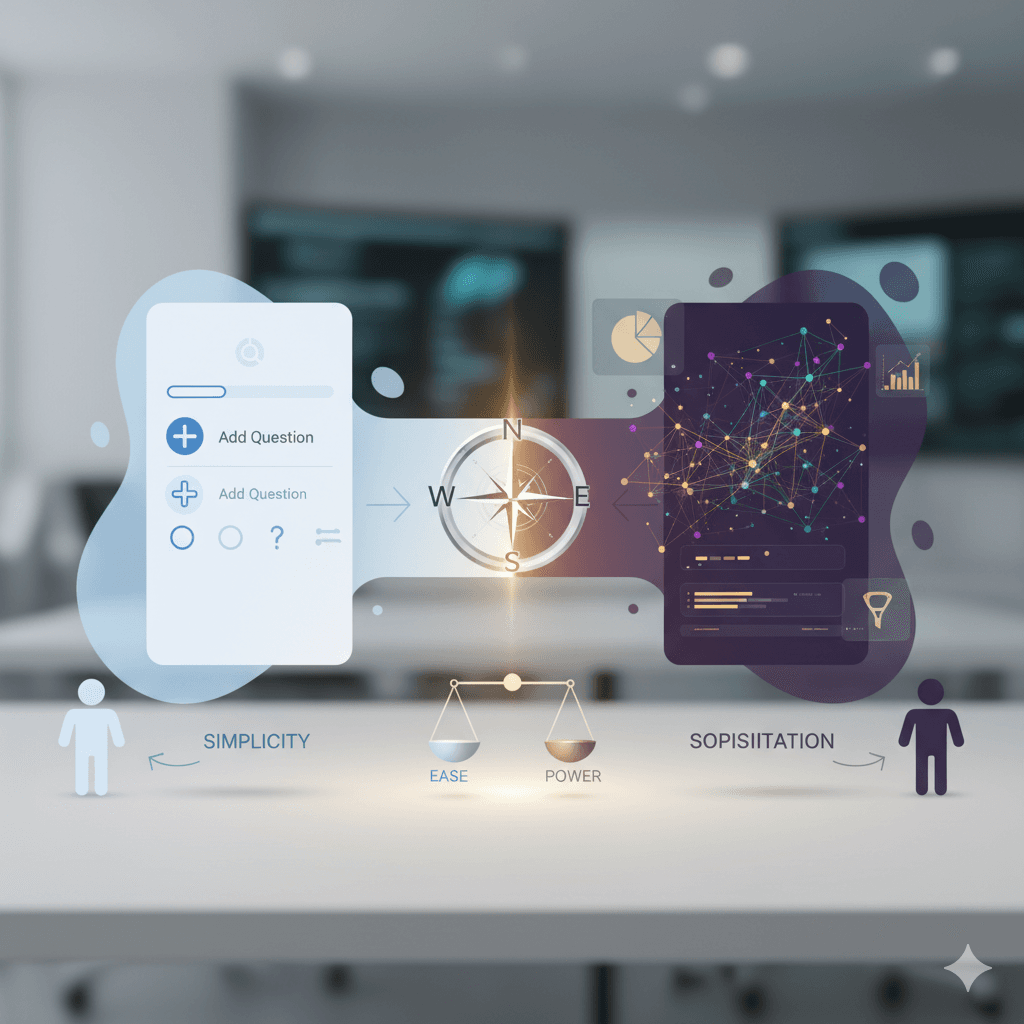
In today’s data-driven world, surveys remain one of the most powerful instruments for gathering insights. Yet, the effectiveness of a survey tool hinges on its ability to balance simplicity—making it accessible to users of all skill levels—with sophistication—providing advanced features for complex research needs. Striking this balance is not just a design challenge; it’s a strategic imperative for tools aiming to serve diverse industries and audiences.
✨ Why Simplicity Matters
- Ease of Use: A clean, intuitive interface lowers the barrier to entry, enabling non-technical users to design and deploy surveys quickly.
- Speed: Simple workflows reduce the time needed to create surveys, which is critical in fast-moving environments like marketing campaigns or humanitarian fieldwork.
- Accessibility: Minimalist design ensures inclusivity, allowing users across geographies and skill levels to engage without steep learning curves.
Example: A health NGO conducting rapid assessments in rural areas benefits from straightforward survey creation and offline capabilities, ensuring data collection without technical hurdles.
⚙️ Why Sophistication Matters
- Advanced Analytics: Sophisticated tools offer features like branching logic, sample size calculators, and integration with visualization platforms.
- Customization: Researchers often need tailored question types, multilingual support, and complex skip patterns to capture nuanced data.
- Scalability: As organizations grow, they require tools that can handle larger datasets, integrate with CRMs, and support longitudinal studies.
Example: A multinational corporation conducting employee engagement surveys may need advanced segmentation, benchmarking, and predictive analytics to inform strategic decisions.
🔑 The Balancing Act
The challenge lies in designing tools that are simple enough for everyday use yet powerful enough for advanced research. Successful survey platforms often adopt:
- Layered Complexity: Basic users see a streamlined interface, while advanced users can unlock deeper features.
- Guided Workflows: Step-by-step builders help novices, while experts can bypass them for efficiency.
- Modular Design: Features like offline data collection, dashboards, or integrations can be added as needed, avoiding clutter for casual users.
- Human-Centered Design: Prioritizing clarity, visual cues, and contextual help ensures users don’t feel overwhelmed.
🚀 Looking Ahead
The future of survey design tools lies in adaptive intelligence—platforms that learn from user behavior and recommend features accordingly. Imagine a tool that suggests advanced sampling techniques to a researcher but keeps things simple for a community organizer running a quick poll.
Balancing simplicity and sophistication is not about compromise; it’s about creating harmony. Tools that achieve this balance empower organizations to collect meaningful data efficiently, whether they’re startups testing product-market fit or global institutions shaping policy.
🎯 Conclusion
Survey design tools must evolve to meet the dual demands of accessibility and depth. By blending simplicity with sophistication, they can democratize data collection while still serving the needs of advanced researchers. The result? Smarter decisions, stronger communities, and a more informed world.