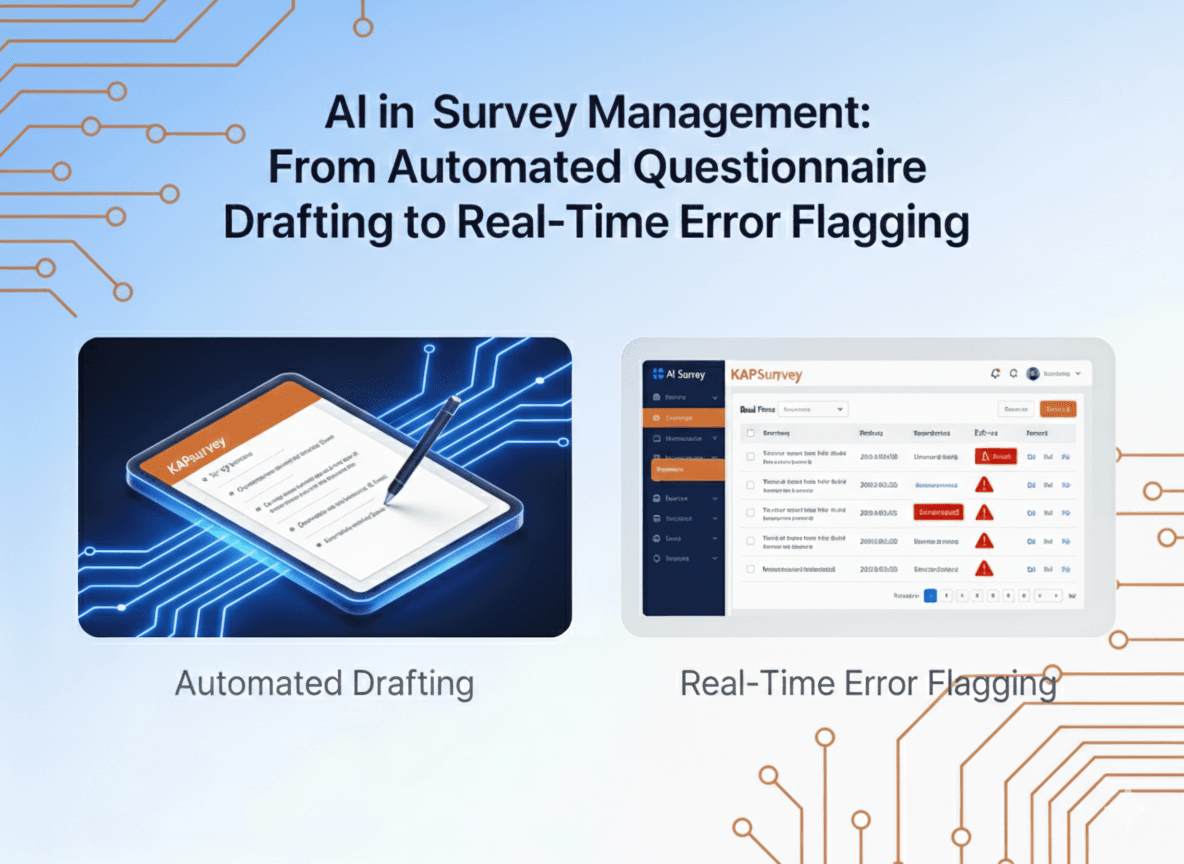
Artificial intelligence (AI) and machine learning (ML) are rapidly reshaping how surveys are designed, administered, and evaluated. Beyond automating repetitive tasks, modern AI systems now contribute to higher-quality question design, adaptive survey flows, and real-time data quality assurance. This article explores how AI/ML models assist researchers and practitioners across the survey lifecycle — from crafting better questions to flagging errors as data arrives — with evidence from current research and industry applications.
🧠 1. Enhancing Questionnaire Design with AI
Traditionally, creating a survey instrument has been a manual process rooted in survey methodology expertise. Researchers write, review, and pilot test questions to ensure clarity and relevance. AI is now augmenting that process in several ways:
📌 Automated Drafting and Refinement
Large language models (LLMs) can generate first-draft questions based on topic descriptions, research goals, and respondent characteristics. These models learn from large corpora of well-designed questions and research principles, helping to produce phrasing that reduces ambiguity and bias while improving clarity. Early evidence suggests that LLM-generated drafts align closely with human expert reviews and can accelerate early stages of survey creation.
🧪 Pretesting Support and Feedback
AI tools can simulate respondent interpretation and offer feedback on question quality before field deployment. For example, recent research investigated using generative models for questionnaire pretesting, highlighting how AI feedback can supplement human judgment and reduce costly iterations later in study design.
🌍 Multilingual and Cultural Optimization
Machine learning also facilitates question evaluation across languages and cultural contexts. A study applying ML to multilingual recordings demonstrated that algorithms could flag questions with poor performance, helping to adapt instruments for diverse populations.
🎯 Adaptive and Conversational Surveys
Beyond drafting static questions, reinforcement learning frameworks like AURA have shown promise in adaptive conversational surveys that tailor follow-up questions in real time based on respondent behavior, improving engagement and response quality.
🔍 2. Real-Time Error Flagging and Data Quality Monitoring
AI’s capacity to process vast amounts of data quickly makes it a valuable partner in ensuring data quality during and after collection.
🚨 Real-Time Validation
AI systems can perform consistency, completeness, and format checks as respondents enter answers. For example, algorithms may detect unrealistic values (e.g., implausible ages) and prompt respondents to correct them before submission, reducing downstream cleaning work.
🔁 Anomaly Detection
Machine learning models excel at identifying patterns that deviate from expected response distributions. These anomalies may signal careless or fraudulent entries, repeated participation by the same individual, or other data quality threats. Various commercial tools incorporate multi-layer ML checks that can flag issues like “flatlining” (same answer patterns) and improbable durations.
🔎 AI-Generated Response Detection
As AI becomes capable of generating human-like text, differentiating between genuine human responses and machine-generated ones has become crucial. Institutions like NORC have developed specialized classifiers to flag AI-generated open-ended replies with high precision, exemplifying how AI can be part of robust quality control pipelines.
📊 Predictive Quality Flags
Advanced models can leverage paradata — such as mouse movement or response times — to predict respondent difficulty or disengagement. ML approaches using these stimulus features can help researchers intervene or adapt the survey structure in real time to mitigate poor-quality responses.
🤖 3. Automating Post-Collection Quality Assurance
AI continues its role after data collection:
🗂️ Coding and Thematic Analysis
Natural language processing (NLP) models automate coding of open-ended text, clustering responses into themes and summarizing larger trends, tasks that previously consumed significant human effort.
📦 Data Cleaning and Imputation
ML algorithms identify outliers, inconsistencies, and missing patterns and suggest corrections. These systems help streamline cleaning workflows and reduce manual intervention.
🧩 4. Challenges and Ethical Considerations
While transformative, AI integration in survey management isn’t without challenges:
- Algorithmic bias: Systematic biases in training data can skew question generation or error detection outcomes if not properly audited.
- Human oversight: AI should augment, not replace, expert judgment. Poor prompts or misinterpretations from models can lead to misleading outputs.
- Privacy and trust: Handling sensitive respondent data demands careful governance to ensure compliance with confidentiality standards.
📈 Conclusion
AI and machine learning are revolutionizing survey management across design, collection, and analysis phases. From automating questionnaire drafting and offering pretest feedback to flagging errors and optimizing data quality in real time, these technologies help researchers generate more reliable insights faster. By combining human expertise with AI’s analytical power, organizations can enhance both the efficiency and quality of their survey research.
📚 References
- Generative AI can assist question design and interpretation by flagging ambiguity and improving clarity. (lycasurvey.com)
- AI enhances survey design, data cleaning, and validation tasks. (MoldStud)
- Machine learning assists in multilingual survey question evaluation. (Survey Practice)
- NORC’s AI detector improves identification of AI-generated responses for quality control. (NORC)
- LLMs help with questionnaire design and coding of open responses. (NORC)
- ML-based pretesting tools can supplement human review in early survey design. (arXiv)
- Reinforcement learning frameworks can enable adaptive survey questioning. (arXiv)
- Predictive models using paradata can flag respondent difficulty. (arXiv)
- Algorithmic bias represents risks in AI-driven decision systems. (Wikipedia)