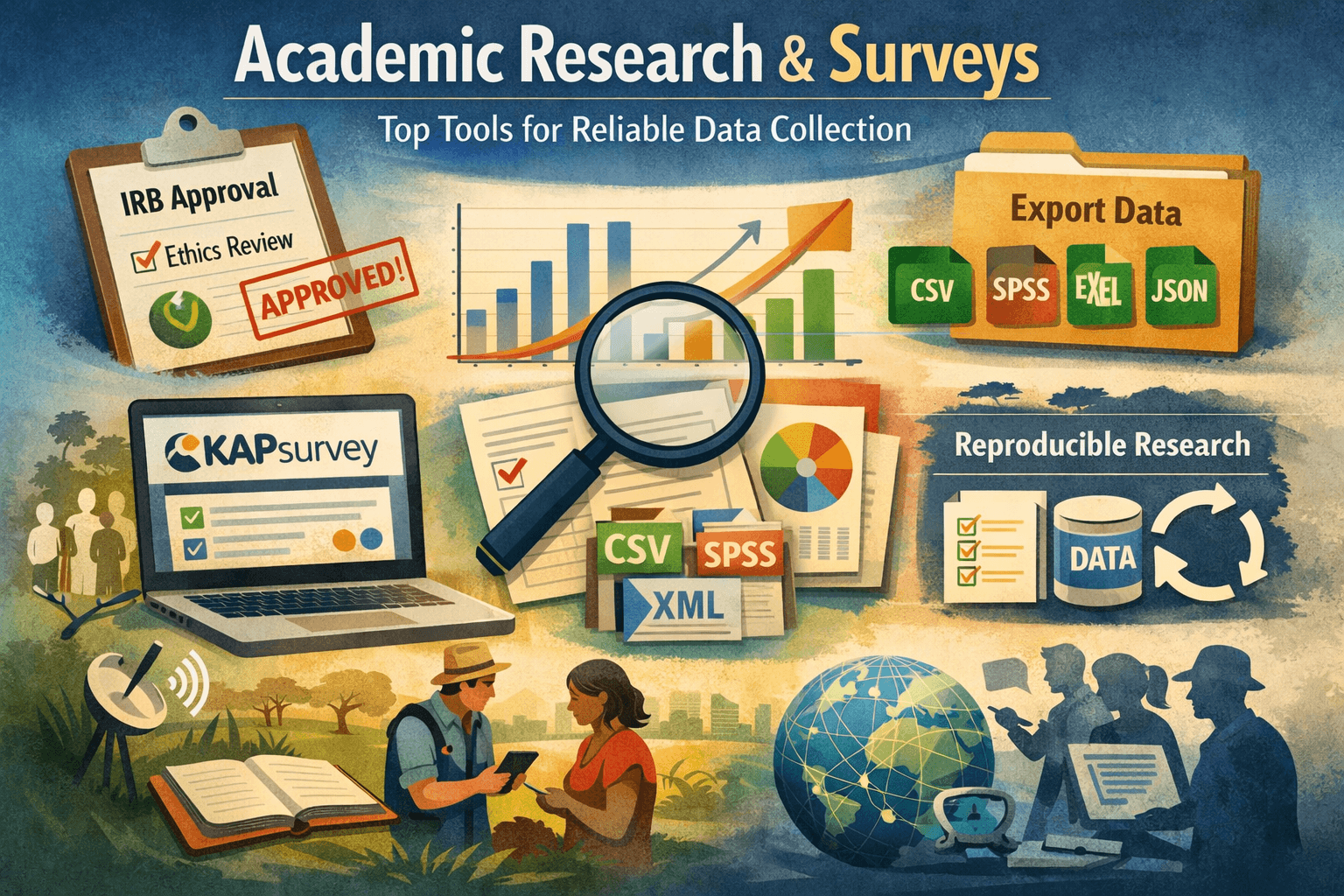
Focusing on Ethical Approval, Data Export Formats, and Reproducibility
Academic research relies heavily on trustworthy data collection, especially when surveys form the backbone of empirical work. Whether you’re conducting social science research, public health assessments, or behavioral studies, choosing the right tools and adopting best practices — including ethical approval, flexible data export options, and reproducible methodologies — is essential. Below is a comprehensive guide to help you navigate this landscape.
Why Reliable Tools Matter in Academic Surveys
Effective survey tools do more than collect responses — they support scientific rigor by ensuring:
- Ethically sound data collection, especially involving human subjects.
- Flexible data export formats compatible with analysis tools like SPSS, R, Python, etc.
- Reproducibility and transparency, allowing other researchers to validate and replicate findings.
- Field-ready capabilities (e.g., offline collection for remote data gathering) that maintain data quality across contexts.
1. Key Considerations in Academic Survey Tools
Ethical Approval and Human Subjects Research
Before deploying survey tools, especially in academic settings:
- Most institutions require ethical review board (IRB/REC) approval for studies involving human participants.
- Ethical approval ensures respect for participant rights, informed consent, and safeguards against harm — criteria that must shape your choice of tool and protocol.
- Many journals and funders expect explicit documentation of ethical approvals in final manuscripts.
Best Practices:
- Draft detailed protocols describing how your chosen tool supports participant privacy and consent.
- Ensure the platform you select can anonymize and securely store sensitive responses.
- Use audit trails when available to document data collection steps for review boards or audits.
2. Top Survey and Data Collection Tools for Academic Research
Below are widely used platforms — each with strengths for academic research:
Qualtrics
- Advanced logic, extensive question types, and powerful analytics.
- Supports export to formats like CSV, SPSS, and XML, enabling downstream statistical analysis.
SurveyMonkey
- Versatile and researcher-friendly.
- Offers templates and export options suited to academic workflows.
Typeform
- Engaging survey design that improves response rates.
- Strong data export functionality for research reporting.
LimeSurvey
- Open-source and customizable.
- Good for researchers needing control over survey logic and data storage.
Microsoft Forms & Google Forms
- Easy to deploy and integrate with analysis tools (e.g., Excel and Sheets).
- Ideal for pilot studies and classroom research. (SCI Journal)
KAPsurvey: A Powerful Academic Data Collection Platform
One emerging platform worth highlighting is KAPsurvey, designed with research flexibility in mind:
- Dynamic Survey Design: Create intelligent surveys with logic-driven questions and auto-translation — essential for cross-cultural academic surveys.
- Multi-Channel Data Collection: Collect responses online, offline, via email, WhatsApp, or in person — crucial for field research in low-connectivity areas.
- Project Management: Manage survey teams, assign targets, and monitor progress within a single platform.
- Real-Time Insights: Transform raw responses into actionable insights with built-in visualization tools.
- Flexible Export: While specifics depend on subscription, most research platforms like KAPsurvey allow exporting data for statistical analysis — which is key for academic publication and reproducibility.
KAPsurvey’s strengths in field data collection and project tracking make it especially suitable for large-scale or geographically dispersed academic studies.
3. Export Formats and Data Interoperability
Academic researchers often require specific formats for deeper statistical work:
- CSV/TSV: Universally accepted for import into R, Python, and Excel.
- SPSS / SAS / Stata: Standard formats for social science analysis.
- JSON / XML: Useful for integration with custom data pipelines and reproducibility frameworks.
Good survey platforms support multiple exports, ensuring data is portable and analysis-ready without loss of structure or metadata.
4. Reproducibility: Ensuring Research Integrity
Reproducibility — researchers’ ability to replicate and verify findings — is central to academic credibility.
- Documented Workflows: Save detailed survey design and data cleaning steps so others can replicate your methodology.
- Version Control: Use versioning for survey instruments and datasets to track changes.
- Structured Schemas: Emerging frameworks such as ReproSchema aim to standardize survey definitions, enhancing reproducibility across tools. (PMC)
- Data Sharing: Where ethically permissible, share anonymized datasets with publications or repositories to facilitate verification.
Transparent reporting on tool choice, data handling, and analytical decisions strengthens trust in research outcomes.
5. Concluding Best Practices for Academic Surveys
To maximize the reliability of your survey research:
- Obtain Ethical Clearance Early: Align your survey tool choice with privacy and ethical review requirements.
- Choose Tools with Robust Export Capabilities: Pick platforms that support formats comfortable for your analysis pipeline.
- Document Everything: From consent scripts to data cleaning steps, thorough documentation improves reproducibility.
- Leverage Standards and Open Formats: Use schemas, version control, and repository sharing to future-proof your research.
References
- Qualtrics, SurveyMonkey, Typeform, and other tools supporting export for academic research. (SCI Journal)
- Importance of data privacy, anonymity, and export capabilities in academic tools. (Polling.com)
- Structured approach to reproducibility in survey research (e.g., ReproSchema). (PMC)
- KAPsurvey platform capabilities for intelligent survey building and data collection. (KAPsurvey)