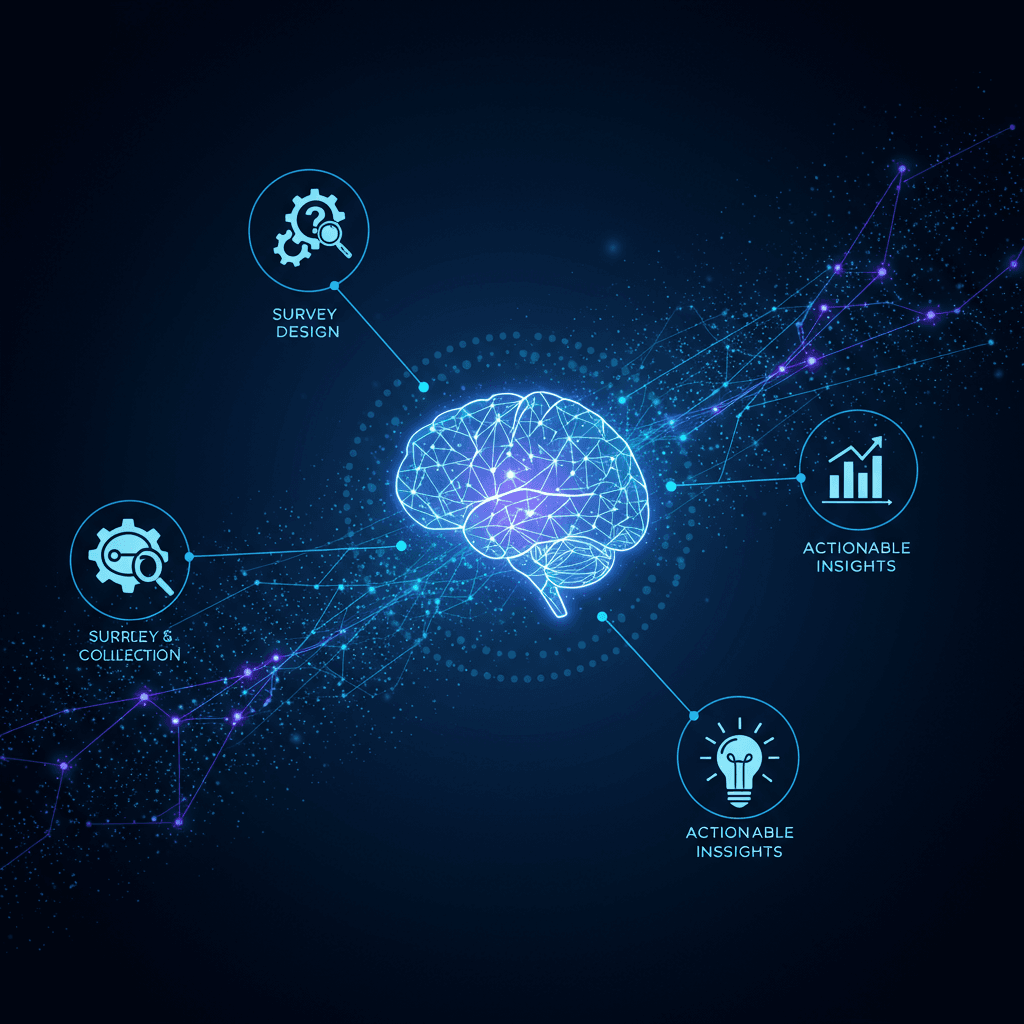
How AI is Redefining Data Collection?
For decades, Knowledge, Attitude, and Practices (KAP) surveys have been a cornerstone of research. They provide a vital snapshot of what a population knows, how they feel, and how they behave regarding a specific issue. From understanding vaccination hesitancy to gauging consumer sentiment, KAP surveys have been instrumental in shaping policies and strategies. However, the traditional methods of conducting these surveys; often manual, time-consuming, and prone to biases are ripe for a revolution. Artificial Intelligence (AI), a transformative force that is not just improving but fundamentally redefining the entire KAP survey process, from conception to conclusion.
Smarter Survey Design
The foundation of any effective KAP survey lies in its design. Traditionally, crafting the right questions has been a meticulous, and often subjective, process. AI is changing this by introducing a level of precision and objectivity previously unattainable. AI algorithms can now sift through vast repositories of academic literature, existing survey data, and public discourse to identify key themes and generate relevant, well-structured questions. This not only saves researchers countless hours but also helps in uncovering angles that might have been missed.
Furthermore, AI is a powerful ally in the fight against survey bias. By analyzing question wording and structure, AI tools can flag leading or loaded questions that might subtly influence a respondent's answer. This leads to more neutral and reliable data. The most exciting development, however, is the rise of adaptive surveys. Instead of a static set of questions, AI can create a dynamic and personalized experience for each respondent. Based on their initial answers, AI can intelligently select the next most relevant question, delving deeper into areas of interest or skipping over irrelevant topics. This not only keeps respondents more engaged but also yields richer, more nuanced data.
Dynamic and Engaging Data Collection
AI is making data collection a more interactive and engaging process. AI-powered chatbots and virtual assistants can now administer KAP surveys in a conversational format, creating a more natural and less intimidating experience for respondents. This can be particularly effective when dealing with sensitive topics, as people may feel more comfortable sharing honest answers with a non-judgmental AI.
The global reach of research is also being expanded by AI. Real-time translation capabilities allow surveys to be deployed seamlessly across different languages and cultures, breaking down barriers that have long hindered international research. Moreover, AI is enhancing the quality of the data collected. By implementing real-time data validation, AI can identify and flag inconsistent or nonsensical answers as they are entered. This allows for immediate clarification, ensuring that the final dataset is clean and accurate.
Accelerated and Deeper Analysis: From Data to Insights in Record Time
One of the most significant bottlenecks in the traditional KAP survey process has always been data analysis. Cleaning, coding, and analyzing large datasets can be a laborious and time-consuming task. AI is dramatically accelerating this process. Machine learning algorithms can automate the analysis of quantitative data, identifying patterns, correlations, and trends in a fraction of the time it would take a human researcher.
But where AI truly shines is in its ability to unlock the insights hidden within qualitative data. Open-ended questions in KAP surveys can provide a wealth of information, but analyzing this unstructured text has always been a challenge. AI-powered Natural Language Processing (NLP) can now analyze these responses at scale, identifying key themes, sentiments, and even emotions. This provides a much deeper and more holistic understanding of the "why" behind the numbers. Beyond just analyzing the present, AI can also help us look into the future. By identifying patterns in KAP data, predictive analytics models can forecast future trends and behaviors, giving organizations a valuable head-start in their planning and decision-making.
From Insights to Action: Closing the Loop
The ultimate goal of any KAP survey is to drive meaningful action. AI is helping to close the loop between data collection and intervention. By providing a more granular and real-time understanding of a population's knowledge, attitudes, and practices, AI enables the development of highly targeted and personalized interventions. For instance, if a survey reveals a specific knowledge gap in a particular demographic, AI can help in crafting and delivering tailored educational content to that group.
Moreover, AI can provide personalized feedback to survey respondents themselves. Based on their answers, an AI system can offer relevant information, resources, or recommendations, turning the survey from a simple data extraction tool into a valuable and interactive experience.
While the potential of AI in redefining KAP surveys is immense, it's not without its challenges. Issues of data privacy, algorithmic bias, and the need for human oversight are critical considerations that must be addressed. However, as AI technology continues to evolve, its role in helping us understand and address the world's most pressing challenges will only grow. The era of static, one-dimensional surveys is slowly evolving. The future of KAP surveys is intelligent, interactive, and insightful, and it's a future that is being written in the language of AI.





