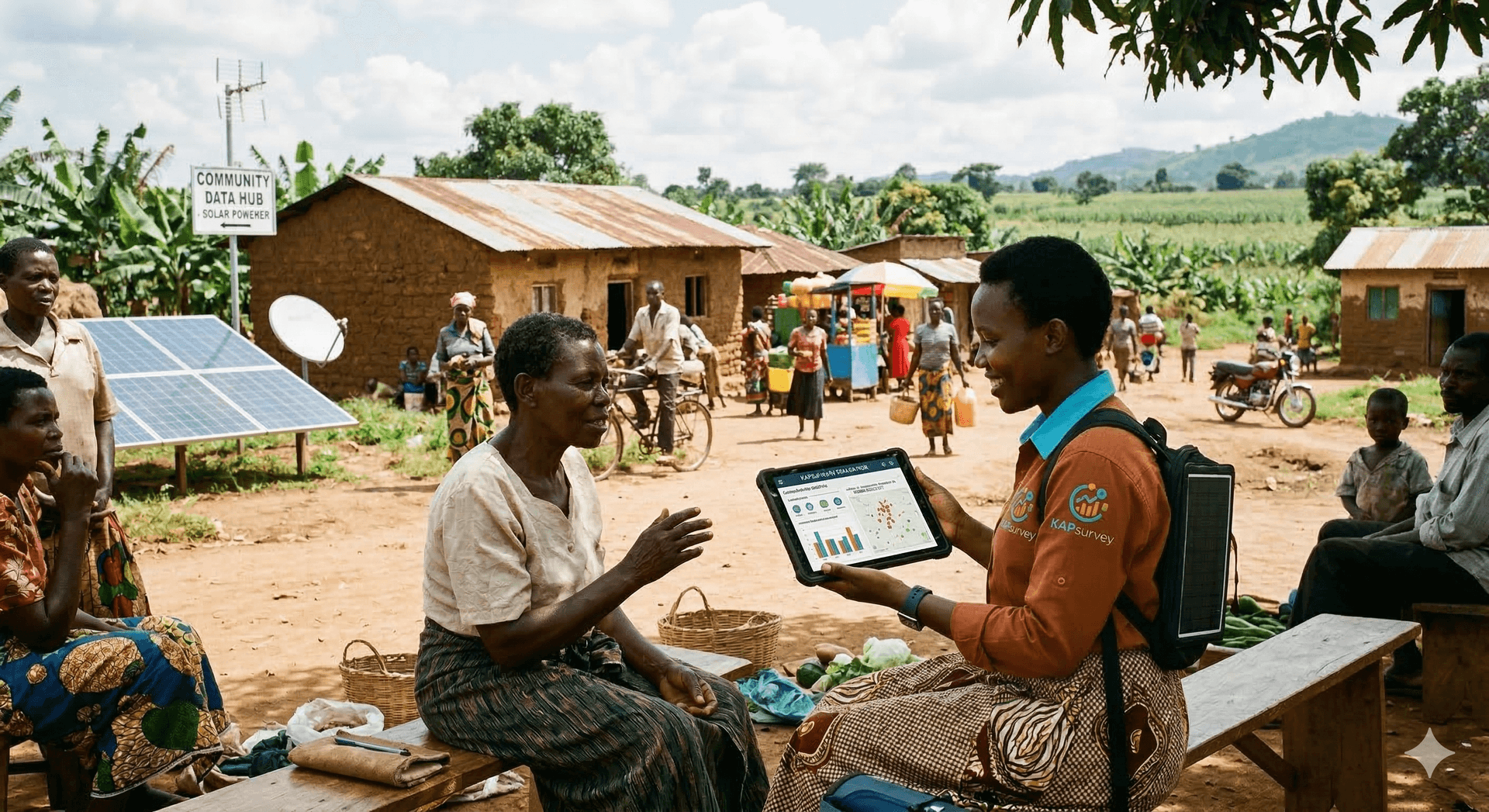
How mobile technology, AI, and community-driven approaches are transforming data gathering — and who benefits from it.
In a rural health clinic in Uganda, a nurse taps an offline-capable mobile form on a cracked smartphone screen. Kilometers away, a farmer in Bangladesh scans a QR code to report crop prices at the local market. In a São Paulo favela, residents use a community app to map broken streetlights. These are not isolated stories — they represent a quiet revolution transforming how data is collected across the developing world.
For decades, data collection in low- and middle-income countries was dominated by slow, expensive, and often inaccurate paper-based surveys. International organizations ran large-scale censuses every ten years and produced reports that were outdated before they were published. The systems were extractive: data flowed out to capitals and donor headquarters, rarely returning to the communities that generated it.
That model is changing — and rapidly.
54%
Mobile internet penetration in Sub-Saharan Africa
6.8B
Mobile subscriptions globally, led by emerging markets
3×
Faster collection via mobile vs. paper-based methods
The mobile-first leap
Perhaps the most significant structural shift is that many developing nations are skipping legacy infrastructure entirely. While Western countries built data systems on desktop computers and landlines, countries like Kenya, Nigeria, and Indonesia entered the data age through the smartphone — often a secondhand Android device running on 3G.
This "leapfrogging" effect is profound. Mobile data collection platforms such as KAPsurvey, KoboToolbox, ODK, and DHIS2 are now used by thousands of organizations across Africa, South Asia, and Latin America. They enable surveyors to collect GPS-tagged, time-stamped data even without connectivity, syncing automatically when a signal is found. What once took weeks of manual data entry now happens in real time.
"The question is no longer whether developing countries can collect data — it's whether that data serves the people who generate it.
Artificial intelligence as an equalizer
AI is increasingly being deployed to fill gaps that traditional surveys cannot reach. Satellite imagery analyzed by machine learning can now estimate crop yields in remote areas without a single field visit. AI-powered voice recognition tools trained on local languages — from Swahili to Hausa to Tagalog — enable populations with low literacy to participate in data collection through voice-based surveys.
Computer vision models trained on aerial photography are helping city planners in Nairobi and Accra map informal settlements with greater accuracy than any census has achieved. These tools don't replace ground-level knowledge — they amplify it, allowing small NGOs and government departments to do work that once required enormous resources.
That said, the risks deserve serious attention. Biased training data produces biased outputs. A model trained predominantly on data from one region may perform poorly — or harmfully — when applied in a different context. The deployment of algorithmic systems without local oversight raises accountability questions that developers in San Francisco or London are often poorly positioned to answer.
The sovereignty question
As data becomes ever more valuable, questions of who owns data generated in developing countries are becoming politically charged. For years, the dominant model involved data flowing from communities to international organizations, processed and stored on foreign servers, used to influence aid allocations and policy decisions. Communities themselves often had no access to the insights derived from their own information.
70%
Of African health data stored on servers outside the continent
40+
Countries enacted national data protection laws since 2020
A growing movement of data sovereignty advocates is pushing back. Countries like Rwanda, South Africa, and India have introduced or strengthened data localization laws. The African Union's Data Policy Framework explicitly frames data governance as a development issue — asserting that African nations must control the value generated by their citizens' data. When a fintech company processes transaction data from millions of Ghanaian mobile money users, those insights are commercially valuable. If they flow exclusively to shareholders abroad, Ghana captures none of that value.
Challenges that remain
Progress is real, but the obstacles are formidable. Nearly 2.7 billion people — most of them in the developing world — remain offline. In areas without reliable electricity or mobile coverage, cutting-edge digital tools are simply irrelevant.
Key obstacles
Infrastructure gaps — unreliable power and limited rural connectivity
Digital literacy — training requirements for enumerators and communities
Data quality — inconsistent standards and verification protocols
Privacy risks — inadequate frameworks for protecting sensitive data
Funding dependency — reliance on donor support for data systems
There is also the persistent issue of data quality. Faster collection does not automatically mean better data. Surveyors under pressure to hit targets may skip hard-to-reach households; app-based forms can be completed carelessly; satellite-derived estimates carry their own error margins. Building institutional capacity to validate, clean, and interpret data is a long-term investment that cannot be shortcut by technology.
Community-driven models leading the way
The most promising developments may not be the most technologically sophisticated. Across sub-Saharan Africa and South Asia, participatory data collection models are gaining traction — approaches where communities define what data is collected, participate in gathering it, and retain access to the results.
In Kenya, community health workers equipped with smartphones are not just data collectors — they are healthcare providers who use the data they collect to make immediate decisions about patient care. In India, self-help groups of rural women use simple data tools to track agricultural prices, monitor water quality, and report governance failures to local authorities. These models produce data that is both more accurate and more actionable than externally designed surveys, because the people collecting it have a genuine stake in its quality.
"Data collected by communities, for communities, has a fundamentally different character — and a fundamentally different impact."
The road ahead
The future of data collection in developing countries will likely be defined less by any single technology than by the governance structures that determine who controls the process. Mobile devices, AI, and satellite imagery are tools — powerful ones — but tools whose impact depends entirely on institutional context.
The countries and regions that will benefit most are those investing simultaneously in digital infrastructure that reaches the last mile; local technical capacity that keeps expertise within country borders; and regulatory frameworks that protect citizen privacy while enabling responsible data use.
International donors and development organizations must also reckon with their role. Too many data systems in the developing world are built to report to funders rather than to serve local decision-makers. Shifting toward genuinely locally-owned data ecosystems will require not just new technology but new power dynamics — and that is a harder, slower, and more important transformation than any app can deliver.
What is clear is that the era of extractive, episodic, paper-based data collection is ending. What replaces it — whether it empowers or further marginalizes the communities it measures — is still being decided.