Understanding When to Use Each Tool for Maximum Impact
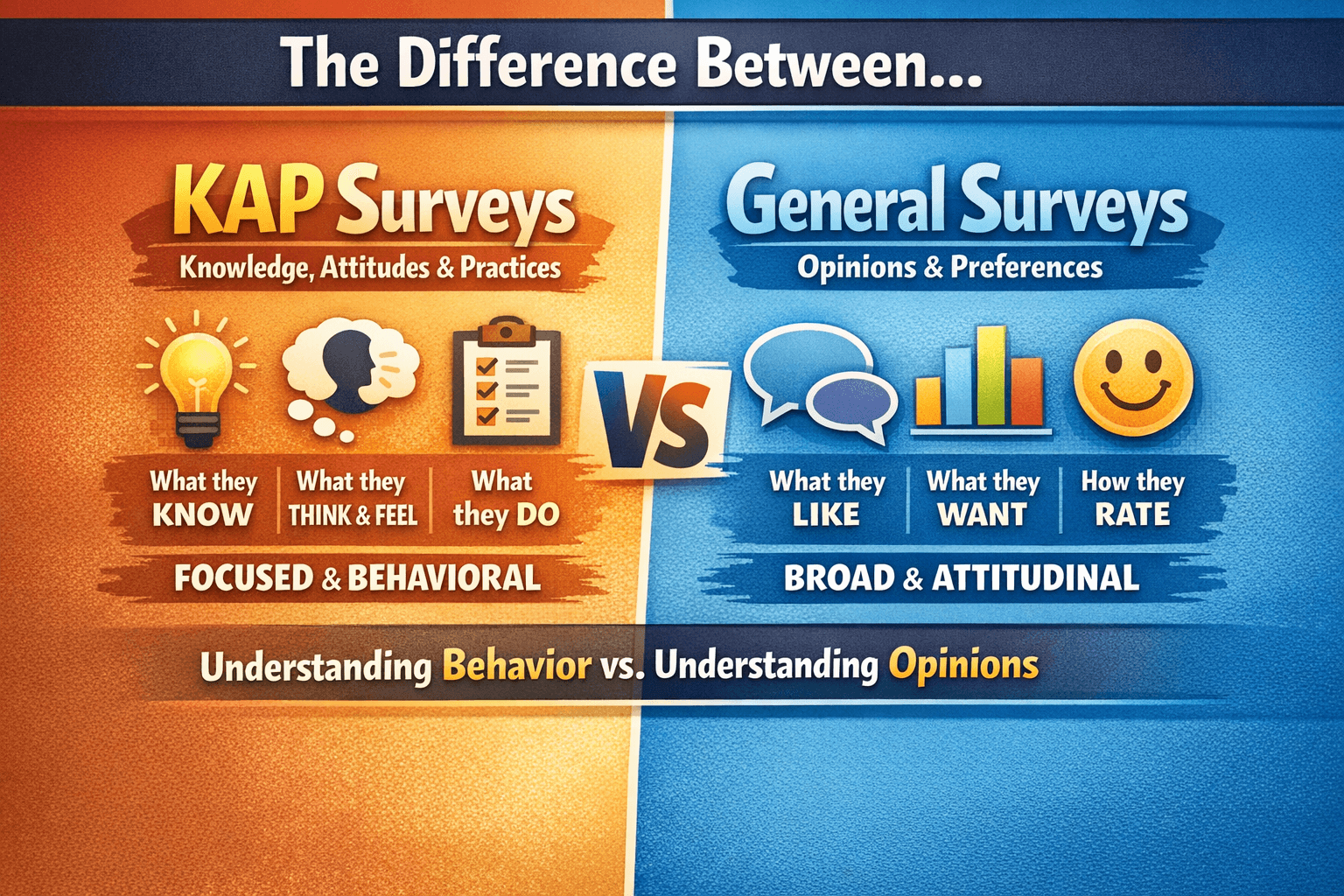
When it comes to gathering data from people, not all surveys are built the same. Two of the most commonly used survey frameworks are the KAP Survey which stands for Knowledge, Attitudes, and Practices and the General Survey. While both are valuable tools in data collection, they serve fundamentally different purposes, follow different design principles, and are used in very different contexts.
Understanding the distinction between these two types of surveys is essential for researchers, programme managers, public health professionals, NGOs, and organisations that rely on data to drive decisions. Using the wrong type of survey can result in data that is irrelevant, misleading, or insufficient for the decisions you need to make.
This article breaks down the key differences between KAP surveys and general surveys, exploring their structure, purpose, use cases, and how each one adds value in its respective context.
What Is a KAP Survey?
A KAP survey is a specialised research tool used to measure three interconnected dimensions of human behaviour in a specific population:
- Knowledge — What does the target group know about a particular subject or issue?
- Attitudes — What are their feelings, beliefs, or perceptions about that subject?
- Practices — What do they actually do in relation to that subject?
Originally developed in public health settings, KAP surveys are now widely used across international development, humanitarian response, education, agriculture, sanitation, nutrition, and community health programmes.
The primary goal of a KAP survey is not just to gather opinions or preferences, but to identify the gaps between what people know, what they believe, and what they actually do. These gaps, often called the KAP gap, are crucial for designing behaviour change communication strategies and targeted interventions.
For example, a KAP survey on handwashing might reveal that a community has good knowledge about the importance of hygiene (knowledge), holds positive views about cleanliness (attitude), but does not consistently wash hands before meals (practice). This gap immediately tells programme planners where to focus resources.
What Is a General Survey?
A general survey is a broad data collection instrument used to gather a wide range of information from a group of people. It is not bound by any specific thematic framework. General surveys are used for purposes as varied as:
- Customer satisfaction and service feedback
- Market research and consumer behaviour
- Employee engagement and workplace assessments
- Academic and social science research
- Event feedback and audience analysis
- Census and demographic data collection
General surveys are flexible in structure and can incorporate multiple question types multiple choice, Likert scales, open-ended questions, rankings, and more. They are designed to serve a wide variety of data needs and can be deployed quickly across many sectors.
Unlike KAP surveys, general surveys do not follow a fixed tripartite framework. Their design is guided primarily by the specific information the researcher or organisation wants to collect, without a predefined analytical structure tied to behaviour change theory.
Key Differences Between KAP Surveys and General Surveys
1. Purpose and Focus
The most fundamental difference lies in the purpose of each survey. A KAP survey is explicitly designed to understand behaviour and the factors that drive or inhibit it. It answers a very specific research question: Why do people behave the way they do, and where are the gaps between knowledge, attitude, and practice?
A general survey, by contrast, is designed to answer any number of research questions depending on the organisation's needs. It could be measuring customer loyalty, gathering demographic data, or evaluating an event. The purpose is defined by the researcher, not by a fixed framework.
2. Theoretical Framework
KAP surveys are rooted in behavioural science and public health theory. The framework assumes that knowledge influences attitudes, which in turn influence practices. By measuring all three dimensions simultaneously, researchers can map the pathway from awareness to action and identify precisely where that pathway breaks down.
General surveys operate without a prescribed theoretical framework. They are content-agnostic and can be structured in whatever way best serves the data collection goal.
3. Target Population and Context
KAP surveys are typically designed for specific, defined populations a community in a particular region, beneficiaries of a health programme, students in a school, or farmers in a rural area. They are conducted in contexts where behaviour change is the ultimate goal, and where understanding the population's current knowledge, attitudes, and practices is a necessary precursor to intervention.
General surveys are used across a far broader range of contexts and populations. A retail brand might survey thousands of customers online. A university might survey its staff. A government might conduct a national census. There is no restriction on who is surveyed or in what context.
4. Question Design
In a KAP survey, questions are specifically written to assess knowledge (often using correct/incorrect or true/false formats), attitudes (commonly using Likert scales to measure agreement or perception), and practices (using frequency-based or behavioural questions about actual actions). The three domains must be clearly delineated and balanced within the questionnaire.
In a general survey, question design is entirely flexible. Questions can be structured in any way that serves the research objective. There is no requirement to cover all three domains or to follow any particular sequencing logic.
5. Analysis and Outcomes
The analysis of a KAP survey is oriented towards identifying gaps between the three domains and drawing implications for intervention design. Results are often used to inform communication campaigns, capacity-building programmes, or policy changes aimed at closing the KAP gap.
General survey analysis depends entirely on the study objectives. Outcomes could include descriptive statistics, trend analysis, satisfaction scores, demographic breakdowns, or qualitative themes — whatever the research design calls for.
6. Timing and Use in Programme Cycles
KAP surveys are commonly deployed at the beginning and end of a programme or project. A baseline KAP survey is conducted before an intervention to establish benchmark levels of knowledge, attitudes, and practices. An endline survey, using the same tool, is conducted after the intervention to measure change.
General surveys do not follow this pattern. They can be one-off exercises or recurring surveys and are not necessarily tied to an intervention cycle.
When Should You Use Each Type?
Use a KAP Survey When:
- You are designing or evaluating a behaviour change programme
- You need to understand why a gap exists between awareness and action
- You are working in public health, development, or humanitarian response
- You want comparable data across baseline and endline measurement points
- Your research goal is to inform targeted interventions for a specific population
Use a General Survey When:
- You need broad feedback across a wide range of topics
- You are conducting market research, customer feedback, or staff assessments
- Your research objectives do not involve behaviour change analysis
- You require a highly flexible, customisable data collection tool
- You are gathering data from a large, heterogeneous population
How KAPsurvey.com Bridges Both Worlds
Platforms like KAPsurvey.com have been purpose-built to support the rigour and structure that KAP surveys require — while also being flexible enough to accommodate general survey needs. With features like offline data collection, multilingual support, smart skip logic, and real-time analytics dashboards, KAPsurvey.com is particularly well-suited for field-based research in challenging environments where KAP surveys are most commonly deployed.
Whether you are running a structured KAP assessment for a nutrition programme in rural Kenya or designing a general feedback survey for a post-webinar audience, understanding the distinction between these two survey types is the first step to collecting data that is meaningful, actionable, and fit for purpose.
Conclusion
KAP surveys and general surveys both serve important roles in the data collection landscape — but they are not interchangeable. KAP surveys offer a structured, theoretically grounded approach to understanding the relationship between knowledge, attitudes, and practices, making them indispensable tools for behaviour change programming. General surveys offer broad flexibility and can be adapted to virtually any data collection context.
The key is knowing which tool your research question calls for. When the goal is to understand why people act the way they do and how to change it, the KAP survey is your instrument of choice. When the goal is to gather diverse information across a wide audience, a general survey will serve you better.
In practice, the two approaches are not mutually exclusive — many comprehensive research programmes use both to build a full picture of the communities and contexts they serve.





