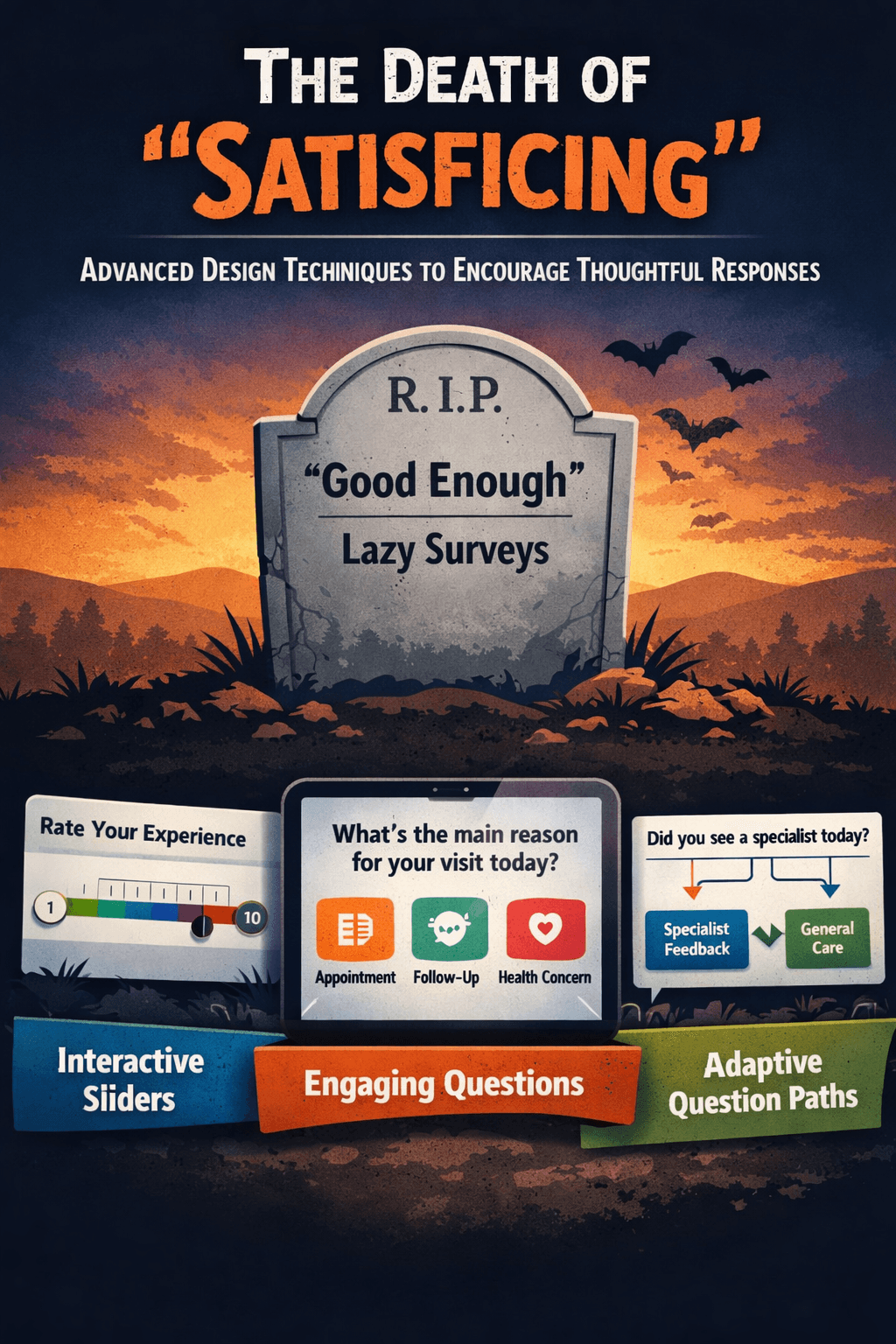
Advanced Design Techniques to Encourage Thoughtful Responses.
Every survey has a silent enemy. It's not dishonesty — it's indifference. When respondents click the first option they see, check every "neutral" box, or complete your 10-minute survey in 45 seconds, you're looking at satisficing: the tendency to settle for a "good enough" answer rather than an honest one.
Coined by economist Herbert Simon, satisficing is a rational survival strategy in a world that demands too much of our attention. Respondents aren't being malicious — they're being efficient. Your job as a survey designer is to make thoughtful engagement the easier path. Here's how.
1.Forced-Choice Design: Remove the Easy Exit
The "neutral" option — Neither agree nor disagree — is the satisficer's best friend. It's fast, safe, and requires zero thought. Forced-choice design removes it.
Instead of a five-point scale with a center point, use four or six points: two positive anchors, two negative anchors, no middle ground. Respondents must commit to a direction, even if it's a gentle one. The result isn't artificial polarization — it's revealed preference.
✓ Good Fit
Satisfaction ratings
Brand or feature preference
NPS and likelihood-to-recommend
Attitude and opinion scales
✗ Poor Fit
Knowledge / recall questions
Topics respondents may be unfamiliar with
Demographic items with a valid "prefer not to say”
Consent and opt-in questions
"Removing the neutral option doesn't eliminate neutrality — it reveals whether neutrality is genuine or just cognitive avoidance.”
2. Pattern Detection: Read the Fingerprints
Satisficing leaves a trail. Straight-lining (selecting the same response across every item in a grid), speeding through long surveys, and agreeing with mutually contradictory statements are all detectable — if you're collecting the right data.
Modern survey platforms capture paradata: metadata about how respondents interact with your survey, not just what they answer. Time-per-item, click coordinates, and back-button patterns all reveal engagement quality. Use them.
Signals worth tracking
- Under 1.5 seconds per rating item — almost certainly not read
- Zero standard deviation across a matrix — straight-lining detected
- Contradictory scale responses — agreeing with opposite-meaning items
- Open-text under 5 seconds — likely keyboard smashing or a single character
Matrix Row Randomization - Shuffle row order on every load. Straight-lining becomes inconsistent and self-defeating
Scale Direction Reversal - Alternate agree→disagree and disagree→agree scales. Automatic top-box clicking breaks down.
Response Option Rotation - Rotate answer choice order to neutralize primacy and recency effects.
Attention Check Items - Embed one or two items that include their own answer in the question text. Use sparingly — overuse breeds resentment.
3.Complexity Management: Work With Cognitive Load
Here's the design paradox: the techniques that best discourage lazy responses — longer questions, more nuanced scales — also increase fatigue, which itself causes satisficing. The solution isn't simpler surveys. It's smarter sequencing.
Cognitive load follows a curve. Too little challenge and respondents coast through on autopilot. Too much and they mentally check out. Your target zone depends on your audience: highly motivated respondents (customers who just had a bad experience) tolerate more friction than cold-outreach panel respondents.
Practical rules of thumb
- Keep items under 25 words. Every word above this threshold measurably reduces completion probability.
- Cap matrix grids at 7 rows. Beyond this, straight-lining rates spike regardless of other design choices.
- Front-load complexity. Put your most demanding questions in the first third, when respondents are freshest.
- Use one open-text question early. It sets a reflective tone that carries through the rest of the survey.
- Show honest progress. A progress bar that reflects actual time remaining (not item count) prevents the "endless survey" abandonment cliff.
"Data quality is not a feature of the analysis — it's a consequence of the design. Build for engagement, and validity follows."
The takeaway
Satisficing isn't a character flaw in your respondents. It's a design flaw in your survey. When an instrument makes thoughtful engagement the path of least resistance — through smart scale design, embedded disruption, and calibrated complexity — you stop fighting human nature and start working with it.
The data you get out is only as good as the experience you put in.





