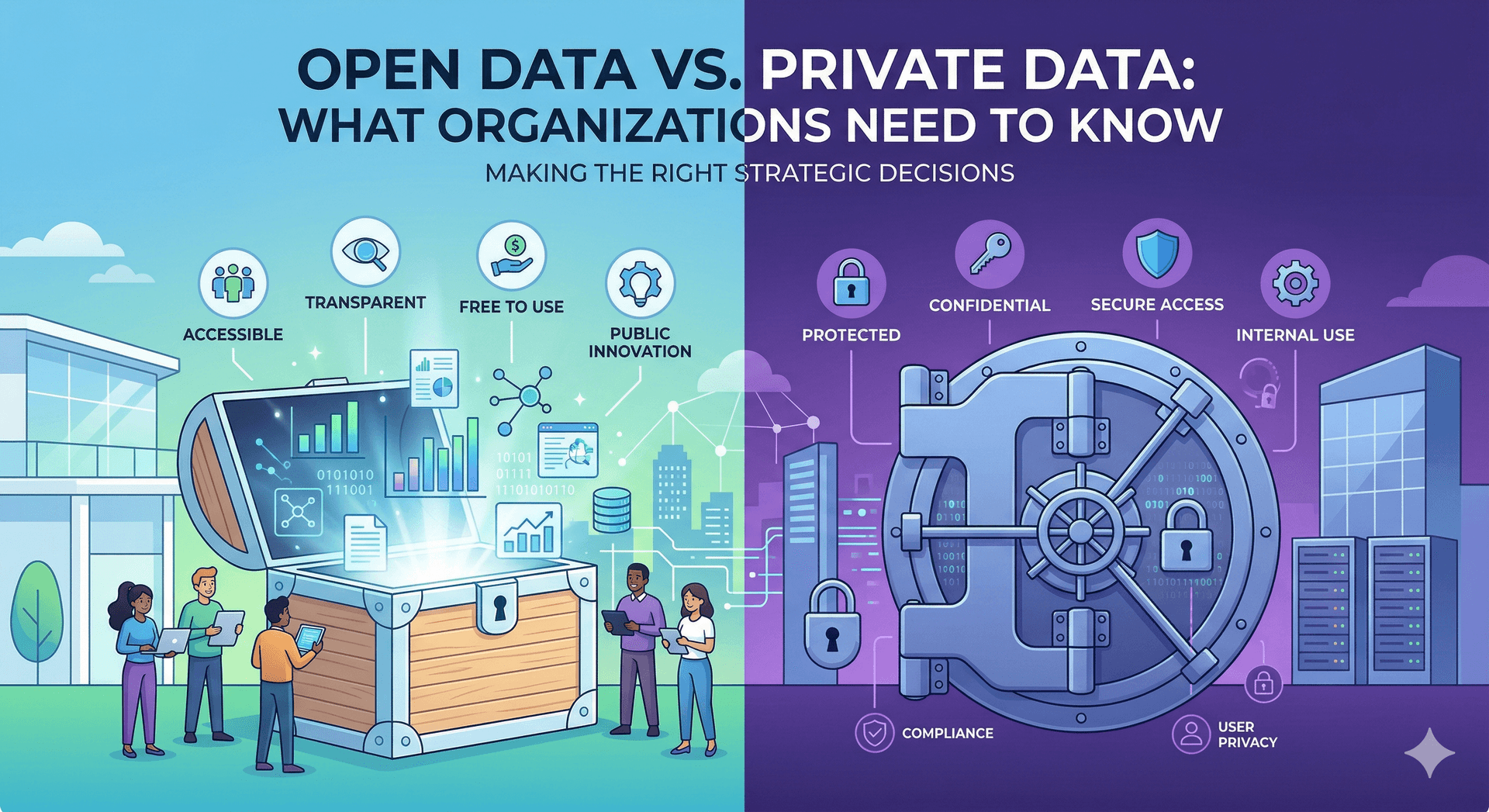
Every organization working in data-driven programming eventually faces a version of the same question: how much of what we collect should we share, and with whom? It sounds like a policy question. In practice, it is one of the most consequential decisions shaping how your data creates value or risk.
The distinction between open data and private data is not simply technical. It reflects a philosophy about who data belongs to, who benefits from it, and what obligations come with collecting it. For organizations working in international development, humanitarian response, public health, and social impact, getting this balance right is not optional it is foundational to ethical, effective programming.
Defining the terms
Open data is data that is made freely available for anyone to access, use, and redistribute typically with little to no restriction. It is published in formats that are machine-readable, well-documented, and discoverable. Governments publish open datasets on budgets and population statistics. Research institutions release anonymized survey findings. Humanitarian coordination bodies share operational data through platforms like the Humanitarian Data Exchange (HDX).
Private data, by contrast, is information that is collected, stored, and used within a defined boundary. Access is controlled. Sharing is governed by policy, consent, or legal obligation. This category includes personally identifiable information (PII), sensitive community-level data, proprietary organizational data, and anything collected under a confidentiality agreement.
The distinction is not always clean. Most organizations operate in a middle space collecting data that is partly shareable and partly protected and the challenge lies in knowing which is which, and building systems that can handle both.
Why it matters more now
Data collection in the development and humanitarian sectors has grown dramatically in scale and sophistication. Digital tools have made it faster and cheaper to gather large volumes of survey data, GPS coordinates, household-level information, and biometric records. This is largely positive richer data supports better decisions.
But scale changes the stakes. When a small NGO collected paper-based household surveys in a single district, the risk of a data breach was contained. Today, when that same organization uses a mobile data collection platform to gather structured data across five countries, the question of what is open and what is private carries real consequences for the people whose information is collected, for the organization's legal standing, and for the integrity of the programmes that data is meant to support.
At the same time, donors and coordination bodies are increasingly pushing for open data as a condition of funding and partnership. The open data movement argues, with considerable force, that data collected using public resources whether government funding, charitable donations, or international aid budgets should be a public good. Transparency builds accountability. Shared datasets enable comparisons, meta-analyses, and learning that no single organization can produce alone.
Both arguments are valid. The question is how to honour both.
The case for open data
Opening your data even selectively creates compounding value. A baseline survey published openly can become a reference point for researchers, peer organizations, and government planners working in the same geography. A de-identified dataset from a nutrition programme can contribute to sector-wide evidence on what works. An openly published indicator framework can save another organization months of methodological work.
Open data also builds trust. When organizations demonstrate transparency about what they collect and what their data shows including findings that complicate their own narrative they signal a commitment to evidence over advocacy. That matters enormously in an environment where community trust in external actors is often fragile.
From an operational standpoint, open data encourages better data management practices. Organizations that know their data will be scrutinized externally tend to invest more in quality control, documentation, and metadata standards. The discipline required to publish well is the same discipline required to analyze well.
The case for protecting private data
None of this means all data should be open. In many contexts, making data publicly available is not just inadvisable it is harmful.
Consider a household vulnerability survey conducted in a conflict-affected area. The dataset might contain names, GPS coordinates, income levels, displacement history, and protection concerns. Published openly, even with good intentions, this data could identify individuals to armed actors, expose aid workers to retaliation, or undermine the community's willingness to participate in future programming. The harm is not hypothetical. It has happened.
Private data protection is also a legal obligation in a growing number of jurisdictions. The EU's General Data Protection Regulation (GDPR) applies to any organization handling data belonging to EU residents, regardless of where that organization is based. Kenya's Data Protection Act of 2019, Nigeria's Nigeria Data Protection Regulation, and South Africa's POPIA are among the growing body of national frameworks that impose obligations around consent, data minimization, storage limits, and breach notification. Non-compliance carries penalties and increasingly, enforcement.
Beyond legality, there is an ethical dimension that frameworks alone cannot fully capture. People who participate in surveys, assessments, and research do so based on a relationship of trust with the collecting organization. That trust is violated when data collected for one purpose is repurposed or shared without meaningful consent. Informed consent is not a checkbox it is the foundation of ethical data practice.
Where the line sits: a practical framework
Rather than treating open and private as binary categories, organizations benefit from thinking in terms of data sensitivity tiers.
The first tier covers information that is inherently public or aggregate population-level statistics, anonymized thematic findings, published indicators, and programme-level outcomes. This data can and often should be made open. It adds to the shared knowledge base without exposing individuals.
The second tier covers operationally sensitive but not personally identifying information community-level assessments, sectoral analyses, geographic coverage maps, and partner coordination data. This data may be shareable within a defined community of practice (for example, a cluster coordination group), but should not be published without review.
The third tier covers personally identifiable or protection-sensitive information individual survey responses linked to names or locations, household vulnerability data, health records, and data collected from children or other protected populations. This data must be protected by default, shared only on a strict need-to-know basis, and stored securely with defined retention limits.
Applying this framework requires three things: a clear data inventory (knowing what you collect), a documented data governance policy (knowing the rules that apply), and technical infrastructure that can enforce those rules in practice.
What your data collection platform needs to do
The distinction between open and private data is not just a policy conversation it is a system design requirement. The tools your organization uses to collect, store, and manage data need to be built with this distinction in mind.
A well-designed data collection platform should support granular access controls, allowing you to determine who can view, download, or export specific datasets. It should enable you to collect consent at the point of data capture not as an afterthought and store that consent record alongside the data it governs. It should offer audit trails, so you can see who accessed what and when. It should support data minimization, allowing you to configure forms so that only the fields necessary for a given purpose are collected in the first place.
Equally important is what happens after collection. Data that has served its primary purpose should have a clear retention and deletion pathway. Datasets that will be shared externally should go through a de-identification or anonymization process before publication. These are not luxuries they are baseline requirements for responsible data management.
Making the decision in practice
When an organization sits down to decide whether a dataset should be open or protected, the decision rarely reduces to a single factor. It is shaped by the sensitivity of the data itself, the legal framework of the operating context, the terms of the consent under which it was collected, the capacity of the organization to manage it responsibly, and the potential benefit or harm of wider access.
A useful rule of thumb: start from protection and move toward openness only with deliberate justification. The burden of proof should rest on the decision to share, not on the decision to protect. This is especially true when the data touches vulnerable populations, conflict-affected communities, or individuals whose participation was premised on confidentiality.
At the same time, defaulting to secrecy without cause is its own failure mode. Organizations that hoard data that treat their datasets as competitive assets rather than shared resources contribute to the fragmentation and duplication that weakens the sector as a whole.
The goal is intentional stewardship: knowing what you have, understanding the obligations it carries, and making deliberate choices about how it serves both the people it represents and the programmes it is meant to improve.
Closing thoughts
Open data and private data are not opponents. They are two modes of responsible data management that exist on a continuum, and most organizations need to operate effectively in both.
What separates organizations that manage this well from those that do not is rarely intent it is infrastructure, policy, and practice. The right data collection tools, clear internal governance, and a team that understands the stakes are what make the difference.
As the data landscapes in which we work become more complex more regulated, more scrutinized, and more consequential the organizations that thrive will be those that treat data governance not as a compliance burden, but as a core programme competency.
The question is not whether your data should be open or private. The question is whether you have the systems, the policies, and the understanding to make that call well.