How Offline Data Collection is Transforming Field Research
The digital revolution has reshaped research, yet a significant challenge persists: conducting effective studies in areas with poor or nonexistent internet connectivity. For organizations working in remote communities, this digital divide is a major hurdle. While paper-based surveys have been the traditional fallback, they are inefficient and prone to errors. Today, modern offline data collection methods are transforming field research, ensuring high-quality data can be gathered from anyone, anywhere.
The Unique Challenge of KAP Data Collection
In sectors like public health and international development, one of the most vital research tools is the Knowledge, Attitudes, and Practices (KAP) survey. This methodology is designed to collect specific KAP data; what people know, what they believe, and what they do regarding a particular issue. Effective KAP data collection provides the deep insights necessary to design effective community health campaigns, agricultural programs, and social interventions.
However, the communities where these insights are most needed are often the ones with the least reliable internet access. This creates a conflict: the need for sophisticated data collection clashes with the reality of the technological infrastructure on the ground. As research has shown, relying solely on online methods can lead to samples that aren't representative of the entire community, which can introduce significant bias into the findings (Gunter et al., 2004).
Effective KAP Design and Questions
A successful KAP survey depends on more than just access; it requires meticulous KAP design. This involves structuring the survey logically and, most importantly, crafting effective KAP questions. These questions must be carefully worded to accurately distinguish between knowledge, attitudes, and self-reported behaviors without leading the respondent. For example, a survey might ask:
- Knowledge: "What are the symptoms of malaria?"
- Attitude: "How effective do you believe mosquito nets are?"
- Practice: "Did you sleep under a mosquito net last night?"
The nuance required in KAP design makes digital tools far superior to paper. Digital platforms allow for features like skip logic (to ask relevant follow-up questions) and validation rules (to prevent impossible answers), which are crucial for maintaining the integrity of complex KAP data.
Kapsurvey.com: A Hybrid Solution for Modern Research
This is where modern platforms designed for field research become essential. Kapsurvey.com is a prime example of a tool built to handle the entire research lifecycle, from initial KAP design to the final analysis of KAP data. Crucially, Kapsurvey.com offers offline and online services, providing a flexible solution for the diverse environments researchers operate in.
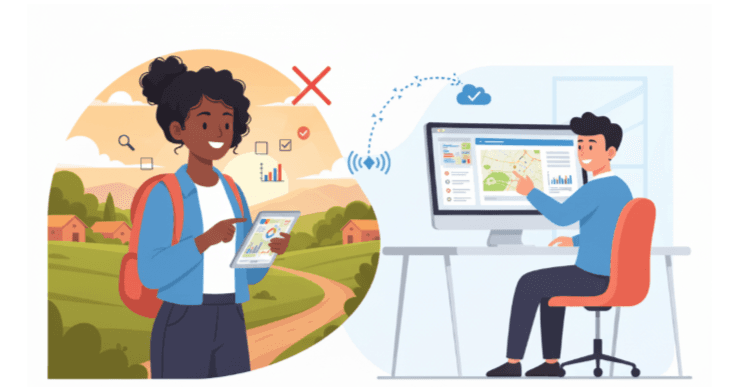
Using a platform like Kapsurvey.com, an enumerator can conduct face-to-face KAP data collection on a smartphone in a remote village with no internet. The data is stored securely on the device and syncs automatically when a connection is found. Simultaneously, the same survey can be shared online with participants in urban areas. This hybrid approach ensures that data collection is not only efficient and accurate but also inclusive, allowing organizations to gather a truly comprehensive dataset. By removing the barrier of connectivity, such tools ensure that a lack of internet is no longer an obstacle to understanding and serving communities effectively.
Reference:
Gunter, B., Nicholas, D., Huntington, P., & Williams, P. (2004). Online versus offline research: Implications for evaluating digital media. Aslib Proceedings, 54(4), 229-239.