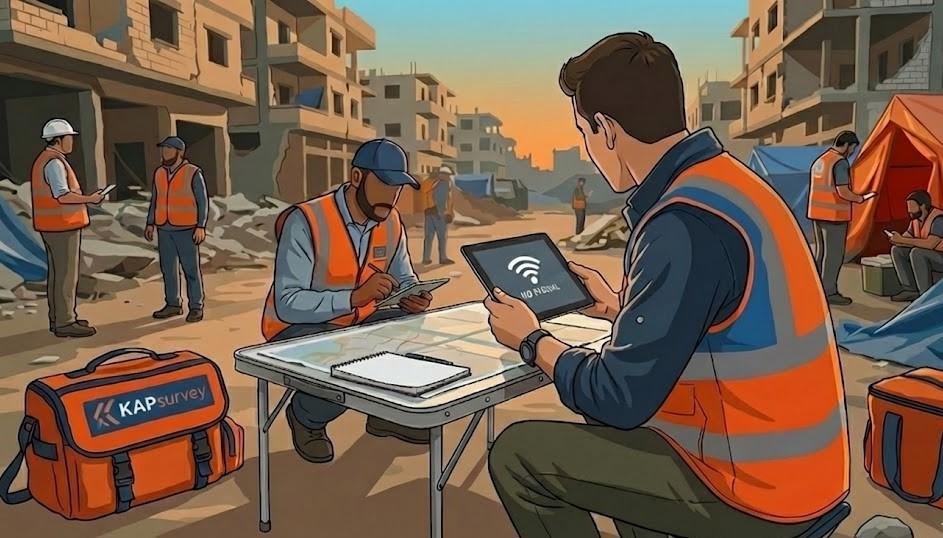
Humanitarian aid continues to struggle against persistent hurdles, especially information breakdowns that interrupt the flow of data between field teams and coordination centers. When online systems fail and offline reporting cannot sync back into shared platforms, responders lose the ability to see needs clearly and act quickly. These disruptions increasingly shape the speed, accuracy, and equity of humanitarian interventions (OCHA, 2024).
The Gaza crisis in 2025 is a vivid example of just how costly these information gaps can be. In June 2025, the United Nations reported a “complete collapse of internet and data services,” describing how the blackout paralyzed aid operations across the Gaza Strip (UN OCHA, 2025). Without connectivity, responders were unable to receive updated field assessments, track displacement patterns, or communicate with affected communities. Humanitarian organizations noted that vital needs remained unverified for days because online tools could not function and offline notes could not be transmitted (OCHA oPt, 2025). The ICRC further observed that when connectivity disappears, communities also lose access to “potentially life-saving information” such as evacuation routes or available services (ICRC, 2025).
Events like this show how quickly an information vacuum can deepen a humanitarian crisis, not because responders lack willingness, but because they lack visibility.
This is where flexible data-collection tools become important. Platforms such as KAPsurvey.com offer a way for field teams to gather structured information offline and sync it once connectivity returns. Such systems do not remove the risks posed by blackouts or damaged networks, but they reduce the extent to which operations collapse when the digital layer fails. By helping preserve local assessments, beneficiary feedback, and rapid monitoring data during connectivity gaps, tools like KAPsurvey act as a buffer between field realities and coordination needs.
In an era where humanitarian teams move between unstable networks and unpredictable operating environments, ensuring that data can survive temporary outages is increasingly essential. The 2025 Gaza experience shows that strengthening this online–offline bridge is no longer optional; it is part of the backbone of effective, timely, and accountable humanitarian action.
Reference
United Nations Office for the Coordination of Humanitarian Affairs (OCHA). (2025, June). Gaza crisis: Impact of connectivity collapse on aid operations. https://www.unocha.org/occupied-palestinian-territory





