Can Badges, Progress Bars, and Rewards Boost Survey Participation?
What the research says — and what it means for teams collecting KAP data in the field.
Why Survey Participation Is Getting Harder
If you run surveys for a living — whether you're coordinating KAP assessments in health programmes, tracking community attitudes in humanitarian response, or conducting employee engagement studies — you've likely noticed that getting people to respond, and to finish what they start, is more challenging than it used to be.
The numbers are striking. Research by the Pew Research Center found that telephone survey response rates fell from 36% in 1997 to just 6% in 2018 [1]. While online surveys avoid some of the barriers of telephone polling, web-based surveys carry their own challenge: respondents who begin but do not finish. Low completion rates introduce selection bias, reduce statistical power, and — when respondents rush through out of fatigue or disengagement — compromise data quality itself.
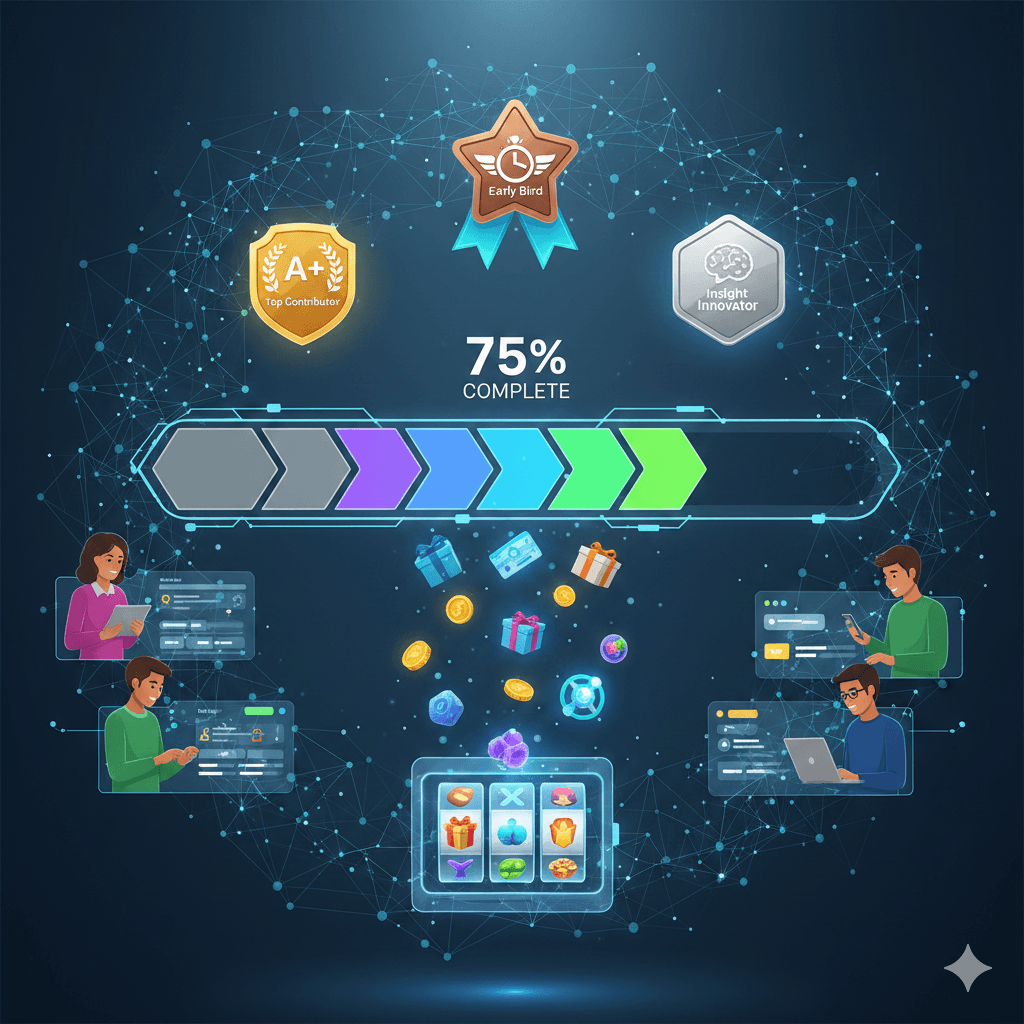
One proposed solution is gamification: the application of game design elements (progress indicators, badges, points, rewards) to non-game contexts. The idea is intuitive — make the survey experience more engaging and rewarding, and people will be more likely to complete it. But does it actually work? The honest answer, based on published research, is: sometimes — and the details matter a great deal.
This post walks through the evidence, with particular attention to what it means for researchers and field teams using KAPsurvey for Knowledge, Attitude and Practice data collection.
The Behavioural Science Behind the Idea
Gamification is not a gimmick. It draws on well-established psychological principles, several of which are directly relevant to survey design.
Self-Determination Theory
Deci and Ryan's Self-Determination Theory (SDT) holds that sustained human motivation is driven by three psychological needs: autonomy (feeling in control), competence (feeling capable of achieving goals), and relatedness (feeling connected to others and to a meaningful purpose) [2]. Surveys that address none of these needs — that simply demand information — tend to produce reluctant, rushed respondents. Surveys that communicate purpose, show progress, and signal that the respondent's input matters address all three.
The Zeigarnik Effect
Psychologist Bluma Zeigarnik demonstrated in 1927 that people retain unfinished tasks in memory more vividly than completed ones, and experience a cognitive tension that motivates completion [3]. This is the psychological mechanism behind the effectiveness of progress indicators: once a respondent sees they are 60% through a survey, the incomplete state becomes slightly uncomfortable, nudging them toward finishing. This is why streaming platforms show you how far through an episode you are — and why it works.
Context-Dependence of Gamification Effects
A landmark 2014 literature review by Hamari, Koivisto, and Sarsa [4] examined 24 empirical studies on gamification across multiple domains. Their conclusion was cautiously optimistic: most studies reported positive effects on engagement, but — critically — the effects were strongly context-dependent. Gamification worked best when it was meaningfully aligned with users' existing motivations and the nature of the task. When game elements felt tacked on or irrelevant, the positive effects were reduced or absent. This finding has important implications for survey researchers: the question is not simply whether to gamify, but how to gamify in ways that fit your respondents and your research context.
What the Research Says About Specific Mechanics
Progress Bars: Promising but Nuanced
Progress bars are the most widely studied gamification element in survey research, and the evidence reveals a genuinely nuanced picture. A controlled experiment by Conrad et al. [5] demonstrated that progress feedback could either help or hurt completion rates depending on how early progress was displayed. When respondents received encouraging early feedback — indicating they were moving through the survey quickly — completion rates improved. When early feedback showed slow progress, abandonment rates increased. The implication is clear: progress bars work when they are designed to show early momentum, not when they inadvertently highlight how much remains.
Research by Villar, Callegaro, and Yang [6], in a meta-analysis of progress bar experiments, similarly found that the framing and positioning of progress indicators matters significantly. A large-scale analysis of real-world surveys by Liu and Wronski [7] using over 25,000 surveys found that surveys with progress bars actually had lower completion rates on average than those without — a finding that underscores the importance of implementation quality over the mere presence of the feature.
The practical takeaway for survey designers: a progress bar placed at the bottom of the survey screen, framed around what has been accomplished rather than what remains, and designed to show early momentum in longer instruments, is more likely to help than one added without these considerations.
What this means for KAP surveys
KAP assessments — which often cover three distinct domains (knowledge, attitudes, practices) — are natural candidates for section-based progress design. Showing respondents they have completed the 'knowledge' section before moving to 'attitudes' creates natural milestones without requiring complex platform changes.
Badges and Recognition
Badges — digital emblems awarded for completing tasks or reaching milestones — have shown positive effects in contexts where participants have an ongoing relationship with a platform or research programme. The mechanism is primarily one of identity reinforcement: visible badges signal that the respondent is someone who contributes, which strengthens the habit of participation over time. This makes badges most relevant for panel studies, longitudinal KAP assessments, and community health monitoring programmes where the same respondents are surveyed repeatedly.
Research on badge effectiveness in online learning environments by Hamari [8] found that badges increased engagement when they were perceived as representing genuine effort or achievement, and had little or negative effect when awarded trivially. Researchers designing badge systems should therefore ensure that milestones require meaningful participation and that the criteria are transparent.
Points, Incentives, and Reward Systems
Tangible rewards — data bundles, airtime, small payments, vouchers — are among the most reliably effective methods for increasing initial survey uptake, particularly in low-resource or mobile-first settings where respondents may face real costs (data, time, transport) to participate. The survey methodology literature consistently finds that incentives increase response rates [9], though their effect on data quality is less clear. When incentives are contingent on completion (rather than participation), they may introduce response satisficing — where respondents rush through to claim the reward rather than engaging thoughtfully.
For field-based KAP data collection, non-monetary recognition can also be effective. Providing communities with aggregated results from the survey — showing them what their neighbourhood or group reported — serves both as reciprocity (you gave us data; here is what we learned) and as a motivator for future waves of data collection.
Special Considerations for KAP and Humanitarian Research
KAP surveys — which assess community knowledge, attitudes, and practices on health, WASH, nutrition, or related topics — are used extensively in humanitarian and development settings. This context introduces several considerations that go beyond general survey gamification research.
Sensitivity and Tone
Many KAP surveys address topics where respondents may feel vulnerable, judged, or uncertain: health-seeking behaviour, nutrition practices, sanitation habits, or disease exposure. Heavy gamification — animated badges, competitive leaderboards, colourful reward animations — can feel tonally inconsistent with the seriousness of these topics and may reduce honest responding by trivialising the interaction. In sensitive research contexts, purpose communication and respondent dignity often matter more than engagement mechanics.
Low-Connectivity and Mobile-First Environments
KAPsurvey is designed for both online and offline data collection in field settings. Complex gamification elements (animated progress bars, dynamic badge displays, real-time leaderboard updates) may not function reliably in low-bandwidth environments or on basic Android devices. Simpler, lighter-weight engagement mechanisms — clear section completion markers, text-based milestone messages, printed certificates of participation for community members — are often more appropriate and more robust.
Equity and Access
Gamification designs that rely on visual elements, colour coding, or interactive animations must be reviewed for accessibility. In multilingual or low-literacy field contexts, progress feedback through visual iconography (section ticks, completion stamps) may be more effective and more equitable than text-based percentage indicators.
Avoiding Coercion
In community or workplace settings, social visibility features — team participation rates visible to supervisors, community completion thermometers, named leaderboards — can shift the experience of survey participation from voluntary to implicitly mandatory. Researchers and field teams should ensure that non-participation carries no formal or informal consequence, and should be cautious about designs that use peer pressure as a primary motivator.
Five Practical Principles for Gamification in Survey Design
Start with why respondents should care
The most effective 'gamification' in KAP research is often simply a clear, honest statement of purpose: 'Your answers will help us improve the health services in this community.' This addresses the relatedness and autonomy needs from Self-Determination Theory without any technical implementation.
• Design progress indicators for early momentum. Show respondents what they have accomplished, not just what remains. In multi-section KAP instruments, mark section completions visibly. Avoid displaying percentage complete if early sections are long or slow — this can increase abandonment.
• Use incentives transparently and equitably. If you are offering mobile data, airtime, or other rewards, state this clearly at the outset. Ensure all eligible respondents can access the reward, regardless of connectivity or literacy level. Completion-contingent incentives should be paired with sufficient survey length guidance so respondents can plan their time.
• Reserve social mechanics for appropriate contexts. Participation thermometers and community completion rates work well in voluntary community health campaigns where collective action is the message. They are inappropriate in employment settings or where participation is formally expected.
• Test before deploying. A gamification element that improves completion in one population or setting may have no effect — or a negative effect — in another. Build in a small pilot phase to test engagement elements before full rollout, and track data quality indicators (response consistency, item non-response rates, open-ended response depth) alongside completion rates.
• Match the tone to the topic. The more sensitive the survey content, the lighter the gamification should be. Clear navigation, visible section structure, respectful language, and timely feedback on how the data will be used are the most universally appropriate engagement tools for KAP research.
Conclusion
Gamification in survey design is not a silver bullet, but it is a legitimate and evidence-grounded toolkit. When game mechanics are chosen deliberately — matched to respondents' motivations, appropriate to the research context, technically compatible with the deployment environment, and ethically designed — they can genuinely improve the quality of the data collection experience.
For KAP researchers and field teams, the most impactful changes are often the simplest: communicating purpose clearly, showing respondents that they are making progress, providing meaningful feedback on their contribution, and removing unnecessary burden from the instrument. These principles do not require sophisticated technology — only thoughtful design.
KAPsurvey's platform supports many of these principles natively: section-based navigation, offline capability, and customisable survey flows provide the structural foundation on which engagement-centred design can be built. The rest is up to the researcher.
References
[1] Kennedy, C., & Hartig, H. (2019). Response rates in telephone surveys have resumed their decline. Pew Research Center. Available at: https://www.pewresearch.org/short-reads/2019/02/27/response-rates-in-telephone-surveys-have-resumed-their-decline/
[2] Deci, E. L., & Ryan, R. M. (2000). The 'what' and 'why' of goal pursuits: Human needs and the self-determination of behavior. Psychological Inquiry, 11(4), 227–268. https://doi.org/10.1207/S15327965PLI1104_01
[3] Zeigarnik, B. (1927). Über das Behalten von erledigten und unerledigten Handlungen [On the retention of completed and uncompleted activities]. Psychologische Forschung, 9, 1–85.
[4] Hamari, J., Koivisto, J., & Sarsa, H. (2014). Does gamification work? A literature review of empirical studies on gamification. Proceedings of the 47th Hawaii International Conference on System Sciences (HICSS), 3025–3034. https://doi.org/10.1109/HICSS.2014.377
[5] Conrad, F. G., Couper, M. P., Tourangeau, R., & Peytchev, A. (2010). The impact of progress indicators on task completion. Interacting with Computers, 22(5), 417–430. https://doi.org/10.1016/j.intcom.2010.03.001
[6] Villar, A., Callegaro, M., & Yang, Y. (2013). Where am I? A meta-analysis of experiments on the effects of progress indicators for web surveys. Social Science Computer Review, 31(6), 744–762. https://doi.org/10.1177/0894439313497468
[7] Liu, M., & Wronski, L. (2018). Examining completion rates in web surveys via over 25,000 real-world surveys. Social Science Computer Review, 36(1), 116–124. https://doi.org/10.1177/0894439317695581
[8] Hamari, J. (2017). Do badges increase user activity? A field experiment on the effects of gamification. Computers in Human Behavior, 71, 469–478. https://doi.org/10.1016/j.chb.2015.03.036
[9] Singer, E., & Ye, C. (2013). The use and effects of incentives in surveys. The ANNALS of the American Academy of Political and Social Science, 645(1), 112–141. https://doi.org/10.1177/0002716212458082
[10] Deterding, S., Dixon, D., Khaled, R., & Nacke, L. E. (2011). From game design elements to gamefulness: Defining 'gamification'. Proceedings of the 15th International Academic MindTrek Conference (MindTrek '11), 9–15. ACM. https://doi.org/10.1145/2181037.2181040





