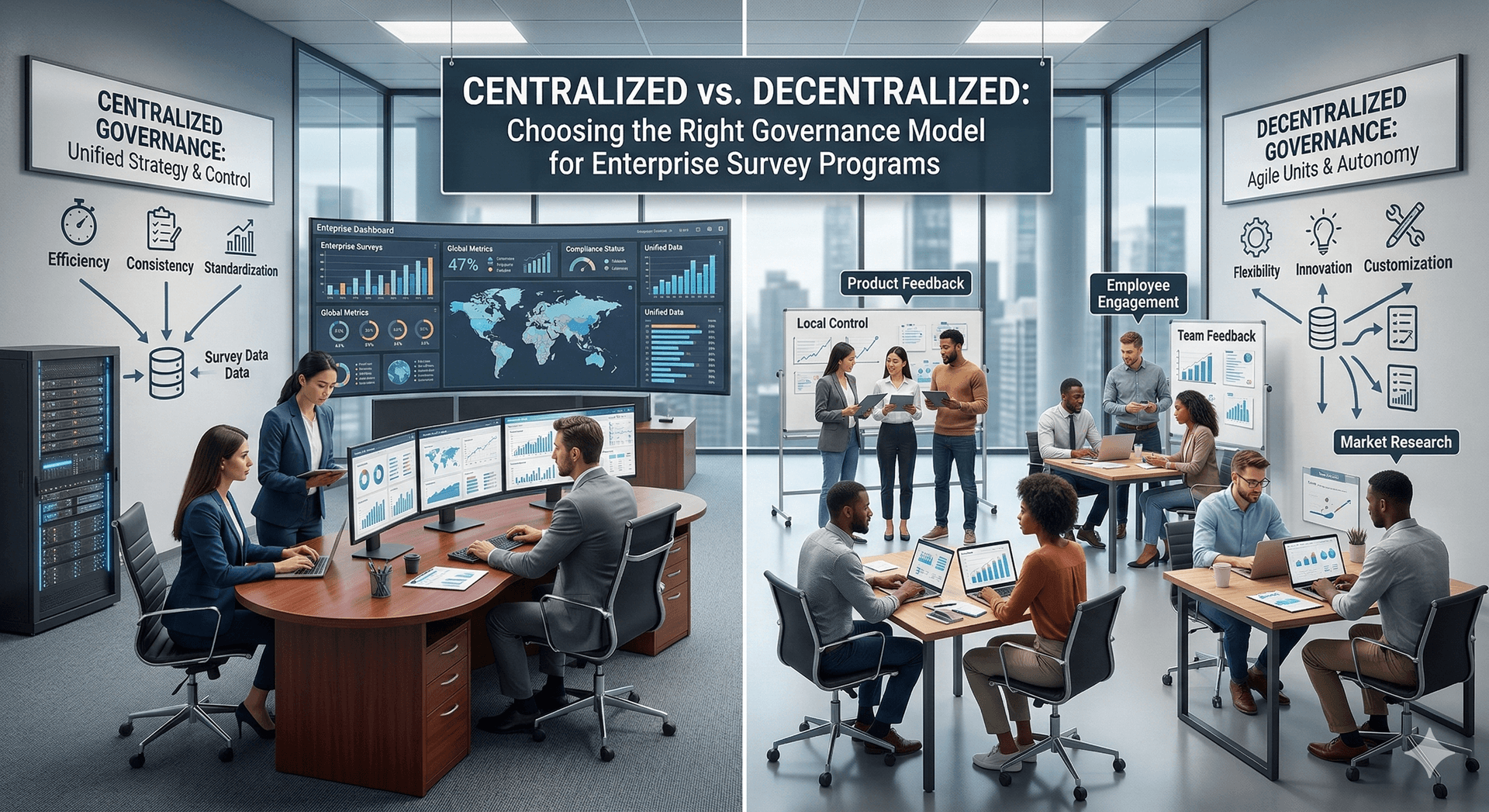
Choosing the Right Governance Model for Enterprise Survey Programs
A strategic analysis of the pros and cons of having one central team manage all surveys versus allowing departments to run their own.
Enterprise survey programs are more than a data-collection exercise they are a strategic asset. Whether you are measuring employee engagement, customer satisfaction, or product experience, the way you govern those surveys has a direct bearing on the quality of insights you generate and the trust respondents place in the process.
At the heart of this governance question lies a fundamental choice: should one central team own and operate all surveys across the organization, or should individual departments be empowered to design and run their own? Both models have compelling advantages and meaningful drawbacks. The right answer depends on your organization's size, culture, risk appetite, and strategic priorities.
This article examines both models in depth — their mechanics, benefits, and pitfalls — and offers a practical framework for choosing or blending the two.
The Case for Centralization
A centralized survey governance model places authority for survey design, deployment, and analysis in a single team — typically within HR, Strategy, or a dedicated Insights function. All departments that want to survey stakeholders must route their requests through this team.
Consistency and Comparability
One of the strongest arguments for centralization is data integrity. When a single team controls questionnaire design, scale choices, and methodology, survey results become comparable over time and across business units. Leadership can track trends with confidence, knowing that a shift in an NPS score or engagement index reflects actual change — not a difference in how the question was worded.
This comparability is essential for benchmark reporting, board-level dashboards, and regulatory submissions where consistency of measurement is non-negotiable.
Respondent Experience and Survey Fatigue
In decentralized environments, it is common for an employee to receive four or five surveys in a single month — from HR, IT, Finance, and their business unit — each unaware of what the others have sent. This creates survey fatigue, drives down response rates, and can damage respondent trust over time.
A central team acts as a traffic controller. It can schedule surveys strategically, consolidate overlapping questions into shared instruments, and set organization-wide frequency caps. The result is a better experience for respondents and higher quality data for the business.
Cost Efficiency and Vendor Consolidation
Survey platforms, analytics tools, and specialist expertise are expensive. When each department procures its own tools independently, organizations often end up paying for multiple overlapping licenses while losing the negotiating leverage that comes with consolidation. A central team can negotiate enterprise agreements, standardize on a single platform, and achieve meaningful cost savings.
Compliance and Data Governance
Data privacy regulations — GDPR, CCPA, and their equivalents — impose strict requirements on how personal data is collected, stored, and processed. A decentralized model creates significant compliance exposure: a well-intentioned marketing team or regional HR manager may inadvertently collect data in a way that violates regulations. Centralization makes it far easier to enforce consent frameworks, data retention policies, and audit trails uniformly.
Key Advantage: Centralization is particularly powerful in regulated industries (financial services, healthcare, government) where auditability and data governance are non-negotiable requirements.
The Limitations of Centralization
Despite its strengths, the centralized model carries real trade-offs that can undermine its effectiveness if left unaddressed.
Speed and Responsiveness
Central teams serve the whole organization. That means queues. A product team that needs rapid customer feedback after a feature launch may find itself waiting weeks while the central team manages competing priorities. In fast-moving markets, this delay can erode the strategic value of survey data entirely.
Loss of Domain Knowledge
A generalist survey team may lack the contextual depth to write highly effective questionnaires for specialized domains. A customer success team understands the nuances of churn signals in a way that a central HR-adjacent survey function may not. When domain experts are removed from questionnaire design, there is a real risk that questions miss the mark — leading to data that is methodologically consistent but strategically shallow.
Organizational Frustration
When departments feel they have little control over how and when they collect feedback, they may work around the central team entirely — using informal polls, personal SurveyMonkey accounts, or other shadow tools. This perverse outcome undermines both the consistency and compliance benefits that centralization was meant to deliver.
The Case for Decentralization
In a decentralized model, individual departments or business units have autonomy to design, deploy, and analyze their own surveys, typically with light-touch guidance from a central body. This model reflects the reality that different functions have different needs.
Agility and Domain Fit
Decentralization puts survey ownership in the hands of the people who best understand the context. A sales operations team knows what questions matter for pipeline health. A product manager knows what signals to look for post-onboarding. This expertise translates into more targeted, relevant, and actionable questionnaires — and faster turnaround when rapid insights are needed.
Departmental Ownership and Action
When teams design their own surveys, they are more invested in the results. Research consistently shows that insight-to-action rates improve when the people who collected the data are also responsible for acting on it. Decentralization creates accountability loops that centralized models often struggle to replicate.
Innovation and Experimentation
Decentralized environments are natural testing grounds for new methodologies — pulse surveys, in-app micro-surveys, video feedback, AI-assisted open-text analysis. Teams can experiment without waiting for enterprise-wide approval, and successful innovations can then be scaled centrally.
Key Advantage: Decentralization works well in organizations with strong business unit autonomy, diverse product portfolios, or highly specialized customer segments where one-size-fits-all measurement frameworks fail.
The Limitations of Decentralization
The freedom of decentralization comes with its own set of challenges, particularly at scale.
Without a coordinating function, organizations lose the ability to compare results across units. When HR measures engagement on a 5-point scale, Finance uses a 10-point scale, and Product uses Net Promoter Score, there is no common language for cross-functional performance reviews. Strategic decisions that require a holistic view of the organization become much harder to make with confidence.
Compliance risk rises sharply. Individual teams may not have the expertise or awareness to navigate GDPR consent requirements, anonymization thresholds, or data retention rules. A single privacy incident — a survey that inadvertently collects sensitive personal information without proper consent — can expose the entire organization to regulatory and reputational damage.
Finally, decentralization tends to be more expensive in aggregate. Each team invests in its own tools, templates, and analytical capacity. The duplication of effort is often invisible from the top, but it accumulates into substantial waste over time.
At a Glance: Model Comparison
Dimension Centralized Model Decentralized Model
Data Consistency High — standardized metrics across org Variable — each team sets
own standards
Speed & Agility Slower — central queue, approval layers Faster — teams act
independently
Cost Efficiency Lower — shared tools & licenses Higher — duplicated spend
per department
Domain Expertise Limited — generalist team serves all Strong — teams know their
context
Respondent Experience Coordinated — avoids survey fatigue Risk of overlap and over-
surveying
Compliance & Risk Easier to govern and audit Higher exposure to data
privacy gaps
Innovation Can be rigid; slower to experiment More experimentation at team
level
The Hybrid Model: The Best of Both Worlds?
Most mature enterprise survey programs ultimately converge on a hybrid approach — one that combines centralized governance with decentralized execution. The key is to be intentional about what you centralize and what you distribute.
In a well-designed hybrid model, the central team owns the infrastructure and standards: the survey platform, the data privacy framework, the enterprise-wide measurement instruments (annual engagement survey, NPS program), and the reporting standards. Departments are granted controlled autonomy — they can design and deploy their own surveys within guardrails set by the centre, using approved tools and pre-validated question libraries.
This model requires investment in enablement. The central team must act less like a gatekeeper and more like a centre of excellence — publishing best-practice templates, offering training, reviewing department survey plans before launch, and synthesizing cross-functional insights for senior leadership.
A Framework for Deciding
Before choosing a model, leadership teams should assess five dimensions:
• Organizational size and complexity: Larger, more complex organizations typically benefit more from centralization or a structured hybrid.
• Regulatory environment: High compliance risk environments favor centralization of governance, even if execution remains distributed.
• Survey maturity: Organizations new to systematic survey programs often benefit from starting centralized to build competency before distributing.
• Culture and autonomy norms: Organizations with strong autonomous business units may resist centralization; a hybrid with clear guardrails is more sustainable.
• Strategic priorities: If cross-functional benchmarking and trend analysis are critical, consistency must be protected — which argues for stronger central control of methodology.
Conclusion
There is no universally correct answer to the centralization question. The most effective enterprise survey programs are not defined by their governance structure alone — they are defined by how well that structure serves the organization's strategic intent and operational realities.
What matters most is clarity. Organizations that struggle most with survey governance are often those that have never made an explicit choice — where centralization exists in some areas but not others, where shadow tools proliferate because the central team is too slow, and where no one is accountable for the overall respondent experience.
Whether you choose a centralized, decentralized, or hybrid model, the imperative is the same: make the choice deliberately, communicate it clearly, and build the capability to execute it well. Your data — and the decisions it informs — depend on it.





