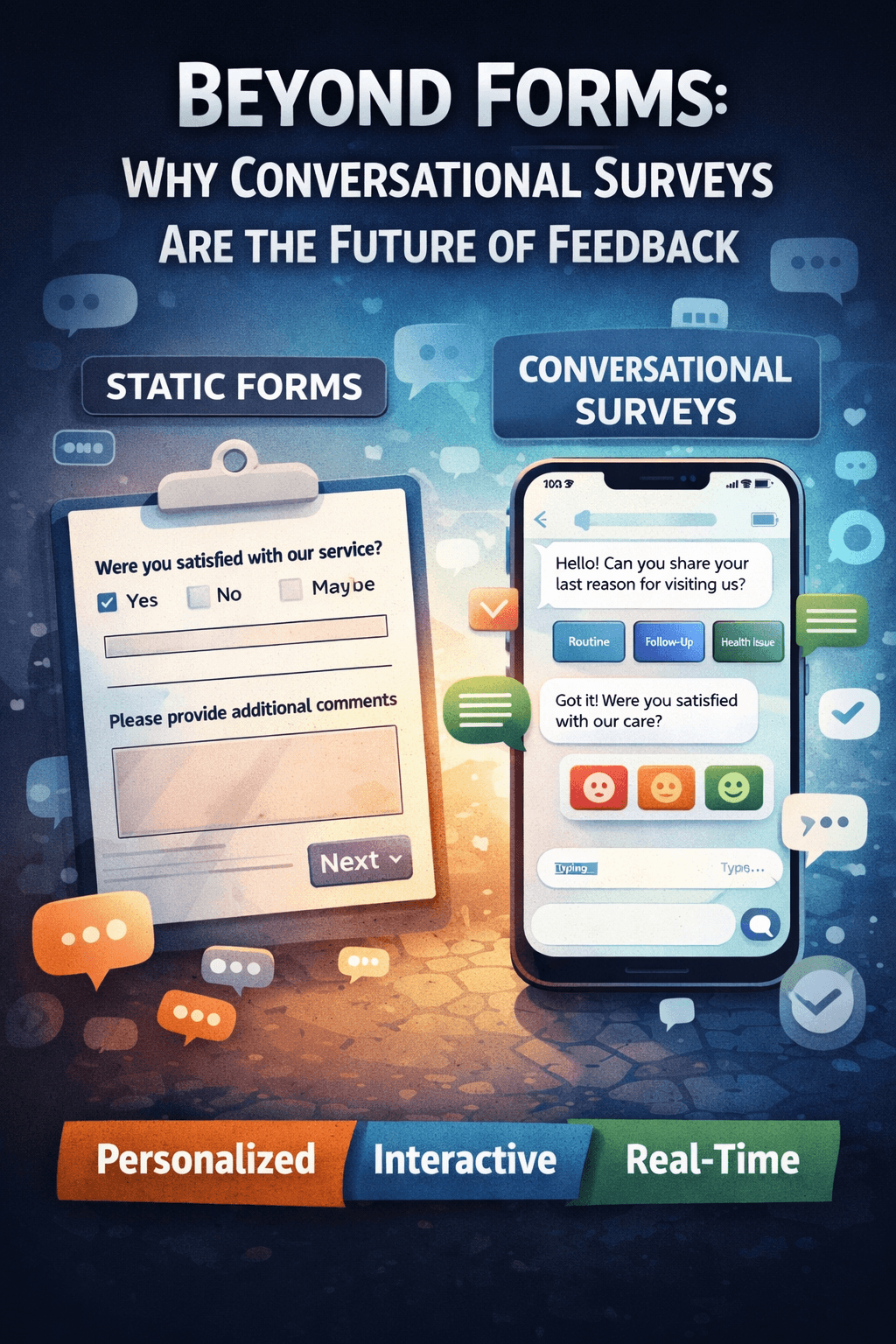
Ditching form fields for chat bubbles isn't just a UX trend — it's a fundamental reimagining of how we collect honest, thoughtful responses.
Traditional surveys are suffering a slow, measurable death. Completion rates hover between 10-30%. Mobile respondents abandon at even higher rates. Those who finish often rush through, selecting the same answer repeatedly or clicking "neutral" down an entire grid.
The problem isn't the questions — it's the format. Dense form fields, unclear progress indicators, and walls of text create a psychological barrier that screams "this will take forever." Your brain does the math and either abandons or settles for the cognitive shortcut of satisficing: answering just well enough to finish, not well enough to be honest.
Enter conversational surveys: feedback collection reimagined as natural language dialogue. Instead of form fields and submit buttons, you get chat bubbles and tappable responses. Instead of seeing 20 questions stacked vertically, you see one at a time. Instead of feeling like paperwork, it feels like messaging a friend.
And the data proves it works.
35% Higher completion rates vs. traditional forms
24% Improvement when using buttons over text input
50% Reduction in mobile abandonment rates
Traditional vs. Conversational: The Paradigm Shift
📋
Traditional Surveys
The old paradigm: forms that feel like work
- All questions visible at once
- Progress unclear or discouraging
- Typing required on mobile
- Feels like an obligation
- High cognitive load
💬
Conversational Surveys
The new paradigm: dialogue that feels natural
- One question at a time
- Progressive disclosure reduces anxiety
- Tappable buttons on mobile
- Feels like conversation
- Distributed cognitive effort
Why Conversation Beats Forms: The Psychology
Humans are hardwired for conversation from infancy. The back-and-forth rhythm of dialogue — ask, respond, acknowledge, ask again — is a cognitive pattern we've practiced millions of times. Conversational surveys leverage this familiarity to reduce friction and increase engagement.
The psychological advantages
- Social presence: Chat interfaces create the perception of a responsive listener, increasing intrinsic motivation to provide thoughtful answers
- Progressive disclosure: Revealing one question at a time eliminates the anxiety of "how much more is there?" that plagues traditional surveys
- Immediate feedback loops: Visual cues like typing indicators and message receipts provide reassurance that responses are being processed
- Reduced formality: Conversational tone and emoji use lower psychological barriers to participation, especially among younger demographics
- Mobile-native design: Tappable buttons and swipe gestures align with how users naturally interact with messaging apps
Research by Hohm & Snijkers (2019) found that conversational survey formats increased completion rates by an average of 35% compared to traditional forms, with particularly strong effects among mobile respondents and Gen Z participants. The mechanism appears to be reduced perceived burden: even though conversational surveys may contain the same number of questions, the sequential presentation makes them feel shorter and less demanding.
"Conversational surveys don't just improve completion rates — they fundamentally change what kind of questions you can ask and what kind of answers you can expect."
How to Design Effective Conversational Surveys
Switching to a chat interface isn't enough. Conversational surveys require rethinking question design from the ground up. Here's what actually works:
💬
Keep each message under 20 words
In traditional surveys, a question can span multiple sentences. In chat, every message should fit comfortably in a mobile bubble. Break complex questions into sequential exchanges rather than cramming everything into one.
🔘
Default to buttons over text input
Tappable response buttons improve completion rates by 24% and eliminate ambiguity. Reserve open-text fields for genuinely open-ended questions like "What could we improve?" — anything with discrete options should use buttons.
📱
Design for thumbs, not cursors
Most conversational surveys happen on smartphones. Prioritize thumb-friendly tap targets (minimum 44x44 pixels), minimize typing, and use progressive disclosure to prevent overwhelming small screens with dense information.
🔄
Use progressive profiling for repeat surveys
Don't ask for the same demographic information every month. Store previous responses and focus each interaction on what's changed since last time. This demonstrates respect for respondent time and builds richer profiles incrementally.
🎯
Show meaningful progress indicators
Instead of "Question 3 of 27" (discouraging), use contextual markers like "Almost done!" or percentage bars based on actual time remaining. Better yet, keep surveys short enough that progress indicators aren't psychologically necessary.
🧠
Implement smart branching logic
Conversational formats excel at conditional paths. If someone rates satisfaction as 9/10, route them to "What do we do well?" If they rate 3/10, ask "What went wrong?" This personalization makes respondents feel heard, not interrogated.
Where Conversational Surveys Excel
Not every research need demands a conversational format. But for certain use cases, the engagement lift is transformative:
Customer Satisfaction (CSAT/NPS)
Quick pulse checks after purchases or support interactions. High response rates and honest feedback when friction is minimized.
Event Feedback
Post-event surveys sent while the experience is fresh. Mobile-first design captures responses during commutes home.
Employee Pulse Surveys
Weekly or monthly check-ins on team morale, workload, and sentiment. Brevity and ease encourage regular participation.
Onboarding Check-ins
Automated touchpoints during customer or employee onboarding journeys. Conversational tone reduces intimidation for new users.
Lead Qualification
Interactive forms that guide prospects through qualification questions. Feels like a helpful assistant, not an interrogation.
Product Feedback Loops
In-app surveys triggered by feature usage. Contextual questions that adapt based on user behavior and responses.
The Limitations You Need to Know
Conversational surveys aren't universally superior. They introduce new constraints that make them poorly suited for certain research contexts:
Sequential presentation limits holistic reflection. Traditional forms let respondents see multiple related questions simultaneously, enabling internal consistency checks. When rating five product features, you can adjust your responses to ensure they're coherent relative to each other. Conversational surveys, revealing one question at a time, eliminate this opportunity. This is particularly problematic for ranking tasks, conjoint analysis, or any research design where response interdependence matters.
Natural language processing remains imperfect. While advanced conversational platforms can handle simple keyword detection, interpreting open-text responses reliably still requires human review or accepts significant error rates. A response like "Not bad" to a satisfaction question could be negative ("not" modifier), neutral (lukewarm phrasing), or positive (colloquial affirmation) depending on demographic and context. This limits the reliability of conversational surveys that rely heavily on free-text input.
Complex logic becomes unwieldy. While simple branching ("If satisfied, ask why; if dissatisfied, route to support") works beautifully, highly intricate survey flows with quota sampling, loop-and-merge functions, or multi-condition triggers become exponentially harder to implement and debug in conversational interfaces than in traditional survey platforms.
Back-navigation feels unnatural. Chat flows are psychologically forward-moving. While most conversational survey tools allow respondents to go back and edit previous answers, the interaction pattern discourages it. Users expect conversations to progress, not require editing like a document. This can be frustrating for respondents who realize mid-survey they want to change an earlier response.
The Future: AI-Powered Adaptive Conversations
Current conversational surveys use pre-designed branching logic: if the respondent selects A, show question B; otherwise show C. The next generation will use AI to generate questions dynamically based on sentiment, language patterns, and engagement signals.
Imagine a survey that analyzes your response style in real time. Provide a detailed, emotionally charged negative review? The AI routes you to open-ended follow-ups: "Can you tell me more about that?" Give brief, neutral responses? You receive multiple-choice options to reduce burden and prevent abandonment.
Large language models make it technically feasible to implement fully generative conversational surveys that compose questions on the fly while maintaining research objectives and data structure. Early prototypes are already in beta testing, adapting not just to respondent answers but to their communication style, emotional state, and engagement level.
The implications are profound: conversational surveys could become truly personalized interviews, adapting question complexity, phrasing, and depth to each individual respondent. However, this also introduces new methodological challenges around reproducibility, comparability across respondents, and algorithmic bias that the research community has not yet fully addressed.
"The question isn't whether conversational surveys are better than forms — it's whether they're better for your specific use case, audience, and analytical needs."
The Bottom Line
Conversational surveys represent a significant evolution in feedback collection methodology. For use cases where engagement, mobile accessibility, and respondent experience are paramount — customer satisfaction tracking, event feedback, employee pulse surveys — they deliver measurable improvements in both completion rates and response quality.
But they're not a panacea. Complex research designs with intricate logic, studies requiring holistic question consideration, and scenarios where data portability across platforms matters may still be better served by traditional survey tools.
The future likely isn't "conversational vs. traditional" — it's knowing when to use each approach, and potentially combining them: conversational interfaces for high-level engagement, with traditional deep-dive forms for respondents who signal willingness to invest more time.
The survey isn't dead. It's just learning to speak human.
References & Further Reading
- Hohm, A., & Snijkers, G. (2019). Conversational survey design: Improving respondent engagement through dialogue. Journal of Official Statistics, 35(4), 817-838. https://doi.org/10.2478/jos-2019-0034
- Luger, E., & Sellen, A. (2016). "Like having a really bad PA": The gulf between user expectation and experience of conversational agents. Proceedings of the 2016 CHI Conference on Human Factors in Computing Systems, 5286-5297. https://doi.org/10.1145/2858036.2858288
- Pickard, M., Roster, C., & Chen, Y. (2021). Revealing sensitive information in personal interviews: Is self-disclosure easier with humans or avatars and under what conditions? Computers in Human Behavior, 65, 23-30. https://doi.org/10.1016/j.chb.2016.08.003
- Revilla, M., & Ochoa, C. (2017). Ideal and maximum length for a web survey. International Journal of Market Research, 59(5), 557-565. https://doi.org/10.2501/IJMR-2017-039